Thank you for joining, that’s all for today.
Check back here for continued coverage of the UN climate change conference in Paris.
Though world leaders have finished making their statements at today’s session, protestors are out in London.
The Guardian’s Emma Howard is at the scene:
Down at St Pancras in London a flashmob organised by Art COP21 is taking place in front of the Eurostar terminal where UK delegates leave for Paris.
First up is a performance from beatboxer Shlomo.
Katy Jetnil-Kijiner, teacher and poet from the Marshall Islands, a small island state threatened by sea rises recited ‘Dear Matafele Peinem’ a poem written for her daughter.
And a flashmob choir performed ‘Kiss from a rose’ outside St Pancras station, where delegates to COP21 are leaving for Paris
Updated
The session has concluded for the day.
Guardian Australia political editor Lenore Taylor writes on what the pledges mean for the future:
But even though the mood was optimistic and the words were full of purpose, the attention of the 40,000 assembled officials and media drifted a bit when each leader got down to the details of exactly what their country was actually doing – even at the beginning when there were still plenty of them watching.
And that’s the danger.
The pledges made so far will still result in global warming of at least 2.7 degrees, even if they are all met – much better than the 5C rise we might expect without action but still short of the 2C goal. Experience suggests there is a very big “if”, and negotiators have virtually given up on the idea that the pledges should be legally binding. Shirkers will face no real sanction, other than international opprobrium. And that means a system to check and report what each country does is critical.
But the rules for monitoring remain unfinished. The plans to regularly review and “ratchet” up the pledges to contain global warming to 2C or lower are not finalised either and will be critical. Developing countries argue they still need more finance.
Those details matter.
Video of David Cameron’s appeal to other world leaders, asking ‘what would we tell our grandchildren if we fail to agree on a deal?’
Masoumeh Ebtekar, vice president of Iran, said that the organization should assess the relationship between conflict and climate change.
“I wish to urge the UN system to initiate an assessment on the carbon footprints of war, conflicts, security and terrorism,” Ebtekar said. “Those perpetuating conflicts are in fact accomplices of the global warming process.”
Ebtekar also said that the immediate needs of developing nations must be addressed as they continue to suffer the damage of climate change.
She concluded by quoting the Qu’ran:
We did not create the heavens and earth but in truth he raised the heaven and established the balance so that you would not transgress the balance. Give just weight – do not skimp in the balance. He laid out the Earth for all living creatures.
“If we are against nuclear energy and want to be more independent of fossil fuels, we have to invest in renewable energy,” said Werner Faymann, chancellor of Austria.
“All nations, big and small economies, developing and industrialized nations, are committed to tackling climate change,” he said.
Updated
Netanyahu: Israel is committed to those goals
Benjamin Netanyahu, prime minister of Israel, said that one element is essential to responding to the climate crisis - technology. He called for continued investments in sustainable technology and said that addressing the crisis requires a global solution.
Israel is committed to those goals and will act accordingly and in deed and in word to fulfill them…
We must learn to do more with less and Israel is a small country with big ideas. I believe it is not enough that we have those ideas or apply them only to our country, we are eager to share them with you.
Karim Massimov, prime minister of Kazakhstan, said that the country is investing heavily in energy efficient initiatives and aims to decrease emissions 25% by 2030.
He urged countries to reach a collective agreement on how to address climate change.
“Ladies and gentlemen, if human history has told us anything, it’s that what we can understand what we fix,” Massimov said. “We understand that climate change is a grave threat to humankind.”
Greenpeace UK executive director John Sauven commented on David Cameron’s earlier speech at the summit.
David Cameron has made a passionate appeal to fellow world leaders for a robust climate deal. The prime minister must now persuade his Chancellor to support it with real action back home. The UK’s pioneering climate targets and the recent coal phase-out plan show that where Britain leads other countries follow. But we need to see the same UK leadership in the race to develop and invest in renewable technologies. This is what Britain’s leading businesses, scientists, and the government’s own advisers are urging Cameron to do - he should listen.
India’s prime minister Narendra Modi just concluded his statement, which called on developed countries to adhere to their pledge to provide $100bn annually to developing nations by 2020.
The prosperous still have a strong carbon footprint and the world’s billions, while countries at the bottom of the development ladder are seeking space to grow. So the choices are not easy...
Democratic India must grow rapidly to meet the aspirations of 1.25 billion people – 300 million of whom are without access to energy. We are determined to do so, guided by an ancient belief that people and planet are inseparable, that human well being and nature are indivisible.
Perry G Christie, prime minister of the Bahamas said climate change: “threatens the very existence of the Bahamas as we know it”.
He pushed for a more aggressive response to climate change, arguing that countries should aim to keep global warming below 1.5 degrees celsius, instead of the two degrees goal many countries support.
“The Bahamas is now more vulnerable to climate change than the history of our country,” Christie said.
He cited Hurricane Joaquin as a key example of what climate change is doing to his country. The storm caused $100mn damage to the central and southern islands, which amounts to nearly 10% of the country’s national budget.
Christie said:
The Bahamas and other small developing island states are seeing unprecedented drought, extreme weather events, accelerating sea level rise and other life threatening impacts and the science tells us we can only expect more intense impacts over time”
Like other EU leaders, Sweden’s prime minister Stefan Löfven emphasized the need for energy innovations that can combat climate change and improve the economy. “I want Swedish companies to develop the new innovations that the world is asking for,” Löfven said.
He said the country would continue to provide “substantial funds” to aid for countries that do not have the resources to respond to the effects of climate change, but are enduring its negative effects.
Löfven said:
Sweden is ready to enter into an ambitious, durable and fair agreement. Our main concern is to keep global warming under the two degree celsius limit. Let’s not see Paris as an end but as a beginning.”
Miro Cerar, prime minister of Slovenia, said his country stands by the EU position on climate change and would abide by its conditions.
Cerar concluded by quoting former US president Dwight Eisenhower:
As we peer into society’s future, we – you and I, and our government – must avoid the impulse to live only for today, plundering for our own ease and convenience the precious resources of tomorrow.
“Today, more than 50 years later, it is high time to heed this warning,” said Cerar
Irakli Garibashvili, prime minister of Georgia, said his country is a leader in responding to climate change. He said that the country is especially susceptible to its effects because of the topography, which is prone to mudslides and floods.
Flooding killed 19 people in the capital city, Tbilisi, in June.
Garibashvili said that the country has mainstreamed climate change into other national strategies, but believes that world leaders need to reach an international agreement.
“I cannot underscore more the importance of reaching such an agreement,” said Garibashvili. “And failing to agree, in a sense, would be agreeing to fail.”
Malcolm Turnbull’s announcement that Australia will ratify the second comittment period of the Kyoto protocol – which started in 2013 and runs to 2020 – is window dressing and entirely meaningless when it comes to emissions.
Australia submitted targets under Kyoto in 2012, even though they had not formally signed up. So this is just a bit of paperwork. Under Kyoto, Australia can do very little and still meet their targets because they get massive credits from land use change and forestry. More worrying is what Australia has planned for after Kyoto, its commitment to the potential Paris deal was branded “inadequate” by Climate Action Tracker.
Updated
Ahead of the summit, activists in New York looked to build ground support for global action on the environment. “It’s almost too late,” said one demonstrator over the weekend.
Emilie Martel with more:
Malcolm Bligh Turnbull, prime minister of Australia, announces that they will ratify the second commitment period of the Kyoto agreement.
From Australia we come with confidence and optimism. We are not daunted by our challenge ... we do not doubt the implications of the science.
He notes Australia’s INDC: to cut its greenhouse gas emissions by 26-28% of 2005 by 2030. Turnbull says that this “represents real economic effort and will halve per capita emissions, one of the biggest reductions of any G20 country”, although some have expressed scepticism that the prime minister will implement the necessary policies.
Turnbull adds that Australian universities are at the forefront of solar energy innovation.
He continues:
Our task is not just to reduce emissions, the impacts of global warming are already being felt ... Adapting to the impacts of climate change is equally important and there too innovation is key. Some of the most vulnerable nations are our neighbours and we are helping them to build resilience. Our agreement in Paris must provide a common platform for action. Australia is not daunted by the challenge. With great optimisim and faith in humanity’s genius for invention we are confident that with collective leadership we will with common cause secure our future.
Updated
The Fossil of the Day award – a prize handed out at climate conferences for most regressive country – goes to New Zealand, whose prime minister John Key met the Friends of Fossil Fuel Subsidy reform on Monday.
His government’s cuts to subsidies on fossil fuel energy have become the stuff of legend. The government now underwrites no fossil fuel energy.
But Fossil of the Day organiser Dan Ilic says: “While New Zealand has abolished subsidies on the consumption side, during the time that the Key party has been in office, subsidies for the production of fossil fuels have gone up over seven times. Seven times!
“New Zealand provides over $80m in production subsidies for fossil fuel industries. To New Zealand that’s a lot of money. In New Zealand $80m can buy New Zealand.”
New Zealand will share the award with Belgium, which the organisers said had lagged behind on its pre-2020 commitments to reduce emission.
Updated
Indian prime minister Narendra Modi will soon announce a new global alliance of 120 countries committed to the largescale expansion of solar power, my colleague Arthur Neslen reports.
India will initially invest $90m, it is reported, with support coming from many countries in the tropics as well as some European countries and businesses.
French climate ambassador Laurence Tubiana has called the programme “a true game changer”.
Updated
Ikililou Dhoinine, president of the Comoros, an archipelago island nation in the Indian Ocean is up. He calls for greater support for developing countries and those vulnerable to climate change:
We are not able to finance basic investments as a result of our modest resources. It is key for funds need to be dispersed...in a more balanced way between adaptation and mitigation. We must accept the reality that climate change is progressing more quickly than international climate change negotiations. We must therefore act differently. Time is running out. The entire world is placing its hope in us. This is the only chance we have to save our planet so let us seize the opportunity before it is too late.
Updated
As the leaders keep reminding themselves, the eyes of the world are on Paris.
It turns out that eyes of astronauts out in the International Space Station are also upon them ...
From space we are privileged to see the beauty of Earth but also our impact on it's environment. #COP21 #YearInSpace pic.twitter.com/rCD3PIDIX5
— Scott Kelly (@StationCDRKelly) November 30, 2015
Updated
Tuvalu’s president, Enele Sosene Sopoaga, is calling for a ‘loss and damage’ mechanism in the Paris climate deal. That’s highly unlikely to make it in, given rich countries view such a proposal, a sort of climate compensation, as a dangerous blank cheque. My colleague Karl Mathiesen has unpicked the issue of loss and damage in-depth here.
Former US vice-president Al Gore has welcomed Obama and Xi’s speeches earlier:
Great to see @POTUS & President Xi Jinping continue to call for urgent climate action here at #COP21 today.
— Al Gore (@algore) November 30, 2015
Another well-known American, Bill Gates, is at the Paris climate summit today for part of an initiative putting billions of dollars into clean energy. More on that in our story here.
With @BillGates & @JustinTrudeau before "mission innovation": mobilisation for research in clean energy #COP21 pic.twitter.com/c8fdoqMySt
— Ségolène Royal (@RoyalSegolene) November 30, 2015
This is a great photo of Obama and Putin meeting earlier in the halls of the summit. The body language says it all.

Updated
Indonesia’s president Joko Widodo has taken the floor. His country is the fifth largest emitter in the world and the fourth most populous country, consisting of 17,000 islands, where 60% of citizens live in coastal areas.
Indonesia has suffered this year from the impact of forest fires that started in July and have engulfed much of the country in toxic air pollution. The CO2 emitted by the fires alone have exceeded the annual emissions of countries such as Japan and Germany.
As a country with one of the largest forest areas acting as the lungs of the world, Indonesia is here today as part of the solution. We are developing Indonesia in a way giving due attention to the environment.
Indonesia has committed to reduce its emission by 29% below a business as usual scenario and by 41% with assistance from developed countries. But it has been criticised by environmentalists for being too vague on setting out how it will tackle the issue of deforestation.
Widodo says they will achieve their ambitions through reallocating fossil fuel subsidies, increasing the proportion of renewables in the energy mix to 23% by 2025 and by converting waste to energy. He recalls that the government has established a moratorium on new permits for peat land – sought after by companies looking to create new plantations, for example for palm oil.
The Paris agreement must be long term, ambitious and not impede development in developing countries. All parties must contribute more in mitigation and adaptation ... for developed countries through mobilisation of $100bn US to be increased over the years. Reaching a Paris agreement is a must and I expect all of us to make earth a comfortable place for our future generation a comfortable place to live in.”
Updated
After lunch all my notes have been scratched up, says Micronesia’s president, Peter M Christian, who is giving one of the more moving, improvised and occasionally inscrutable speeches today.
“But of course you’ve heard this before ...,” he says, before riffing on several previous speeches.
Today we heard a great leader said we have come to challenge ourselves. But this challenge is to save ourselves, not someone else. I also heard another great leader say the economy had grown but the carbon emissions had stayed flat. What I would give for that flatness to dip a little bit during my lifetime. Someone else said that by 2030... ladies and gentlemen there are island states that may not be there by 2030.
....
Two days ago in Paris someone asked me with genuine concern in his manner if the people of Pacific knew about climate change. I said many of my people do know the Earth as a planet among stars, they only know their world is made up of islands and surrounding seas. We have lied to them that sea level rise is a gradual rise of the future and the child asks their grandfather ‘why’.
...
I ask that we mark this spot in our efforts, in Paris, not with a simple dot, but put a stone there, to make it a milestone in our effort. It is important to note we have come so far, to sit in Paris under a tree, on how to slow down and stop damages to our climate. Let us simply say that no fingers are pointed, for each of us did what we needed to do to support our way of life ...
Updated
Uhuru Muigai Kenyatta, president of Kenya, says his country contributes just 0.1% of global emissions but has laid out its climate plan which envisages an expansion in solar, geothermal and wind power to help cut Kenya’s emissions. “Kenya will continue to be guided by the UNFCCC ... and we look forward to an ambitious Paris climate change agreement ...”
Updated
Christopher J Loeak, president of the Marshall Islands, wins the prize for most colourful outfit of any leader so far. He says:
The climate we have known over many centuries has in a matter of three short decades, changed dramatically, before our very eyes.
We are already limping from climate disaster to climate disaster and we know that there is worse to come.
For us, COP21 must be a turning point in history. And one that gives us hope.
Our Paris agreement must set a path to the safe climate future we all strive for. We all know that the targets on the table now are not enough to limit warming to below 1.5C. Although they are a start in the right direction.
Therefore if it is to deliver the end we all seek, the Paris agreement must be designed for ambition. It must send a message to the world that if we are to win the battle against climate change, the fossil fuel era must end ...

He calls for renewable energy instead of fossil fuels, and says the Paris deal must review targets every five years.
“My country is in its hour of need,” he says. “Today I have been presented with a petition from 3.6 million people from around the world, who stand with us on this quest,” he says holding up a piece of paper saying ‘100% clean [energy, presumably]’.
“This is a time for human solidarity, but it also a time for action, for us to be the leaders we were elected to be. Let’s get it done.”
Updated
The Philippines bear a disproportionate amount of the burden of climate change, says President Benigno S Aquino III, who calls himself the head of a nation “affected by the new normal”.
He calls for the conference to recognise the future of small island states and vulnerable countries, by providing more climate finance.
The fight against climate change is a matter of survival... We are indeed hard pressed to build back better in the aftermath of Typhoon Haiyan.
The Philippines is aiming to plant 1.5bn trees by next year, which would save 30m tonnes of carbon annually. He says that renewables account for 33% of their energy mix.
We are willing to share experience and knowledge. We are ready to do our part if other nations demonstrate support.
He’s mentioned Copenhagen. The conference must move beyond recrimination and learn from the past.
“In this effort no one is exempt, all must contribute.”
Updated
John P Key, prime minister of New Zealand, announces his government is giving $20m for a programme to help reduce emissions from agriculture and $200m for climate-related support for its nearby Pacific island nations.
New Zealand faces unique domestic challenges, he says, with almost 80% of electricity already coming from renewables, but around half of country’s emissions are from agriculture, for which there are not cost effective solutions
“While New Zealand’s emisisons are small on a global scale, we are determined to make a strong contribution to the international effort,” he says.
Updated
Idriss Déby Itno, president of Chad in west Africa calls for action to save Lake Chad, which has shrunk to a tiny proportion of its size 50 years ago.
“This basin that supports 30 million people directly is threatened now from disappearing,” he said.
He calls for more robust action for the Sahel, “whose population is among the most vulnerable to climate change.”
“This meeting and summit must find the necessary commitment to protect the environment and the future of the human race,” he says.
Updated
“I think there are better chances [here in Paris than at previous climate summits] ... I get the sensation that there is going to be some development,” says Sir David Attenborough, who is at the Paris summit.
He added he hopes the price of renewable power will become cheaper than coal. The naturalist and broadcaster has previously given his backing to an Apollo programme-style project to increase R&D spending in clean energy.
Updated
Alassane Ouattara, president of Côte d’Ivoire, says his government does not want a minimal agreement. “Paris is giving us a historic opportunity, let us grab that opportunity for future generations. Long live COP21, long live humanity,” he says.
Nigeria will commit to emissions cuts of 20% unconditional and 45% conditional on support, below a business as usual scenario by 2030.
Nigeria’s president Muhammadu Buhari has announced his country’s Intended Nationally Determined Contribution, submitted to the UN shortly before the conference.
Buhari says Nigeria will meet this by making more use of natural gas and climate smart agriculture, energy efficiency measures and investment in renewable energy.
He calls for developed countries to honour their promises in relation to providing climate finance to help developing countries such as his own adapt to and mitigate climate change.
“The Paris agreement must be legally binding and results orientated; a fair multilateral and rules based regime,” he says. Also calls for for means to review and monitor the progress.
Updated
Mahmoud Abbas, president of Palestine, has just finished speaking.
He said: “The question of climate change has become challenge to countries all over the world ... the state of Palestine has taken a number of practical and serious steps to combat climate change.”
He adds that Palestine has “made great progress to adopt necessary laws” but states that “the continued Israeli occupation and violation of international laws related to the environment is one of the main challenges. Our resources being usurped, our trees are being uprooted, our agriculture is being destroyed.”
“We cannot continue with implementation of agreements alone. This meeting is held today 68 year after resolution 181 was adopted that partitioned historical Palestine.”
He calls on the international community to expand and enhance participation to create peace and thanks countries that recognise the state of Palestine.
Issoufou Mahamadou, president of Niger, says: “The leaders of all nations of the world are here to talk about one thing: to protect our common good, the planet Earth.”
The effects of climate change in many countries are already quite tangible, including in Niger, where we have periods of drought, followed by floods, leading to serious losses and seriously trying the resilience of people. The countries of the Sahel expect from the north a strong signal of their commitments ...
He cites hydropower as one of the technologies Niger is using to cut emissions, and says it’s planting trees as well.
Updated
In the UK, shadow climate change secretary Lisa Nandy has issued a statement hours before Cameron is due to speak in Paris, saying:
World leaders arriving in Paris today must grasp the opportunity to secure, for the first time, a truly international climate agreement. While it is clear that the deal being negotiated will not yet be sufficient to prevent dangerous levels of temperature rise, the summit should establish a clear pathway to build a carbon neutral economy within a generation. Ultimately this will be the key test of whether the Paris summit succeeds.
Kiribati president: Fiji has offered to accommodate us if climate change renders our home uninhabitable
Anote Tong, president of Kiribati, a low-lying, Pacific island state and outspoken leader on climate change, is up now.
“As we stand in unity with France against the violence that took place here, we must also stand untied against perhaps the greatest threat against humanity: climate change, that poses a danger to all of us but especially to hose of us on the frontline of climate change, the low-lying atoll countries,” he says.
He welcomes “powerful” speeches made by other leaders earlier today.
I believe that that should be the moral question ... it is my belief that for any measure of success to be achieved here in Paris we must approach the discussions over the next few days as global leaders, let us not bring our national political agendas on to an issue that is global in nature. The future of people, men, women and children, whole cultures, whole communities, villages, cities and nations, hangs in the balance. We must not remain indecisive on the way forward.
For those of us whose very survival is at stake, our plea is very simple: let us give substance to the pledges that have been made ... let us not pay lip service to an urgent and pressing issue.
He says any Paris climate deal must be legally-binding, and repeated his recent call for a moratorium on new coal mines.
“It’s so heartening to hear that Fiji has undertaken to accommodate our people of Kiribati in the event that climate change renders our homes uninhabitable,” he tells fellow leaders. That appears to be a new announcement.
Read Karl Mathiesen’s story here to find out more about how climate change is affecting Kiribati.
Updated
It was 1965 when the Whitehouse first acknowledged the threat of climate change. Fast forward 50 years to a year of concerted action on the issue by US president Barack Obama, with an announcement or event related to climate change occurring every four days.
Guardian US environment correspondent Suzanne Goldenberg takes a look at the 12 steps the US has taken to start to break its fossil fuel addiction
Updated
“The environmental challenges facing us are enormous,” says Mohamed Ould Abdel Aziz, president of Mauritania. Desertification and coastal erosion are two of the biggest threats to his country, he says.
“The challenge of climate change requires that we limit by the year 2100 the increase in temperatures to 2C, so we need to reach an agreement, we need a legally-binding instrument ... to reach this goal, requires a sprit of solidarity and sacrifice.”
Updated
Recep Tayyip Erdoğan, president of Turkey is now up:
Thanks the hosts for holding the conference “at such a trying time”.
The international community is on the verge of a new era in combating climate change ... We all need to do our part to successfully conclude negotiations in the next two weeks ... The issue that needs to be clarified first and foremost is differentiation. The principle of common but differentiated responsibilities as set out in the convention should be maintained.
Calls for mitigation and adaptation to be be addressed equitably. “Responsibility should be assumed by developed countries.”
Updated
Innocent people here in Paris were murdered in cold blood, says Serbia’s president, Tomislav Nikolić. But life and freedom triumphed again, he says of France persevering with the climate talks despite the 13 November attacks.
He says Serbia is committed to tackling climate change, though his government’s climate plan submitted earlier this year was derided because it appeared to actually allow for a rise in carbon emissions, rather than a cut.
Updated
The president of Nauru Baron Waqa, an equatorial small island state, is the first to speak after the break in room two. He represents the smallest nation state in the UN, one of the most remote places in the world.
He said: “Small island communities pay in the droughts that destroy livelihoods and record cyclones. We see a small toll exacted every day as our shorelines are slowly eroded … small island communities are among the first to pay the price of climate change. But no one will escape forever ... We have a choice: we can pay in human misery or pay investing in a more equitable, resilient and sustainable future.”
Updated
Paris “must be a watershed for the world” says Mexico’s president, Enrique Peña Nieto. The world must unite for a climate deal, he adds.
Today we note with enthusiasm the political commitment of 180 countries, he says, in reference to the climate plans put forward already.
“Let us understand in COP21 we are deciding what quality of life we want for the 21st century,” he says, signing off.
Bob Perciasepe, president of the US-based NGO, the Center for Climate and Energy Solutions, says the simple presence of so many heads of state is a sign that Paris could yield a “breakthrough” climate deal.
The presence of so many world leaders in Paris today is the clearest sign yet that we’re on the verge of an unprecedented breakthrough in the global climate effort.
As the leaders themselves have made clear, many tough issues remain. But their overwhelming message is that a global challenge like climate change demands a global response, and they’re committed to delivering it.
Over the past year we’ve seen greater will than ever, from developed and developing countries alike, and growing convergence on the broad contours of a deal. Negotiators are now on notice from their leaders that in two weeks’ time they must deliver a final accord.
They call it “the family photo”: here’s a video from Reuters of leaders from most of the world’s countries gathering in Paris.
Updated
Leaders will soon return from a lunch break with many more speeches expected this afternoon, including from UK prime minister David Cameron.
He is expected to call for an agreement that gives “certainty to businesses and the public across the world that governments are serious about decarbonising”.
But on Friday, 10 large businesses, which collectively employ more than 1 million people worldwide sent a letter to world leaders, asking for stable policies and funding to support renewable energy in the UK.
They call for “a gradual phase-out of support” from the government for the clean energy sector rather than the current proposed cuts.
They write: “regular changes to the policy environment undermine confidence in investment in infrastructure of all kinds and impact on the UK’s ability to continue competing in the rapidly growing global low-carbon sector.”
The companies are:
- Tesco
- BT
- M&S
- Vodafone
- Kingfisher
- Thames Water
- Unilever
- Nestlé
- IKEA
- Panasonic
Updated
From one global negotiating text to $100bn of promised annual funds to developing countries – via 90 electric car charging points and 21,000 tons of CO2 emissions – I put together Paris in numbers: the figures that matter to COP21.
Which figures have I missed? Let us know in the comments below.
Updated
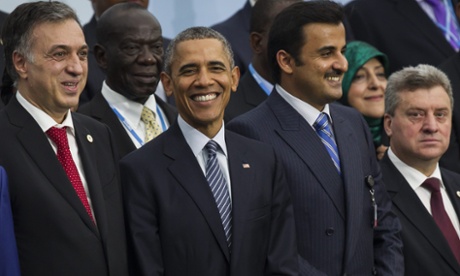
It’s not often that heads of state and government from more than 130 countries in the world come together in one place. We’ve been listening to their speeches all morning: US president Barack Obama, Russian president Vladimir Putin and Chinese president Xi Jinping have already spoken. There are many more to come, including the UK’s David Cameron, who is expected to call for “a global deal for a global problem”
Here’s our gallery of the leaders at COP21 in Paris today.
Updated
As the leaders take a break from speeches, there’s some time to look at the reaction that’s been coming in.
Author and activist Naomi Klein picks up Chinese president Xi Jinping:
Only at the UN does it take 21 years to get to the "starting point"... #COP21 https://t.co/lH8W0CNTCb
— Naomi Klein (@NaomiAKlein) November 30, 2015
Meanwhile founder of 350.org Bill McKibben, writing today in the Guardian, reminds us that the talks are missing one of the most prominent climate change “leaders”, the Maldives’ Mohamed Nasheed. Six years ago, he was the first head of state to arrive at the talks in Copenhagen. Today he is in prison.
WWF-UK have praised Prince Charles’ speech for speaking “from the heart”.
Chief executive, David Nussbaum said: “HRH The Prince of Wales’ spoke from the heart and set exactly the right tone for the start of the Paris climate talks ... I hope the negotiators here in Paris will follow his plea and don’t lose sight of international necessities over national interests.”
Prince Charles said: “The whole of nature cries out at our mistreatment of her. If the planet were a patient, we would have treated her long ago. You, Ladies and Gentlemen, have the power to put her on life support, and you must surely start the emergency procedures without further procrastination!”
You can read Prince Charles’ speech in full here.
Updated
The current tally of countries that have submitted climate plans for emissions cuts beyond 2020 now stands at 183 of the 195 countries in the UN climate process. As Simon Evans at climate analysis site CarbonBrief notes, that’s unprecedented, far higher than those put forward up to 2020 after the Copenhagen climate summit in 2009.
Unprecedented: 183 of 195 countries of the world have pledged climate action https://t.co/XxDenSBALW #COP21 pic.twitter.com/8RPMLGQhb9
— Simon Evans (@DrSimEvans) November 30, 2015
Putin signs off. “We hope that through concerted efforts we will be able to create a new global agreement that will replace the Kyoto protocol.” More on the Kyoto protocol here.
Hollande congratulates the Russian president on being particularly brief and keeping to time, before handing the floor to Hungary.
Putin: climate change one of our gravest threats
Vladmir Putin is up now.
“Climate change has become one of the gravest challenges that humanity is facing,” he says, adding it is causing ever more tangible economic damage.
Russia is taking the lead in terms of reducing its energy intensity, Putin claims.
“We have gone beyond our commitments under the Kyoto protocol. From 1991 to 2012, Russia significantly reduced its emissions ... [equivalent to] 40bn tonnes of CO2e into the atmosphere [a little higher than current annual global higher emissions]... at the same time we have doubled GDP.”
Russia will continue contributing to joint efforts aimed at preventing global warming, he says.
Updated
We have to show we can deliver what we promised in Copenhagen - $100bn a year in climate aid to poorer countries by 2020 – Merkel says.
She adds that the Paris deal should have a review mechanism for countries’ climate plans, and that countries must live up to those commitments.
“This is a question of environmental necessity, but also of economic common sense ... Our very future as humankind hinges on this ... Billions of people are pinning their hopes on what we achieve here in Paris,” Merkel says.
Updated
Paris climate deal must be comprehensive, ambitious, fair and binding, says Merkel.
She cites INDCs (climate plans by governments) that have already been submitted ahead of this summit as a sign of hope. The bad news is that even so, those plans will not keep temperatures below 2C. The Paris deal must show how that gap can be closed, she says.
Merkel: Paris climate summit shows we are stronger than the terrorists
German chancellor Angela Merkel says we are meeting here in turbulent times, mentioning the terrorist attacks of 13 November.
“Through our presence here today we show we are stronger than the terrorists,” she says.
Paris is about creating the basis, the foundation, a possible life for future generations, she says. “We are more than aware of the need to act today.”
Updated
Norway and Brazil have agreed to continue a deal to protect the latter’s forests, until 2020. More details in statement here.
Here’s the video of Obama’s climate speech:
The Chinese government earnestly implements its policy commitments on climate change, Xi says.
Next year, China will launch cooperation projects for 10 low carbon industrial parks and more than 100 mitigation climate projects in other countries, he announces.
“Tackling climate change is a shared mission for mankind. All eyes are now on Paris,” he says as he finishes up, calling for new relationships that bring about “win-win” outcomes.
Updated
Our news story on Obama’s speech is up. Here’s an excerpt:
Barack Obama has told crucial UN climate talks in Paris that the negotiations represent an act of defiance after the barbaric attacks in the city two weeks ago in which 130 people were killed.
Offering his condolences to the people of “this beautiful city” the US president said: “We salute the people of Paris for insisting this crucial conference go on ... What greater rejection of those who would tear down our world than marshalling our best efforts to save it.”
Updated
China has been actively involved in tackling climate change, Xi says, talking of its record on renewable energy.
Going forward, ecological endeavours will feature prominently in China’ 13th five year plan, he says.
Chinese president Xi Jinping: tackling climate change must not stop countries developing
Xi says it is imperative to respect differences between countries’ level of development and ability to cut emissions. Addressing climate change should not impair countries’ ability to develop, he says.
The Paris conference is not the finishing line, but a new starting point, he says. The Paris conference should all countries, in particular developed countries, to assume more responsibilities.
Updated
China’s president, Xi Jinping, is speaking.
The Paris agreement should chart a course for green development, he says. The agreement should put effective control on atmospheric concentrations of greenhouse gases. The agreement should galvanise global efforts [to cut emissions]. Besides governments, it should mobilise NGOs, and all players in society to participate in international cooperation on climate change.
Updated
“Let there be no doubt. The next generation is watching what we do,” Obama says.
He tells the story of a young Indonesia woman he met recently in Malaysia, who asked him if was optimistic for Paris summit.
“I want our actions to show her we are listening ... I want to show her passionate idealistic young generation that we care about their future.”
He cites Martin Luther King’s “such a thing as being too late” quote.
“If we act here, if we act now, if we place our short term interests over air our young people will breathe ... we won’t be too late for them.”
No quick victories in tackling climate change, Obama says, just suffering averted. Our generation may not live to see see full impacts of what Paris achieves, he says.
“Let’s get to work,” he says, signing off.
Updated
Obama: we have broken the old arguments for inaction [on climate change]
Obama is up.
We have come to Paris to show our resolve.
We offer our condolences for the barbaric attacks on this beautiful city.
We stand united in solidarity.
...
We salute the people of Paris for insisting this crucial conference go on.
An act of defiance that proves nothing will deter us from building the future we want for our children.
What greater rejection for those who would tear down our world then marshalling our best efforts to save it.
The growing threat of climate change could define the contours of this century more than any other [issue].
This could be the turning point ...
Our understanding of the ways human beings disrupt the climate advances by the day.
14 of the 15 warmest years on record have occurred since the year 2000. 2015 is on pace to be the warmest year of all.
No nation ... is immune to what this means.
This summer I saw the effects of climate change first hand in Alaska, where the sea is already swallowing villages and eroding shorelines ... where glaciers are melting a a pace unprecedented in modern times.
It was a preview of one possible future: our children’s fate ...
That future is not one of strong economies, nor of one where fragile states can find their footing. That future is one we have the power to change. Right here. Right now.
But only if we rise to this moment. As one of America’s governors has said, we are one of the first generations to feel the impact of climate change and one of the last to do something about it.
I have come here personally as leader of world’s biggest economy and second biggest emitter, he says, to say the that America not only acknowledges its role in climate change but embraces doing something about it.
“We have broken the old arguments for inaction [on climate change],” he says.
“One of the enemies we will be fighting at this conference is cynicism. The notion we cannot do anything about climate change.”
He cites agreement recently on HFC phase-out, and climate plans put ahead by countries as progress on climate action.
He says a deal should have ambition, regularly updated targets, taken into account differences each nation is facing, a strong system of transparency to given countries’ confidence that others are meeting their commitments. Let’s reaffirm our commitment to helping countries skip the dirty phase of development, he says. He cites a green energy project the US is joining – more on that in our news story here.
“We know the truth, that many nations have contributed little to climate change but will be the first to feel its most destructive effects. For some, island nations, climate change is a threat to their very existence.”
He says the US will pledge new contributions to a least developed countries fund on Tuesday.
“Let’s show businesses and investors that the global economy is on a firm path to a low carbon future,” he says.
Updated
Jean-François Julliard, executive director of Greenpeace France, says of the French president’s address this morning:
Hollande has helpfully laid out what a meaningful deal would look like. Now it will be for him and the leaders of other key countries to deliver.
Here’s that family photograph of heads of state:

Morocco’s king has lost his voice so his son is delivering the country’s address instead.
The Paris conference will be instrumental in shaping the future which we are duty-bound to bequeath to our children, he says. He says the natural world’s heritage is threatened because the international community has not yet acted sufficiently on climate change.
There is not a single country that will be spared the consequences of climate change, he says, echoing what climate scientists at the IPCC said in their last big report.
Updated
Paraguay has lots of forests and it’s planting more trees, Cartes says, as he lays out what his country is doing on climate change. He says the country is not a big contributor to climate change (it’s not, it’s about 0.1% of global emissions, compared to around 1.4% for the UK) but it does suffer from its impacts. “Let’s change history ... let’s wake up,” he says as he signs off.
Next up, Morocco, which will host the next UN climate summit. Then the US.
Updated
Climate bingo! Paraguay’s president, Horacio Manuel Cartes, becomes first leader of the day to quote Pope Francis’s encyclical on climate change earlier this year.
The leaders’ speeches are being streamed on the UN site now.
Summary
- French president Francois Hollande has told delegates the future of the world depends on the Paris climate deal
- Hollande said France would not choose between fighting terrorism and global warming
- Ban Ki-moon told leaders that the Paris climate summit could not afford indecision or half measures
- The UN climate chief, Christiana Figueres, says “never before has a responsibility so great been in the hands of so few”
- Prince Charles told delegates that climate change is the world’s great threat and leaders must act now
My colleague John Vidal has posted his five reason to be hopeful of a good deal in Paris - and five reasons to be fearful.
Top of his reasons to cheerful, as has been made clear in opening remarks this morning, is “the world really wants a strong deal”.
Leaders speeches are about to begin – Obama is on third and Xi is fifth.
More than 700,000 people took part in global climate marches
Organisers of Sunday’s marches around the world say that despite the Paris centrepiece one being forbidden by authorities, 720,000 people marched in around 2,300 events in 175 countries.
In remarks earlier this morning, Ban Ki-moon urged world leaders to listen to the voices of the people who marched.
Here’s the video of Prince Charles’ address:
The world leaders are now heading off for their ‘family photograph’.
Fabius: the word historic is often overused, but here that is not the case
Laurent Fabius talks of a large photograph in the conference hall, which on on the left has a tree that has lost all its leaves, they’ve been replaced by plastic bags, “it’s a kind of skeletion, in an environment that has become inhumane.” To the right, he says, is the portrait of a young child waking up. And in the middle is a butterfly, a symbol of hope.
“And that is where we are. Eiether we fail in Paris and spread desolation everywhere, or we succeed and spread a bright future ...,” he says.
Climate change is more than an environmental issue, we need to address it to protect biodiversity, address poverty and stop wars, he says. It is down to France to fight against terorrisim and combat climate change. Future generations will judge us on our actions, he adds.
“The word historic is often overused, but here that is not the case. Together let’s make sure that we make the conference in Paris the historic success that the world is waiting for,” he says at the end of his speech.
Updated
Nearly every country in the world has now lodged an INDC (intended nationally determined contributions) with the UN, showing how they would cut emissions. In the past few days Angola, Nigeria, Bahrain, Kuwait, Iran, South Sudan, Palau, Tuvalu, Malaysia, Jamaica, and Niue have all outlined their plans and they could not be more different.
Nigeria, with a population of 175m and an economy based on oil, plans to bar cars from cities and ramp up solar and wind power. But it says it only plans to “work towards ending gas flaring by 2030”.
Meanwhile, Niue, a tiny Pacific island with a population of about 2,000 people, plans to reduce its electricity demand by 10% and massively increase its renewable energy from 2% now to 38% by 2020. South Sudan, the world’s youngest state which is also dependent on oil, plans to develop hydro power and to plant 20m trees in the next 10 years.
Updated
This is a pivotal moment for the future of your countries, your people, and our common home, Ban says to world leaders.
“The fate of the Paris agreemtn rests with you,” Ban tells heads of state. “The future of your people, the future of the people of the world, is in your hands. We cannot afford indecision, half measures or merely gradual approaches, our goal must be a transformation.”
He’s now also mentioning Sunday’s rallies of more than half a million people around the world, and last year’s People’s Climate March, saying those people are sending their voices to world leaders. He asks leaders to listen to those voices.
Ban is laying out his criteria for a successful deal.
The agreement must be lasting, and must not need continually renegotiating, he says. It must also balance responsibilities of developed and developing countries. Must have solidarity with the world’s poor, he says. It must also be credible, current ambition must be the floor not the ceiling of future efforts, he says, adding five year cycles for a review mechanism will be “crucial”.
Developed countries must also keep their promise of delivering $100bn of climate aid a year to poorer countries by 2020. A new agreement must include a framework for monitoring those financial flows, he says.
UN secretary general: time for brinkmanship at climate talks is over
You are here today to write the script for a new future, says Ban Ki-moon.
“We have never faced such a test. A political momentum like this may not come again. But neither have we encountered such a great opportunity.”
He tells leaders to urge negotiators to choose a path of compromise and consensus at the talks. Bold climate action is in the interests of every single country represented at this conference, he says, saying the time for brinkmanship is over.
“Paris must mark a decisive turning point,” he says.
Hollande: here in Paris we will decide on the very future of the planet
Hollande says:
To resolve the climate crisis, to be frank, good wishes, declarations of intent will not be enough. We are on the brink of a breaking point. Paris must be the start of far-reaching change. We can no longer consider nature as a pool of inexhaustible resources ...
“Everything depends on us,” he tells the nearly 150 heads of state at the meeting, warning them: “the hope of all humanity rests on your shoulders.”
He says he understands for world leaders how difficult it is to balance short-term and long-term imperatives.
“Our greaterst challenge is to go from a globalisation based on competition to a model based on cooperative, where it will be more profitable to protect rather than destroy,” he says.
“Here in Paris we will decide on the very future of the planet,” he says.
Updated
Hollande says he wanted heads of state to attend at the start of the summit to give it ambition consummate with the challenge of climate change, he said.
On what conditions could we consider this a great agreement, he asks, before listing three conditions of what would be a “successful” deal in Paris in two weeks’ time:
The first is that we need to sketch out a credible path allowing us to limit global warming to below 2C, or 1.5C if possible. For us to be sure of being on the right path, we need to provide for regular assessment ... and therefore setup a revision mechanism that corresponds with our commitments every five years.
The second is that we respond to the climate challenge with solidarity. No state can abstain from its commitments ... My thoughts go to those islands which, very simply, could very soon disappear ...
From this we can conclude the agreement must be universal, differential and binding. Developed countries for years emitted the most greenhouse gases. Emerging countries must accelerate their energy transition [to clean energy]. [talks about climate finance]
The third element is that all parts of society get moving [goes on to to say this means local governments as well as national governments]
Updated
Hope has emerged during preparations for COP21, Hollande says, flagging up the sustainable development goals agreed in September. He also lists the climate action plans put forward by more than 180 countries ahead of the summit (more on that here), and rapid progress being made on clean and renewable energy.
France has thrown its full weight behind the success of the summit, and mobilised the whole of government to make the Paris climate summit, he says.
Updated
It’s in the name of climate justice that I’m speaking before you today, Hollande says, talking of the poorest countries with the least responsibility for causing global warming being the most vulnerable to its impacts.
French president: I’m not choosing between the fight against terrorism and the fight against global warming
This is a historic day that we are experiencing, Hollande tells delegates:
Never has a conference welcomed so many dignatories from so many countries. But never have the stakes of an international meeting, and I say never, been so higher. What is at stake is the future of the planet, of life.
And yet two weeks ago here in Paris it was death that a group of fanatics brought to the streets. Here I want to express to you the gratitude of the French people for all the shows of support, of friendship we have received since 13 November.
Tragic events represent an afflciation but also an oblgiation. They force us to focus on what is important. Your presence has generated immense hope which we do not have the right to disappoint.
I’m not choosing between the fight against terrorism and the fight against global warming. These are two major challenges we must overcome. We must leave our children more than a world free of terror, we owe them a planet protected from disasters, a viable livable planet.
The year we have just lived through has been a record-breaking year, temperatures, CO2 levels, a record number of climate events ...
Updated
The UN secretary general commends Francois Hollande on going ahead with the climate summit the despite terror attacks of 13 November, and extends his condolences to the victims of the attacks. No cause or grievance can justify the violence, he says, mentioning violence elsewhere, such as in Beirut. He has just asked delegates to stand for a minute’s silence in honour of victims.
Speeches by heads of state start at 10pm GMT.
Prince of Wales: in damaging our climate, we become the architects of our destruction
Prince Charles is addressing the summit. He echoes Figueres, saying “rarely have so many people placed their trust in the hands of so few.”
“I can only urge you to think of your grandchildren, as I think of mine, and of those billions of people without voice, those for whom hope is the rarest of sensations,” he tells delegates, urging them to consider the needs of the youngest generation.
“Humanity faces many threats but none is greater than climate change,” he says, adding that it threatens our ability to feed ourselves, leaves us at risk of extreme weather, mass migration and increasing conflict.
“In damaging our climate, we become the architects of our destruction ... While our planet can survive the scorching of the Earth and the rising of the waters, mankind cannot,” he says.
Updated
UN climate chief: we stand with Paris
“There is no doubt that the global climate change agreement that we seek must be part of what Paris has become. In the face of adversity, in the face of threats of many kinds, Paris must be where the world unites as one. Paris must be where we show that we are capable in solidarity with one another... determined to collectively commit ourselves for the common good to global safety and for enduring wellbeing for all,” says Christian Figueres, executive director of the UN Framework Convention on Climate Change (UNFCCC), at the summit’s opening ceremony.
She tells delegates: “The eyes of millions of people are on you, not just figuratively but literally” and “never before has a responsibility so great been in the hands of so few.”
Updated
Climate talks open in Paris
Good morning from London. Today 195 countries and nearly 150 heads of state meet in Paris for two weeks of talks to reach a new climate change agreement to avoid dangerous global warming. Here’s a brief at-a-glance guide to what the talks are all about.
Laurent Fabius, the French foreign minister, has just been formally elected president of the COP21 Paris talks by the president of last year’s summit in Lima and Peru’s environment minister, Manuel Pulgar Vidal.
“The Paris conference is a special one, because at the end of the mandate established in Durban in 2011, it is for us to adopt at the COP21 “a new protocol, an other legal instrument or a concerted solution with legal force applicable to all the parties of the UNFCCC. In order to achieve this dear friends, we have just 11 short days before us and in fact fewer, given the time necessary for some final legal verifications and translations into six languages, and we are obliged to succeed,” said Fabius on taking to the podium at the talks.
He added that the role of the French government as hosts of the summit would be to listen, to be transparent (“no hidden agenda, no secret plan, no text in our pockets,” he said, in an apparent reference to the so-called secret text at Copenhagen talks in 2009) and ambitious.
“The eyes of the world are upon and there are great hopes, it is therefore for us to meet our responsibilities head on so that on 11 December we can say the world the four words the world is waiting to hear: our mission is accomplished,” said Fabius.
The opening of the summit comes after more than half a million people marched around the world on Sunday demanding a strong deal in Paris.
Later this morning we’re expecting speeches by the heads of state to begin, as well as a speech by Prince Charles. Fiona Harvey, Lenore Taylor and John Vidal are on the ground reporting.
Updated