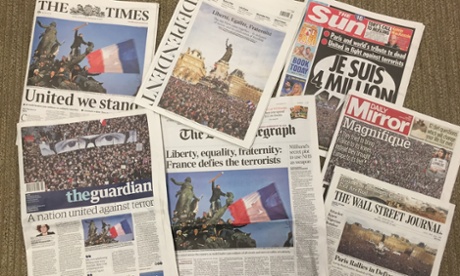
Most of today’s UK national newspapers’ front pages reflect the awesome turn-out for the “Je suis Charlie” rally in Paris and also convey the message it sends to the rest of the world.
Over images of the crowds, here are the headlines: Liberté, Egalité, Fraternité (the Independent); Liberty, equality, fraternity: France defies the terrorists (Daily Telegraph); A nation united against terror (the Guardian); United we stand (the Times); Liberated from terror (i); Magnifique (Daily Mirror);
Je suis 4 million (the Sun); 4m say ‘Non’ to the terrorists (Daily Star); We are all Charlie (Metro); Foreign leaders join 3.7m French in show of defiance over terror killings (Financial Times).
By contrast, the Daily Mail and Daily Express decided the historic event did not merit front page coverage.
Those papers that carried leading articles about the rally either sought to explain the reasons for Islamist terrorism or widened the argument against it, as did columnists.
The Independent began by seeing it as “heartening … that the message is beginning to sink in that the enemy is not Islam but a crude travesty of the religion in the form of a millenarian death cult”.
Although “vast demonstrations of solidarity will make little or no impression on the terrorists … it is essential to demonstrate as loudly as possible... that, for all the handwringing about western society’s decadence, it retains core values of decency, compassion and tolerance”.
But the Indy went on to argue that we cannot ignore that western nations have been responsible for “torture, extraordinary rendition and endless detention, [and] the meting out of long sentences to those such as Chelsea Manning and Edward Snowden who challenge the prerogatives of the security state”.
These policies and actions pursued since 9/11 followed wars launched by George W Bush and Tony Blair in Afghanistan and Iraq that “were the recruiting sergeant for … homicidal jihadists”.
It concludes: “Our leaders cannot be allowed to forget we know this. They and their lousy decisions and dirty secrets are a far more appropriate target of satire than the fatuous taboos of Islam”.
The Times wrote of the “challenge of Islamism” in which “tiny numbers of terrorists are forcing western governments to flood their capitals with police armoured like stormtroopers” to fight terrorists who “derive their power from a global support network”.
It points to the significance of Saudi Arabia as “the most conservative regime in the Middle East” and its Wahhabist clerics. The Times said:
“With supreme hypocrisy, Saudi Arabia joined the rush to condemn the Paris attacks. The truth is the enforcers of its Sharia assert, in common with the Paris gunmen, the bogus right ‘to offend, but not be offended’”.
It continued by contending that “imams who preach violence must be loudly rejected by their fellow Muslims”, while “Saudi Arabia must be shamed into joining the civilised world”.
The Daily Telegraph, in a leader headlined The lasting message of ‘Nous sommes Charlie’, thought the rally a “powerful reproof to the despicable actions – and warped values – of the Islamist thugs”. It continued:
“No one is so naive as to believe that one march will heal a troubled world. The firebombing of a German newspaper that dared to republish offensive cartoons of the prophet Mohammed shows how violence can inspire more violence.
In Nigeria, Syria and Iraq, the extremists of Boko Haram and Isis … continue to impose their wrong-headed version of Islam at the point of a gun.
But the march in Paris reminds us, at the very least, that the men of violence are not just a minority, but a fragment of a fragment”.
Janet Daley, also in the Telegraph, argued that “to call the Paris attacks a ‘war’ dignifies pointless slaughter”. It is not war, “it is more dangerous than that”, she wrote.
“All European leaders will now have to start focusing on the tough challenges ahead”, said the Financial Times. But the immediate task is the one facing France’s president, François Hollande, and his government.
“It is vital that France’s main political leaders do not respond by flirting with the politics of the far-right, making knee-jerk gestures on law and order.
Last week’s attacks, like many such atrocities, may have been conducted in the name of Islam. But it was heartening to see French Muslims at Sunday’s demonstration …
However, the challenge posed by criminals who claim to act in the name of Islam will not be overcome by security policy alone. It requires government agencies to engage painstakingly with Muslim communities, working to deradicalise young people of Islamic faith who might slide into attack planning …
There can be no compromise with the violence we have seen in France in the last week. But the response of the country’s politicians must be guided first and foremost by the display of quiet determination they have just seen on the streets of Paris”.
Both the Daily Mail and the Sun picked up on comments by the culture secretary Sajid Javid, who said fellow Muslims had to accept there is “a special burden on Muslim communities” to deal with terrorism “because, whether we like it or not, these terrorists call themselves Muslims”.
The Mail called it a bold intervention from a man who has shown a refreshing gift for plain speaking and common sense. It went on:
“Although the overwhelming majority of Muslims are rightly horrified by the atrocities committed in the name of Islam, some have been slow to tackle intolerance in their communities, allowing radicalism and militancy to breed.
For the safety of Muslims and non-Muslims alike, this reticence must end”.
The Sun, also in praise of Javid, accepted that the views of Islamist terrorists “may be a perversion of Islam”, but it believed it wrong “to pretend that the terrorist murders in Paris have nothing to do with Islam”. The paper said:
“The murderers themselves, the people who train them, the people who fund them, the people who help them and the people who support them all have one thing in common. They all say they are acting in the name of Islam …
It may be unfair to normal, peace-loving Muslims. But it does no one any good – especially the majority of Muslims – to ignore reality”.
Gary Younge, in the Guardian, warned against simplistic analyses that “seek, with a singular linear thesis, to explain what happened and what we should do about it”.
The roots of terroristic actions, he wrote, “are deep and complex and the motivations, to some extent, unknowable and incoherent”.
He also argued (as I did too in relation to the decision by editors not to republish Charlie Hebdo’s cartoons) that all societies impose limits on freedom of speech, especially “when it comes to cultural, racial and religious sensitivities”.
Younge moved on to explore the reasons why young Muslims raised in the west turn on western society. He wrote:
“Given world events over the past decade or so, the most obvious explanation is also the most plausible: the fate of Muslims in foreign conflicts played a role in radicalising these young men.
Working-class Parisians don’t go to Yemen for military training on a whim. Since their teens these young men have been raised on a nightly diet of illegal wars, torture and civilian massacres in the Gulf and the Middle East in which the victims have usually been Muslim”.
He concluded: “We, as a society, are collectively responsible for the conditions that produced them. And if we want others to turn out differently – less hateful, more hopeful – we will have to keep more than one idea in our heads at the same time”.
Melanie Phillips, in the Times, contended that “the Muslim world, which insists terrorism has nothing to do with Islam, must now take responsibility for its own religion. But it never will if the west continues to endorse this evasion”.
She concluded: “As long as the ignorant, the complacent and the prejudiced dismiss this threat as caused by a few rogue actors, the west will surely lose this war it refuses even to name”.
And, in the Express, Leo McKinstry argued that “behind all the rhetoric about freedom and tolerance the politicians remain in denial about the real nature of the menace we face. They still refuse to face up to the failure of their disastrous experiment in multiculturalism”.