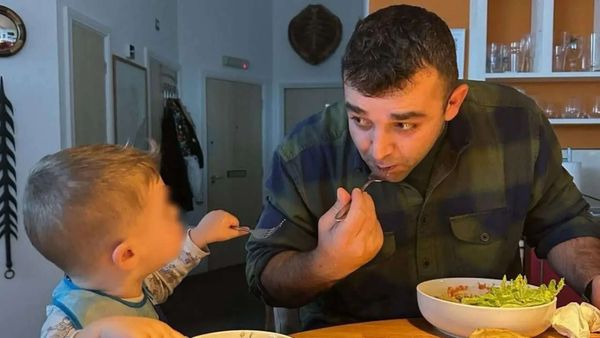
Dr Steven Fisher has a decision to make.
It’s an agonizing one.
Working in the Emergency Room & Trauma Center of the Abington Memorial Hospital in Pennsylvania, he’s seen enough concussion victims to last a lifetime.
Yet, as the summer begins to edge closer and the football season lurches into view, his 11-year-old son will ask the question: Dad, can I play?
For someone who has grown up loving the college game, its drama, excitement and the type of shoulder-to-shoulder camaraderie which melds communities together, the call is not an easy one to make. Far from it.
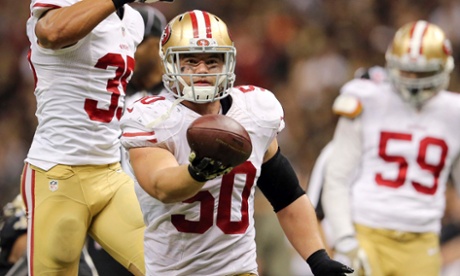
The concussion debate in the NFL is unlikely to recede, and the surprise retirement of the San Francisco 49ers linebacker Chris Borland, 24, earlier this week has reignited arguments.
A decision to turn his back on such bountiful riches and fame for the sake of his health has gotten parents worrying. Continuing revelations from former players of the horrific physical and mental anguish sustained by having their bodies pounded into the dirt year after year have simply added to the increasingly disconcerting feeling around a sport which remains No 1 in North America.
Dr Fisher sits in a unique position: a vastly experienced healthcare professional and father of two football-mad sons. At present, he doesn’t know which way to turn.
The sterling work of the USA Football organization and its Heads Up Football program has begun revolutionizing coaching at youth levels and is helping ease his mind.
Coaches are certified and taught the safest ways to bring down an opponent. There are crucial provisions, for example, to ensure helmets are fitted correctly.
In a 2014 study by Datalys Center for Sports Injury Research and Prevention, youth leagues that participate in Heads Up Football showed a 76% reduction in injuries compared to those who did not.
That’s 34% fewer concussions in practices and 29% fewer in games.
The NFL itself has begun taking steps towards recognizing concussions. Since 2011, a doctor has sat in the press box and has watched for any players who may have undetected injuries and concussions.
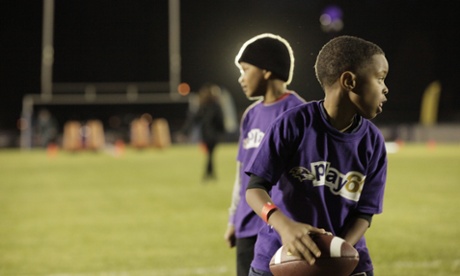
But parental concerns remain. While flag football is perceived to be the safe precursor to full contact and is an activity Benjamin Fisher enjoys, his father’s fears for the future grow stronger.
“As we approach the end of summer, my son’s level of interest will increase, so we will have to make a call,” he said.
“But I will want to speak to the coach, find out his philosophy: does he have the awareness to not bring a kid back into play after they have potentially had their bell rung? I don’t know right now. I can’t completely turn my back on the good things about football.
“The irony is, based on sheer numbers, injuries seem to be playground- or soccer-related, but there have been some devastating football injuries which have crossed my path. There was one case, in particular, around two years ago, which particularly resonated.
“A 16-year-old came in and was so profoundly concussed and amnestic to the events which preceded his injury that he had difficulty in forming memories thereafter. There was no reason, per se, for him to stay in the hospital, but I remember feeling absolutely devastated for him. You wondered what was going to happen with his memory and cognition going forward.
“We see severely concussed folks all of the time, but the fact that this was a football injury was very impactful because I love the sport. We are now finding ourselves in a position where we are having to counsel parents about their kids returning to play.
“That causes a lot of consternation because the big issue is we are trying to avoid second-impact syndrome, which is a concussion upon another concussion where your brain loses that auto-regulation and you have exceedingly high blood pressure.
“I think seeing what Chris Borland has done has made me think twice. The professional game is a different beast because the force and inertia are much greater than what is occurring in younger age groups. Yet if guys who are earning massive salaries are turning their backs on the sport for fear of head injury then, yeah, it registers.
“The vast majority of head injuries we see in the hospital are motor-vehicle related. No one is talking about giving up driving, though. That also plays in my thinking.”
The risks certainly have resonated already for New Jersey resident Kathryn Grifonetti.
Her son John’s decision to swap football for wrestling at the age of 15 was commended at home with a sigh of relief. Yet it was a chance meeting with a parent whose story ended in tragic heartbreak which really hit home.
Kurt Schmitz was a star at the Don Bosco Preparatory High School in Ramsey, New Jersey. His life came to a tragic end at the age of 22 in his bedroom.
The fact that his college career was punctured after suffering a fourth concussion was not underplayed in a death which wasn’t treated as suspicious by police.
“I met his mom at a wrestling match. My son had done very well that day and she congratulated me. I quickly realized who she was and it was very emotional. That was a heartbreaking story,” she admitted.
“He had some heavy hits, but, of course, meeting her brought it all home and makes you think twice about everything. If my son wanted to continue, I wouldn’t have stood in his way, but would I have been nervous? Yes.
“That constant fear of something happening would never go away. Seeing footage of years gone by when players were getting hit so hard – it’s a scary thing.
“You get can get injured in any sport, but it’s that head-on-head contact which makes it worse.
“Of course, wrestling isn’t without its dangers, but it’s just the head-injury risks with football which worry me. It is a very physical sport.
“When my kids heard about Chris Borland, their jaws dropped.”
While it’s widely accepted that the behemoths of college and NFL football remain laws unto themselves, USA Football has worked tirelessly to implement its coaching and safety protocols at the youth and high-school level for the past two years.
Over 5,500 youth football organizations across the country participate – more than half of all US youth football leagues – while more than 750 high schools, spanning 44 states, are involved.
Yet, in such a vast country – there are approximately 14,000 high schools in the US – many institutions are continuing to dangerously play by their own rules.
Any programme to address the issue is an encouraging start.
Places like the Matthew J Morahan III Health Assessment Center (MJM) in New Jersey are providing a vital outlet for studying the effects of concussions as well as providing education and assessments of myriad sporting injuries.
MJM has completed over 13,000 screenings and provided over 100 community programs since the its inception in 2010.
“Education changes behavior,” stressed USA Football spokesman Steve Alic. “And that is happening in football and other sports, too. There have been a lot of notable changes. It addresses a safety concern as well as a coaching concern: hands-on training, as well as a 16-chapter course, would be relevant to many sports.
“We are teaching the game in a better way, the fundamentals in a better way, and being aware of the topics. The medical community are quick to point out (that) a fundamentally sound player is a safer player. When you tackle the right way and you’re not leading with your head and the crown of your helmet, there is scientific evidence to support it.” Educational efforts continue.
“As with anything in life, it’s about being smart. The research being done now and in the future ensures we’re so far ahead of where we were a few years ago,” said former New York Giants offensive lineman David Diehl, who will be presenting prizes at a special “Staying a-HEAD of sports injury” event at MJM on 26 March to celebrate its efforts at the end of brain injury awareness month.
Dominic Santulli, of Congers, New York, took coaching into his own hands after being left appalled at the needless intensity his son’s previous coaches had displayed.
“I definitely see that parents are more concerned now, but ... every coach needs to be Heads Up-certified, which I am and remain fully behind everything they are trying to do,” he said.
“When I started getting involved with coaching them, I immediately was told that I need to take these courses. That took me aback for a second, but once I started getting involved, I saw exactly what they were trying to do: they were training us to make sure we trained the kids the right way.
“That certainly seemed to put the parents at ease ... the fact we, as coaches, are certified. They knew we had been trained and weren’t just some good Samaritans coming off the sidelines.
“They are very proactive in trying to stop or prevent concussions. When I was a kid, it never crossed our minds.”
While the Esquire TV series Friday Night Tykes brutally illustrated the insane, and often dangerous, world of the youth game in the football hotbed of Texas, teams trying to cut corners without thinking about the consequences aren’t restricted to cowboy country.
Mother of four Erica Sforza campaigned to get flag football banned in Rockland County, New York, a northern suburb of Manhattan, because of the lack of protection afforded to her son, who took a crushing hit and smacked his head in the so-called safe version of the sport.
It has since been reinstated. Yet she was soon battling authorities once again in the Tiny Mites League, which attempts to enforce strict age and weight requirements.
“One of my boys was involved in a match where the opposition tried to hide some kids who were larger at the pre-match weigh-in,” she said. “They put them in the cars. I saw them do it and then they put them on the field, so together, with some other parents, we stopped the game from happening.
“We wrote letters of complaint to the league and they were suspended. A mother actually verbally attacked me one night, saying I was disgrace. I am sorry, but I am not putting in a kid who is over 100 lbs against one who is 57 lbs.
“It’s all about the safety of the children.”