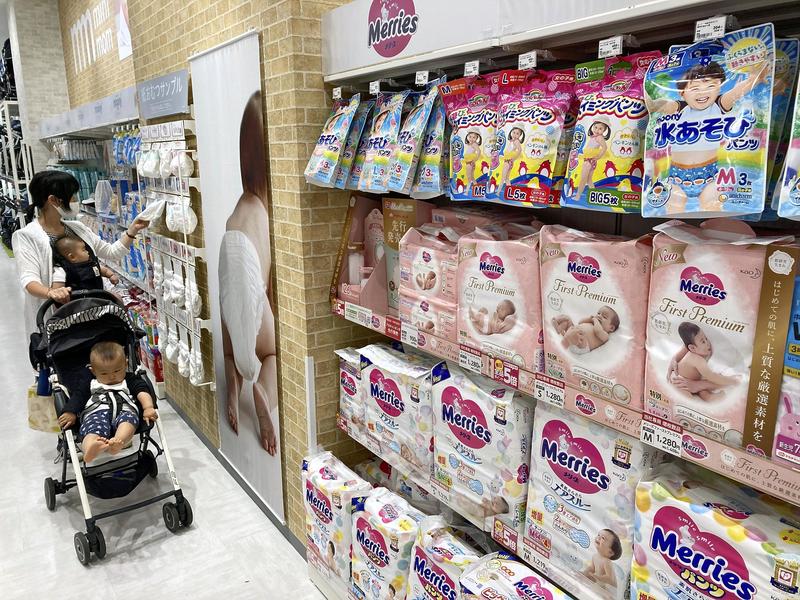
Major consumer goods companies are rolling out diapers at higher price points.
The low birth rate means that parents are generally able to spend more money on an individual child, making them more willing to pay a little more for higher quality products.
About 30% of the diaper section at the Akachan Honpo Co. store in LaLaport Toyosu in Koto Ward, Tokyo, is taken up by higher-priced products. This is triple the amount compared to three years ago, the store said.
One 33-year-old woman with a 1-year-old child said, "I feel bad when their skin gets irritated, so I value [diapers] that feel good to the touch."
Kao Corp. plans to release a more expensive First Premium version of its Merries line on Saturday. The diaper will maintain good breathability, but feel as soft as cashmere, the company said. A pack of 60 small diapers will cost about 1,400 yen including tax, about 30% more expensive than the regular product.
Daio Paper Corp. started selling a GOO.N Plus product on Wednesday. These diapers will feel smoother because it has the same moisturizing ingredients as the company's high-end toilet paper Elleair Zeitaku Hoshitsu. As babies have thinner skin than adults, the company tried to reduce the amount of friction between the diaper and skin.
Procter & Gamble was said to be the first to sell diapers at a higher price point about 10 years ago. They were followed by Unicharm Corp. and others.
The number of births in Japan was down by 20% in 2019 compared to 10 years before. Companies are trying to increase sales by raising both quality and unit prices.
According to the Japan Hygiene Products Industry Association, about 14.2 billion baby diapers were produced domestically in 2019, down 10% from two years before. In contrast, sales of higher-priced diapers have grown from about 2.3 billion yen in 2016 to about 9.6 billion yen in 2019, according to an estimate by Kao.
With the diaper market expected to shrink, companies started targeting China's wealthy. However, China has placed restrictions on online shopping for items such as diapers to foster its domestic companies. The new coronavirus pandemic has made it difficult to forecast demand from tourists in Japan.
Companies are also trying to develop smaller diapers that can be used by babies who weigh less than 3,000 grams. Unicharm sells products that fit even small infants without creating a burden.
"The movement toward products with high functionality is expanding outside of diapers," said Masayuki Kubota of the Rakuten Securities Economic Research Institute. "I expect the trend of developing value-added products to continue in the future."
Read more from The Japan News at https://japannews.yomiuri.co.jp/