As one whose workouts include swimming with parachutes attached to her body to increase the load, Mayumi Narita is no stranger to rigorous training. But unable to train in the pool for extended period of time, Japan's top Paralympic swimmer took to land to stay in shape.
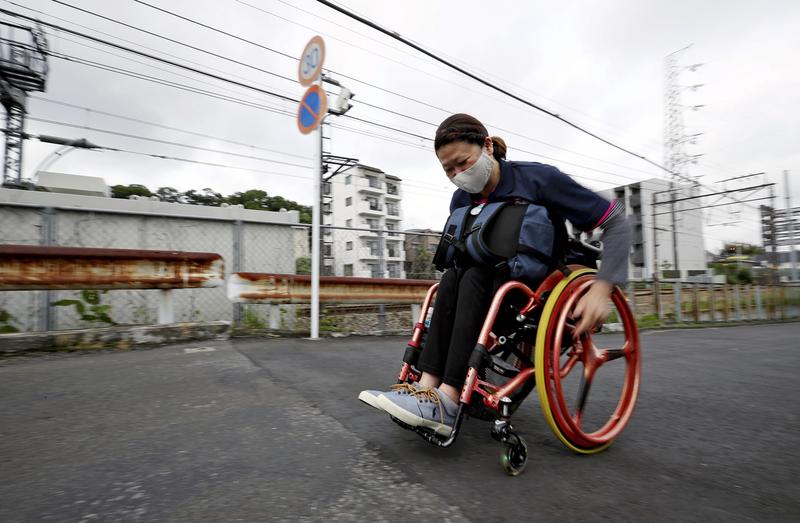
Loading the basket of her wheelchair with dumbbells, Narita set off on a course of several kilometers on the hilly streets around her home. It was a vast increase in the time spent on weight training.
"I've created an intense situation that is close to that of swimming practice, and it's also building power," said Narita, who made the most of the circumstances before being able to return to the pool last weekend.
The 49-year-old Kanagawa Prefecture native amassed 15 gold medals over five Paralympic Games. Still the Japan record-holder in the 50-meter backstroke and numerous other events, she remains at the top among Japanese competitors and has certainly earned the moniker of "Queen of the Pool."
Narita made her first Paralympics appearance at the 1996 Atlanta Games, the first of four straight through 2008 Beijing, after which she retired. But she returned to competition in 2015, and competed at the 2016 Rio de Janeiro Games.
When she first heard that the Tokyo Games had been postponed, anxiety filled her head, and it took her a while to settle back down. "Am I going to go through another year of hard training?" she thought.
But giving up was never an option.
"From the beginning, I have been preparing with the intention that Tokyo would be my last," she said. "Actually, this year, I would have been 49 at the opening ceremony [of the Tokyo Paralympics] and swum in my best race at age 50 [as my birthday is on Aug. 27]," she adds with a laugh.
Narita was 13 when he contracted myelitis, or inflammation of the spinal cord, which left her paralyzed below the waist. She started competitive swimming at 23, and the wear-and-tear on her upper body over the years has taken its toll, causing her to struggle recently in long-distance events that involve multiple turns. She also suffered from an elbow injury last season.
Still, with the postponement of the Tokyo Games, it strengthened her resolve to make it her grand finale and boosted her mentally and physically.
Another setback came when the Yokohama Sakura Swimming School, which has been her training base for more than 20 years, temporarily closed in line with measures to contain the spread of the new coronavirus.
It also deprived her of social interactions with her friends there. One friend is a woman in her 80s who lives alone, with whom she mainly keeps in touch through the free communication app LINE. When she has time, Narita buys boxed lunches to bring to her.
"We look out for each other," Narita said. "In times like these, I don't want to lose my kindness and compassion for others," she said.
Narita has gained new appreciation for things she had taken for granted like her training environment and daily life. She believes that her experiences during the current crisis will make her stronger as an athlete.
Read more from The Japan News at https://japannews.yomiuri.co.jp/