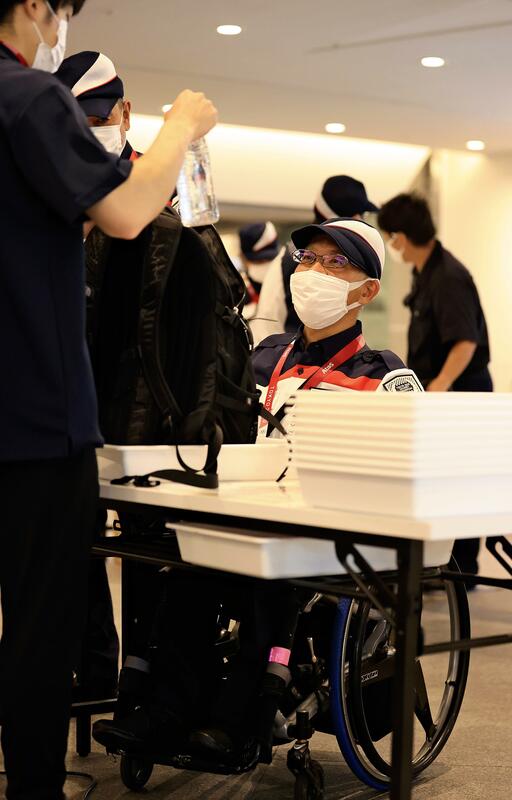
Wheelchair user Kunihiko Hamada has played two important roles at the Tokyo Paralympics -- assisting security efforts by checking officials' bags at a competition venue, and helping to identify new employment opportunities for people who live with physical impairments.
It is rare for a guard in a wheelchair to work at such events, according to members of the security service industry.
Hamada, 61, was dispatched by Zenko, a security agency based in Saitama City. He was assigned to Makuhari Messe, an international convention complex in Chiba City, where the goalball and wheelchair fencing events were held on Aug. 25.
"Would you mind opening this [bag], please?" he asked officials from his wheelchair. "Are there any drinks inside?" The bags were placed in front of him, and he carefully checked their contents.
"I've been giving it my all, to prevent something unchecked from getting through," Hamada said.
Hamada contracted polio at the age of 1 and lost a significant amount of the mobility in the lower half of his body. He chose to use a wheelchair, as it was difficult to walk for extended periods by himself, even with crutches.
After graduating from high school, Hamada worked for a private company and later joined the Saitama prefectural police. Until he retired at the mandatory age in March last year, he performed clerical tasks such as handling fingerprint-related documents in an identification division.
He started working in security at the encouragement of a former superior from his police days, who also had been working at Zenko.
At first, Hamada was uncertain whether he could handle the job, due to the lack of mobility in his legs. But he joined the company in January this year in the hope of seeing "a wider range of job options open up for people with disabilities."
Starting in April, the company dispatched Hamada to a university in Saitama Prefecture to verify IDs and take people's temperature as part of measures against the novel coronavirus.
"When I greeted them, the students would always greet me back," Hamada said. "My physical impairment might have worked to my advantage in terms of the students treating me with kindness."
Zenko has also dispatched staff to fill security positions at the Paralympic Games. When Zenko offered Hamada, who played on a community wheelchair basketball team from his high school days to the age of 30, the chance to work at one of the venues, he accepted without hesitation.
Hamada is unable to carry heavy items or walk up and down staircases, but "I want young people living with impairments to have a wider range of job opportunities. So even though I have a disability, I'll get the job done and show the world that even a man using a wheelchair can do security work," he said.
As part of efforts to boost its support for para sports, Zenko has become an official supporter of the Japan Goalball Association.
Zenko President Hiroyuki Umino, 58, said: "By having Hamada accumulate experience in security, we're trying to determine what kinds of jobs we can entrust to people with physical impairments. In the future, we also want to aim at hiring Paralympians."
--Untapped resource
According to the National Police Agency, there were about 10,000 security service operators authorized by the public safety commissions of Tokyo or other prefectural governments nationwide as of the end of last year. Around 590,000 people worked as security personnel.
The Security Services Law stipulates that a person cannot work as a security guard if they have mental disabilities and are unable to properly discharge the duties involved. However, restrictions are not stipulated for people with physical disabilities.
According to the All Japan Security Service Association, which has a membership of about 7,000 security firms, the private security sector has been seeking to hire more elderly people, women and foreign employees, in part due to a labor shortage.
But when it comes to hiring people with physical disabilities, that area is "almost completely untapped," an association official said. "Zenko's efforts can be seen as a fresh approach within our industry. The association wants to pay attention to such endeavors."
Read more from The Japan News at https://japannews.yomiuri.co.jp/