LUCKNOW: If we want to save and rejuvenate rivers, it is important that we develop a sense of ownership of rivers and stop overexploitation of groundwater. We will have to come out of the notion of ‘jal aseemit hai’ (water is unlimited) if we want potable water in future.
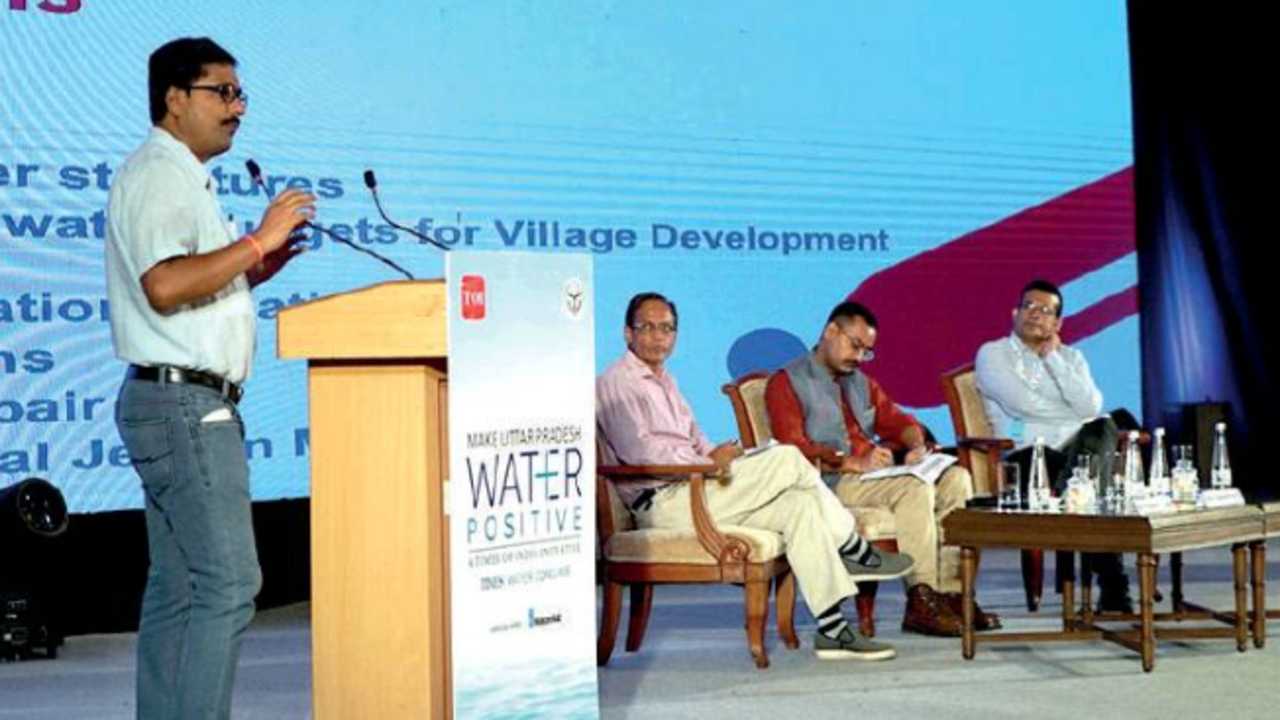
These views were expressed by scientists, hydrologists and stakeholders at the ‘Make UP A Water Positive State’ initiative. Experts said that conservation of wetlands and real-time monitoring of water supply in the state is the need of the hour.
“It’s important to build a sense of ownership and pride for rivers among the people. Namami Gange campaign is based on four pillars – ‘nirmal Ganga’ (unpolluted Ganga) wherein the focus is on solid waste management and rural sanitization, ‘aviral Ganga’ where work is carried out on ecology and flow, ‘jan Ganga’ under which people’s connection is established with the river, and ‘gyan Ganga’ which works towards research, policy and knowledge management,” said executive director (projects), National Mission for Clean Ganga (NMCG) Ashok Kumar Singh.
“Under Namami Gange, we have achieved success in rejuvenating the river by working on these four pillars. The common perception that we have unlimited availability of water needs to be changed. People must understand that we have limited water resources and that too are polluted,” said director, UP State Groundwater Board, VK Upadhyay.
He said every three years, the UP groundwater department conducts an assessment of groundwater in 10 cities which have a population of more than 10 lakh. The assessment of Aligarh, Moradabad, Bareilly, Varanasi, Prayagraj, Ghaziabad, Agra, Meerut, Lucknow and Kanpur revealed that groundwater situation in these cities is alarming.
Director, Rivers, Wetlands & Water Policy, WWF India, Suresh Babu, emphasized on the importance of wetland conservation.
“We have roped in Wetland Mitras, student volunteers who have done a wonderful job by conducting surveys and making a checklist. Water budgeting (measuring the quantity of water entering and leaving a system) and minimizing the loss of wetlands can make us water sufficient,” he said.
Programme officer, Centre for Science & Environment (CSE), Dhruv Pasricha said urbanization was inevitable and urban built-up area had increased drastically in UP leading to an increase in water demand across sectors.
“This has resulted in stretches of rivers with non-existent flow, overexploited aquifers, urban lakes and ponds which are being encroached upon. This has left an alarming impact on both quantity and quality of water. There is a need to protect local water bodies for supplementary resources, and stormwater management in public places should be promoted,” he added.
Team leader, WASH, Tata Trust, Pankaj Papnoi said monitoring of water consumption could help in improving the water management system. “Real time monitoring can be effectively done by using advanced technologies like the Internet of Things (IOTs),” he added.