NEW DELHI: There is a vast choice in the post-Covid period for those who would like to pursue a degree course online from Indian universities. From just 50 such courses in July 2020, the number being offered now stands at around 375 in over 40 universities.
A report by Class Central, a search engine for online courses, after tracking the trend for over 100 hours, determined that the increase in online offerings was a response to the pandemic, which only boosted the effort of the University Grants Commission to have institutions offering online degree courses via the UGC (online courses) regulations of 2018.
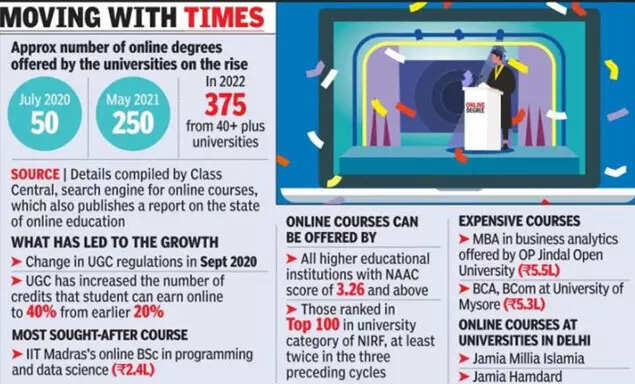
Besides the pandemic, the report also attributed the increase to the amendment in the UGC regulations in 2020 permitting higher-education institutions with a national accreditation score of score 3.26 and above and those ranked in the top 100 universities in the National Institutional Ranking Framework. “Before these regulations were introduced, students in India could complete up to 20% of their degree online via Swayam, India’s official MOOC (massive open online courses) platform. On March 25, 2020, an amendment in the regulations allowed 40% of the credits to be earned online,” pointed out Dhawal Shah, founder and CEO, Class Central.
In 2020, UGC listed 37 programmes being offered online in seven Indian universities. “So far, UGC hasn't released any enrollment statistics and I am not sure too many students know about these degree courses,” said Shah. “The has, however, been a fair amount of buzz around the Stackable Online BSc in Programming and Data Science from IIT-Madras.”
The course costs are not easy on the pockets. Private universities charge high fees, with the MBA in business analytics offered by OP Jindal University, for instance, costs Rs 5.5 lakh. “The median price for the two-year master’s degree course is Rs 73,500 and for the three-year bachelor’s, Rs 90,000,” revealed Shah. “In private universities, the fees for thesecourses are well over Rs 1 lakh. But they are still affordable compared with onlinecourses abroad.”
Shah said that from the perspective of access to higher education, the trend was welcome, especially for those who cannot be physically on the campus. “The worry, however, is that not all universities will be able to quickly scale up their online teaching, both in terms of pedagogy and technology,” the Class Central CEO added.” He cited cases in which the degree information pages were so poorly built that they did not inspire confidence in the degree itself.