The coronavirus epidemic has plunged Japan's public bathhouses into a serious situation.
In Tokyo, public bathhouses continued to operate during the state of emergency as they were regarded as a "lifeline" from the viewpoint of maintaining livelihoods. However, the number of public bath users fell amid calls to avoid the so-called Three Cs -- closed spaces, crowded places and close-contact settings -- and some public bathhouses have decided to close down.
Some public bathhouses, known as "sento" in Japanese, had looked forward to promoting "sento culture" to the world on the occasion of the Tokyo Olympics and Paralympics, but the future of such movement is now bleak.
--'Can't take holidays'
"Tsuki no Yu," a public bath in Kita Ward, Tokyo, had 50 to 60 customers a day before the outbreak, but the number of users has recently dropped by about 10%.
The bathhouse continues to run in the red. "I pride myself on being a lifeline for neighbors," said Tsuki no Yu President Ichiro Fukushima, 48. "I can't take holidays."
The appealing point of Fukushima's bathhouse is the good quality underground water which is boiled for use in the bath. Another key feature at the bathhouse is a service to wash customers' backs, a service that has now become rare.
"[Tsuki no Yu] helps me a lot because I don't have a bath at home," said regular user Hisako Saito, 70. "My friends gather here and it's a fun place to exchange information."
Fukushima is determined to keep his bathhouse. "I don't want to give up this place of relaxation and refreshment," he said. But he is worried that customers will lose interest in his establishment amid increased concern about sanitation due to the pandemic.
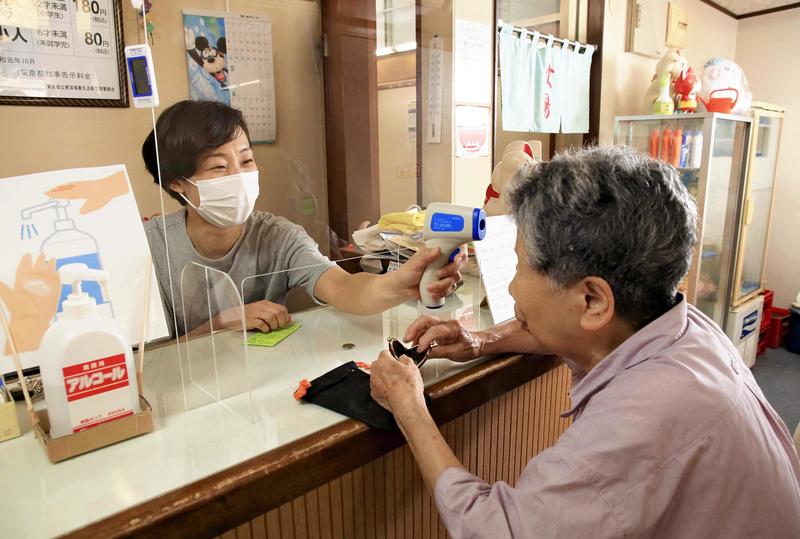
Earlier this month, the bathhouse began using a noncontact thermometer to measure customers' temperatures. A transparent acrylic barrier has been set up across the reception counter and face shields are prepared. Ventilation of the dressing rooms and disinfection with alcohol have been conducted thoroughly.
"With apologies to my customers, I ask them to refrain from talking as much as possible," Fukushima said.
--'Coronavirus pushed me'
Meanwhile, "Ichi no Yu," a public bathhouse in Adachi Ward, Tokyo, quietly closed down at the end of May. "The novel coronavirus may have pushed me [to make the decision]," said Nobuyuki Saigan, 51, who ran the bathhouse.
The bathhouse was opened in the booming decade of the Showa 30s (1955-1964), after Saigan's grandfather migrated to Tokyo from Ishikawa Prefecture. Traditional Mt. Fuji paintings on the walls and firewood-heated water reputed to have a "comfortable texture" had been loved by people in the community for about 60 years. Before the coronavirus, as many as 100 customers immersed themselves here every day.
However, Saigan's business had seen tough times due to such factors as a rise in fuel costs. And the pandemic worsened the situation. Since March, the number of daily visitors had dropped to about 30, and Saigan decided to shut down.
"I have no one to succeed me in my business. I have no leeway to continue the business with new capital investment," Saigan said bitterly.
Read more from The Japan News at https://japannews.yomiuri.co.jp/