The spread of the new coronavirus is forcing Japanese companies to take a hard look at how business is conducted, with the traditional emphasis on "face-to-face" methods such as conversation, meetings and dining together.
One big change has been the surge in teleworking, or telecommuting. Starting in March, Mitsubishi Chemical Holdings Corp. Chairman Yoshimitsu Kobayashi, 73, has spent all day on weekdays working at home, participating in teleconferences via his personal computer for board conferences, internal and external meetings and government deliberation councils. He feels that he can work more efficiently because he cuts out long distance commuting by company car and taking business trips.
His eating habits have also changed, from working dinners to his wife's homemade meals, while his weekends, which used to be nothing but golfing, have been drastically altered.
"Life before [the new coronavirus pandemic] was not normal," he said. "We should not go back to the way it was even when the spread of infections ceased."
Corporate giants such as Hitachi, Ltd. and Nissan Motor Co. are increasingly shifting to teleworking. According to a survey conducted by the Japan Business Federation (Keidanren) in mid-April on about 1,500 member companies, the rate of those that have introduced the system jumped to 97.8% percent. However, as only 406 companies responded, there is a possibility that they were ones most active in adopting teleworking.
The gap in enthusiasm for teleworking among companies is large. According to a survey by the Tokyo Chamber of Commerce and Industry, only about 14% of companies with less than 50 employees are implementing teleworking. "You have to be there to make things or transport things."said Chairman Akio Mimura, 79.
Presenting another problem is the threat of cyberattacks. According to information security company Trend Micro Inc., about 47,000 cases of phishing and other malicious attacks were reported globally in the first three months of this year. Japan had about 6,600 cases, second only to the United States. In mid-April, a panel of experts from the Economy, Trade and Industry Ministry issued a warning to industrial circles.
Employees who actually work from home also have their share of problems. Among the most frequent concerns are that small children make securing a quiet working space impossible, that they find it difficult to draw a line between their personal and professional lives, and that they have little contact with colleagues.
Unicharm Corp. has started a system that bears the costs for participation in a monthly "online social gathering" held by each department of up to 3,000 yen per person. Measures to promote teleworking are just getting off the ground.
In March, the yen fluctuated wildly more than 10 yen against the U.S. dollar due to fears of an economic downturn caused by the pandemic. Trading volume in foreign exchange margin trading (FX) reached 1,015 trillion yen for the month alone, surpassing the previous record of 660 trillion yen set in January 2015. Behind the scenes, the main players were teleworkers.
A male employee in his 30s of a major life insurance company has made hundreds of thousands of yen on FX transactions during working hours since March.
"When [the market is] volatile, it is a good chance to make money. [While teleworking,] I can make trades without worrying about people around me watching," he said unapologetically.
Takuya Kanda, 55, a senior researcher at the Gaitame.Com Research Institute, observed, "FX trading during the daytime has become more active than before, clearly because the number of transactions by teleworkers is increasing rapidly."
The Japanese corporate characteristic of "omotenashi," of going the extra yard in terms of hospitality, is also going through a modification.
Two hotels in Tokyo, which have been accepting patients with mild or no symptoms of the new coronavirus since May, are using the Softbank Group's humanoid robot named Pepper to welcome new arrivals, and having the lobbies cleaned by robots controlled by artificial intelligence (AI). More and more restaurants in the city are introducing robots for serving. These were originally measures meant to deal with a labor shortage, but infection prevention has produced a new form of demand.
In 2013, Michael Osborn of the University of Oxford co-authored a paper titled "The Future of Employment: How Susceptible Are Jobs to Computarisation?" He predicted that half of jobs would be replaced by AI and robots in 10 to 20 years. In an era of "noncontact," the increased use of AI to promote unmanned work will deepen concerns.
The employment environment, which had begun to stabilize, has become very wobbly.
Furloughs are spreading from the devastated airline industry to automakers, steelmakers and other manufacturers. The ANA Group has decided to furlough about 42,000 employees. Three major steelmakers, including Nippon Steel Corp., which supply steel to the auto industry have put 50,000 employees on furlough.
The government is working on measures to prop up employment. Under its employment adjustment subsidy system, the government subsidizes part of the allowance paid by companies to furloughed employees. The scope of the system has been expanded to part-time workers who work less than 20 hours a week, and the period until payment is received has been halved to one month. The number of days to be paid the subsidy, which was up to 100 days a year, has also been eased.
However, many public job-placement offices across the country have been flooded with business owners applying for the subsidy, resulting in a backlog of processing applications. Many business owners believe the longer the furloughs are extended, the more likely they will have no choice but to fire the workers.
In Europe, debate has begun over adopting a "basic income" system, under which a country guarantees a minimum income by unconditionally distributing cash to each member of the public. In Japan, the government has proposed an across-the-board special cash handout of 100,000 yen per person, which one senior executive of a business organization views as "a test run of a de facto basic income." However, to make the payments on a regular basis necessitates an annual budget of more than 100 trillion yen. The hurdles to turning this into reality are high.
How can we ensure a stable income?
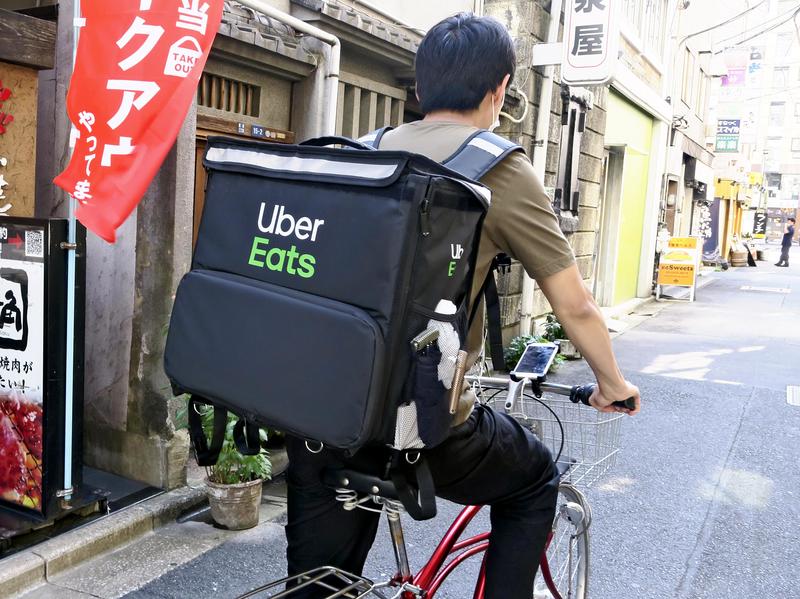
One new form of working is called "gig work." This involves taking a one-time or short-term job over the internet. One noticeable group in recent months has been the swarm of bicycle riders bearing big backpacks all over town. They are the delivery corps for UberEats, a food and drink delivery service operated by the major U.S. car-hailing service provider.
Often, it is employees of restaurants that are closed due to the government's request of self-restraint, and office workers who have been furloughed, who take these jobs as a way to supplement their income. It is gaining greater recognition as a temporary safety net for employment amid the current "corona crisis."
On the flip side, there are many problems with this system. Unlike company employees, such laborers are not covered by social security or worker's compensation in case of accidents, nor are their rights as workers adequately protected. The search for work styles in the new era will continue.
Read more from The Japan News at https://japannews.yomiuri.co.jp/