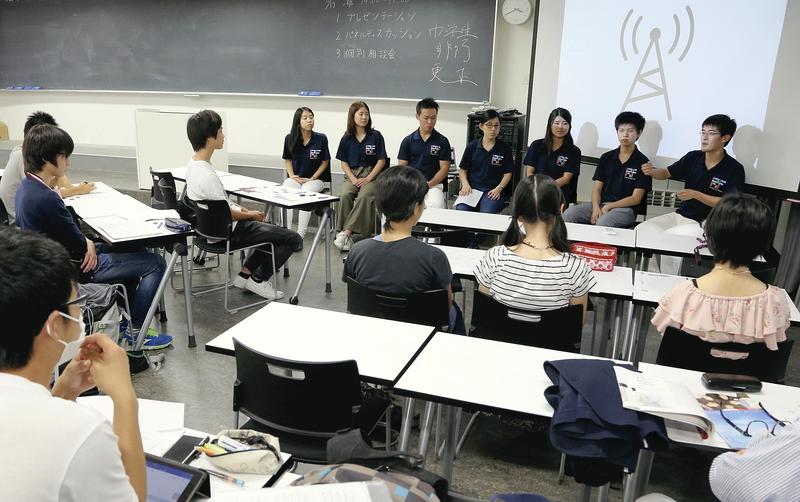
Many Japanese students who had been studying abroad have returned to Japan because of the coronavirus crisis, which is having a serious impact on overseas study programs.
Students who had been planning to study overseas are facing such problems as travel restrictions and the suspension of such programs amid the pandemic, putting the brakes on what had been a growing trend.
"I didn't join any university clubs [in Japan] because I was going to study abroad. I'll be disappointed if things remain as they are now," said a Sophia University senior who had been studying at a university in Luxembourg.
The student won a scholarship from a program jointly run by the Education, Culture, Sports, Science and Technology Ministry and had planned to be abroad for about a year from September 2019, but was ordered by Sophia University to return to Japan temporarily in March because of the pandemic.
The student, who initially tried to return to Japan via Turkey, had to go back to Luxemburg because Turkey was refusing entry to foreign passengers to prevent the spread of infections. The student eventually returned via Paris with the help of the Japanese embassy.
The student is now taking online classes from the university in Luxembourg but is unsure whether returning to Europe will be possible.
The study abroad program has granted extensions up to March 2021 to about 500 university students who were slated to begin studying abroad from April to October. The selection process for high school and university students has been suspended.
Education minister Koichi Hagiuda apologized to applicants on the program's website, and called on them to "take up the challenge of going overseas again when the situation has been resolved."
About 3,300 students were studying in 65 countries and regions under a nationally funded study abroad support system run by the Japan Student Services Organization. Most of them have already returned to Japan.
The total number of Japanese students who studied abroad in fiscal 2018 was about 115,000, according to figures from universities and other entities, nearly twice as many as five years ago, though it is unclear if the growth will continue.
Universities that rely on their study abroad programs to attract students are also struggling.
Chiba University made studying abroad mandatory for all new students starting this spring and has signed agreements with more than 400 foreign universities. However, all overseas placements have been suspended.
"I hope students will use this time to prepare for their overseas placements by looking at what is happening around the world," a university official said.
Akita International University requires students to study abroad for one year. This spring 164 students left for overseas placements, but many have returned home.
"We don't expect study abroad programs to start this autumn, but we're trying to enhance online classes and want our students to develop a global perspective and communication skills," an official said.
The new coronavirus pandemic is also affecting young researchers sent overseas under a program run by the Japan Society for the Promotion of Science.
Though the society has relaxed rules on trips back to Japan, few have returned. Some of those stuck overseas are unable to work on their research.
According to the ministry, which oversees the society, the pandemic is affecting 319 researchers, who are participating in a two-year "overseas fellow system" for researchers who have had doctorates for less than 5 years or a three-months to one-year "overseas challenge program" for young researchers currently enrolled in doctoral programs.
They receive support for travel and living expenses, but most are in countries that have been seriously affected by the virus, such as the United States, Britain and Germany.
University closures have prevented some from carrying out their research and many are stuck at home due to shelter-in-place orders.
Special exceptions have been made in stages for people who have asked to return home temporarily.
For the overseas fellows, trips back to Japan have been extended from no more than a total of 40 days to six months. The challenge program does not permit trips home in principal, but the society decided that time spent back in Japan would not count against their time in the program, and funds would be allocated for them to return to their placements overseas.
As of May 1, only 18 people had returned to Japan. A ministry official said some participants who want to return are unable to do so due to travel restrictions.
"University closures are having a major impact on short programs. We will deal with the situation as circumstances demand," the official said.
Read more from The Japan News at https://japannews.yomiuri.co.jp/