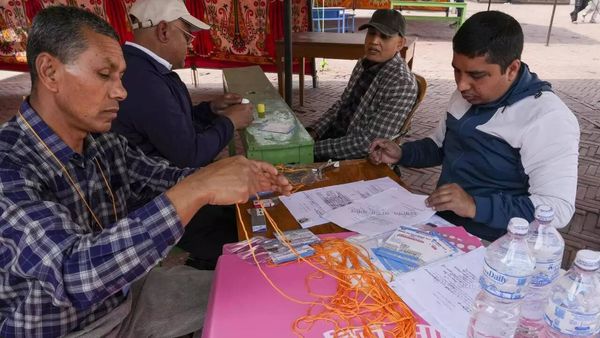
There is growing momentum to review Japan's practice of depending on hanko seals and paper documents. Both the public and private sectors are urged to study ways to improve business efficiency.
The number of companies introducing telework has increased sharply in response to the government's request for the public to refrain from going out due to the spread of the new coronavirus. In many cases, however, employees had to go to their office just to place seals on documents.
Many employees are continuing to work from home even after the state of emergency was lifted, in a bid to follow the "New Lifestyle" to avoid closed spaces, crowded places and close-contact settings. Business operators say the new lifestyle is good for work style reform and boosting productivity.
There must be much room for improvement if the use of seals interferes with this trend.
Seals have long been used to verify the identity of a person and give credibility to documents. In foreign countries, handwritten signatures are common mainly in Europe and the United States, and the use of hanko is limited to East Asian countries and regions.
Seals are required by laws and regulations on such limited occasions as signing contracts for the sale of real estate and changing representative directors of companies. In many cases, it is merely a customary practice to use seals for business contracts and documents to be submitted to local governments.
The Justice Ministry explains that electronic signatures, which prove a person's identity via signature and encryption technology, are also legally valid. If the government and business circles tackle this seriously, it should not be difficult to review the practice.
In the IT industry, there is a growing trend away from the use of seals. Mercari Inc. asks its clients to sign contracts with e-signatures instead of corporate seals. Line Corp. has also stopped signing contracts on paper in principle.
Some financial institutions do not require seals to open accounts either online or at their brick and mortar branches.
"Seals are complete nonsense," Japan Business Federation (Keidanren) Chairman Hiroaki Nakanishi said at a press conference in April. If big companies with a large number of clients and contracts take the initiative, moves to end the practice will accelerate.
Efforts by the central and local governments are also indispensable. Companies are said to be concerned that their documents submitted to government offices would be rejected without seals.
In April at a meeting of the Council on Economic and Fiscal Policy, Prime Minister Shinzo Abe instructed the government to review systems and practices involving physical seals and paperwork.
The government should review administrative procedures and come up with guidelines that separate those requiring seals and those not requiring seals. The government is expected to come up with concrete measures to improve the convenience of the public.
It is important not to forget to take into consideration the needs of small and midsize companies that are not ready for the shift to digital technology. The government should steadily carry out reforms, while at the same time allowing the use of seals depending on the circumstances.
-- This article appeared in the print version of The Yomiuri Shimbun on June 1, 2020.
Read more from The Japan News at https://japannews.yomiuri.co.jp/