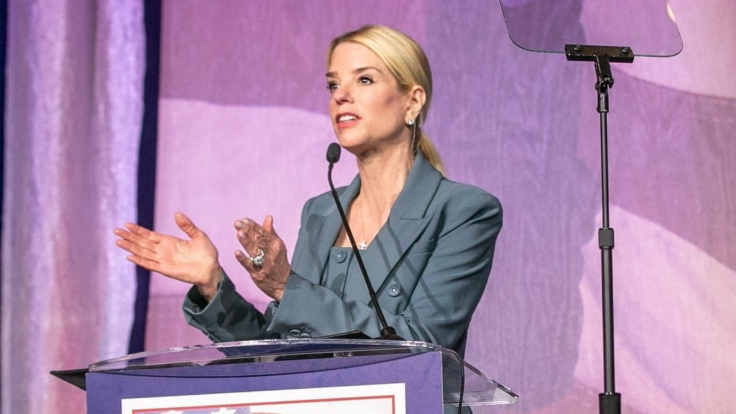
A fiery political storm has erupted after Attorney General Pam Bondi sparked outrage by suggesting that being an American is a privilege rather than a right, triggering immediate backlash from critics who pointed to the Constitution and accused her of misrepresenting fundamental legal principles.
The controversy began when Bondi stated in a public discussion that citizenship should be viewed as a privilege, not an automatic right. Her comment quickly spread online, with critics arguing that the statement directly contradicts long-standing constitutional protections.
Legal experts and commentators were quick to respond, highlighting that the United States Constitution, particularly the Fourteenth Amendment, guarantees citizenship to individuals born or naturalised in the country. The backlash intensified as many accused Bondi of oversimplifying or misrepresenting a complex legal framework.
For critics, the issue was not just about wording. It was about the implications. If citizenship is framed as a privilege, some argue it opens the door to policies that could redefine who qualifies as American.
Critics say the Constitution tells a different story
Opponents of Bondi's remarks have pointed directly to the Fourteenth Amendment to the United States Constitution, which clearly establishes birthright citizenship.
Legal scholars and political opponents argue that her statement undermines a core principle of American democracy. They say the Constitution treats citizenship as a protected right, not something granted or revoked at will based on political interpretation.
Critics also warn that language like this can have real-world consequences, particularly in debates around immigration, denaturalisation, and national identity. They argue that framing citizenship as a privilege risks creating uncertainty for millions of people who rely on constitutional guarantees for their status in the country.
Supporters Defend Bondi Amid Growing Controversy
Despite the backlash, Bondi's supporters have defended her comments, arguing that her statement reflects broader political discussions about national identity and the responsibilities that come with citizenship.
Some allies claim her remarks were taken out of context and were meant to emphasise the value of citizenship rather than diminish its legal standing. They argue that debates over immigration policy and national security often involve strong rhetoric that can be misinterpreted.
However, the explanation has done little to calm critics, who say the issue is not about political messaging but about accuracy, especially coming from a high-ranking legal official.
The controversy has added to the broader political divide over immigration, citizenship, and constitutional interpretation. Analysts say remarks like Bondi's often become flashpoints in an already heated national debate.
Observers note that discussions around citizenship frequently intersect with policy proposals involving border security, naturalisation processes, and enforcement of immigration laws. These issues remain highly sensitive, making statements from senior officials particularly scrutinised.
At the same time, the backlash highlights how quickly public figures can come under fire in the age of social media, where comments are dissected and amplified within minutes.Bondi has not issued a formal clarification, leaving critics and supporters locked in a growing dispute over what her words truly mean and whether they reflect a shift in political thinking.