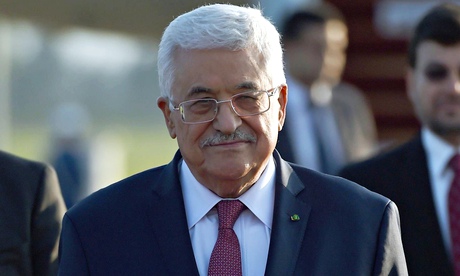
The Palestinian president, Mahmoud Abbas, has signed up to join the international criminal court in the wake of the UN security council’s rejection of a resolution calling for a deadline to end the Israeli occupation.
The move, certain to anger Israel and the US, paves the way for the court to take jurisdiction over crimes committed in the Palestinian territories and investigate the conduct of Israeli and Palestinian leaders over more than a decade of bloody conflict.
The long-threatened move to join the ICC comes amid fury in the Palestinian leadership over US- and Israeli-led efforts that on Tuesday derailed a UN resolution that called for the ending of the Israeli occupation by 2017 and the establishment of a Palestinian state based on pre-1967 borders with mutual land swaps.
The resolution was strongly opposed by the US and Israel and saw both the US secretary of state, John Kerry, and Israeli prime minister, Binyamin Netanyahu, call the president of Nigeria, Goodluck Jonathan, on the eve of the vote to persuade him to abstain.
Before the vote Palestinian officials believed Nigeria was set to back their resolution, which ultimately fell one vote short of a majority of nine votes.
As a first move to joining the court Abbas on Wednesday signed the Rome statute, the ICC’s founding treaty.
Senior Palestinian officials had warned in the weeks before the failed UN vote that the next step would be for Palestine to join the ICC – not least if the resolution was vetoed by the US.
Abbas’s decision is expected to trigger a harsh response from Israel.
Israel says all disputes should be resolved through peace talks, and such actions are aimed at bypassing negotiations.
Based in The Hague, the ICC can prosecute individuals accused of genocide, crimes against humanity and war crimes committed since 1 July 2002, when the Rome statute came into force.
According to the ICC’s official website the Rome treaty has been ratified by 122 states.
The court can pursue an individual only if crimes were committed on the territory of a state party – one that has signed and ratified the Rome statute – or by a citizen of such a state. Israel has signed but not ratified the treaty.
The moves came at the end of 24 hours of high diplomatic drama in which Palestinian officials and other observers had appeared convinced that Nigeria would back the Jordanian-tabled resolution that would have set a 12-month deadline for Israel to reach a final peace deal with the Palestinians and called for a full withdrawal of Israeli troops from the Palestinian territories by the end of 2017. If the resolution had got the nine votes it required it would have required a US veto to block it.
“Even half an hour before the vote Nigeria indicated it was committed to voting for the resolution,” one Palestinian source involved in the negotiations commented furiously to the Guardian.
“We knew that Rwanda, South Korea and Australia would not back it, but we believed Nigeria was on board.”
“The UN security council vote is outrageously shameful,” said the senior PLO official Hanan Ashrawi.
Welcoming the UN vote, Netanyahu extended his special thanks to Nigeria and Rwanda. “This is what tipped the scales,” he said.
The Israeli foreign minister, Avigdor Lieberman, took a swipe at the European countries who backed the resolution. “The Palestinian disregard to the international community’s most important countries – particularly the US – stems from the backing they receive from certain European countries,” Lieberman said.
The Islamist movement Hamas blamed Abbas for the setback, demanding he make good on threats to cut security cooperation with Israel and join the ICC.
Signalling that the vote would not mark an end to the campaign to win a security council resolution, Palestinian and French officials indicated they would continue working to find a text to put to the UN, perhaps within weeks.
Before the vote, the Palestinian negotiator Saeb Erekat said the Palestinians could return again to the security council, which will have five new members starting on Thursday who are viewed as more sympathetic to their cause.
However, despite signalling a sharp defeat to the Arab-supported campaign to get security council backing for a moves towards a Palestinian state, the vote held minimal comfort for Israel, seeing two European countries – France and Luxembourg – support the resolution.
Only the US and Australia voted against it.
Britain, Rwanda, Lithuania and South Korea joined Nigeria in abstaining.
Palestinian officials had long believed the resolution was likely to be defeated by a US veto but had hoped to secure the symbolic figure of nine votes to dramatise what they argue is Washington’s partisan advocacy on behalf of Israel in the Middle East peace process.
Indeed the US, Israel’s closest ally, had made clear its opposition to the draft resolution, insisting instead on a negotiated peace agreement between Israel and the Palestinians, not an imposed timetable.
“We voted against this resolution not because we are comfortable with the status quo. We voted against it because ... peace must come from hard compromises that occur at the negotiating table,” the US ambassador Samantha Power said.
She criticised the decision to bring the draft resolution to a vote as a “staged confrontation that will not bring the parties closer”. She added that the resolution was “deeply unbalanced” and did not take into account Israel’s security concerns.
“Our effort was a serious effort, genuine effort, to open the door for peace,” said Riyad Mansour, the Palestinian UN ambassador. “Unfortunately, the security council is not ready to listen to that message.”