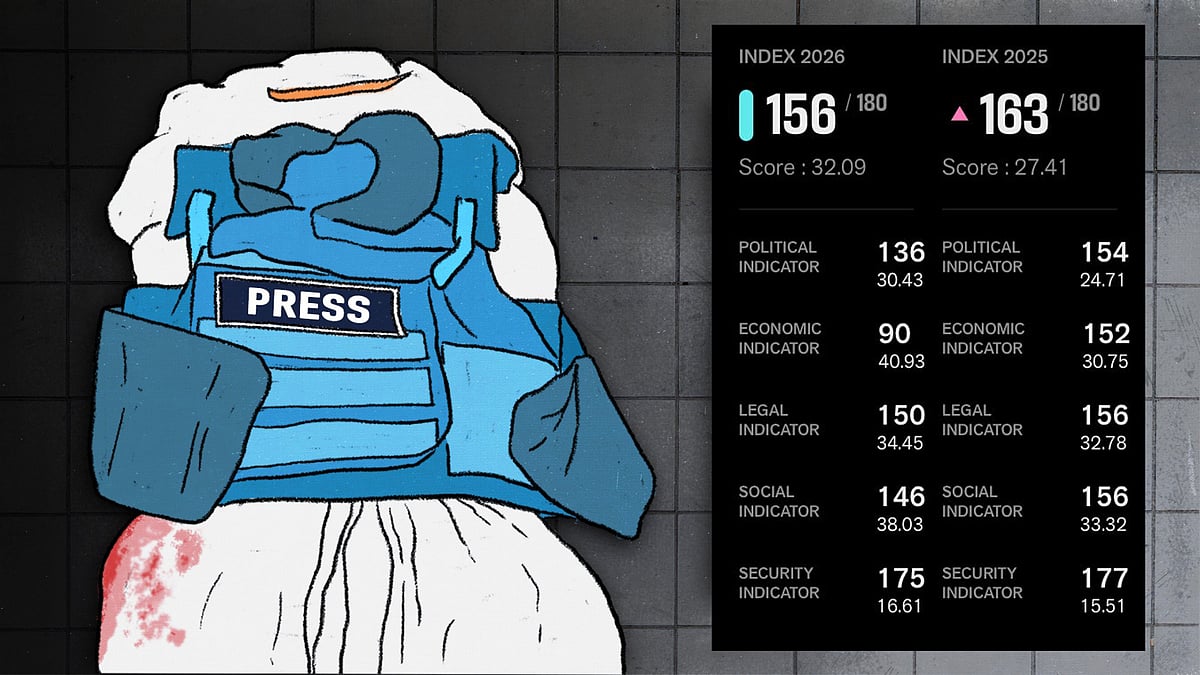
Every year, on or around World Press Freedom Day, Reporters Without Borders (RSF) releases its World Press Freedom Index and India does what India always does: calls the methodology opaque and moves on. The 2026 edition, released today, offers India even less to be comfortable about.
For the second year running, a territory in active, catastrophic war – where journalists are being bombed, starved, cut off from communications, and killed in the largest numbers ever recorded in any single conflict – is judged by RSF to have a marginally freer press environment than many other countries in the world. Last year, it was better than Russia. This time, it’s freer than even India.
India has slipped to the 157th rank out of 180 countries. Palestine is 156th. One spot above. Last year, India was nominally ahead when it was ranked 151 and Palestine 163.
In fact, India had earlier improved its ranking for two consecutive years. It now ranks below not just Palestine but also Tajikistan (155), Laos (154), Pakistan (153), Bangladesh (152), and Cambodia (151). It ranks above only 23 countries, the last of which is Eritrea.
The worst index in 25 years
The 2026 RSF Index is, by RSF’s own account, the bleakest since the organisation began publishing it a quarter of a century ago. For the first time in the index’s history, more than half the world’s countries fall into the “difficult” or “very serious” categories for press freedom. In 2002, 20 percent of the global population lived in a country where press freedom was rated “good.” Today, fewer than one percent does.
Norway holds the top spot for the tenth consecutive year. Eritrea is last for the third. The United States, under Donald Trump, has dropped seven places to 64th – pushed down by what RSF describes as Trump’s systematic policy of attacking the press, the detention and deportation of journalists, and the gutting of the US Agency for Global Media, which led to the closure or downsizing of Voice of America, Radio Free Europe/Radio Liberty, and Radio Free Asia.
Post-Assad Syria, after years in the bottom 10, has jumped 36 places to 141st following the fall of Bashar al-Assad’s dictatorship in December 2025. The steepest fall has been in Niger.
The sharpest overall decline this year is in the index’s legal indicator, which measures the legislative and judicial environment for journalists. This score worsened in more than 60 percent of states – 110 out of 180 – between 2025 and 2026. The RSF report specifically names India among the countries where the legal environment for journalism deteriorated. The others named in the same group: Egypt, Israel, Georgia.
The RSF describes the global criminalisation of journalism as a phenomenon rooted in the misuse of national security laws, emergency legislation, and common law. Russia has become its specialist practitioner, holding 48 journalists behind bars as of April 2026.
The Palestine puzzle, continued?
Since October 2023, according to the RSF’s 2026 report, more than 220 journalists have been killed in Gaza by the Israeli army, including at least 70 killed while actively carrying out their journalistic work. The International Federation of Journalists puts its count higher – over 262 media workers killed in total. The Committee to Protect Journalists documented a record 129 press members killed globally in 2025, with Israel responsible for two-thirds of those deaths. The Gaza conflict is the deadliest on record for journalists, by a significant distance.
And yet, Palestine sits at 156, up 7 places from last year. How?
RSF’s methodology assesses press freedom across five indicators: the political, legal, economic, social, and security environments for journalism. The report attributes the rise to a “ceasefire with Israel in force since October 2025.” The index counts a massive improvement in the ranking in terms of the economic indicator and the political indicator.
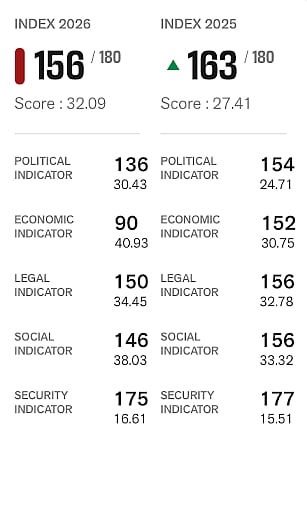
But the reality on the ground tells a different story.
Public debt has reached $14.6bn, exceeding GDP, while unemployment in Gaza hit a staggering 77 percent by late 2025.
Palestine’s scores on the other indicators, particularly the political one, seem to reflect the Palestinian Authority’s relationship with its own press rather than Israeli military conduct.
Since that ceasefire began, the International Federation of Journalists has documented eight journalists killed by Israeli forces in Gaza – three in the final months of 2025.
RSF also applies a specific counting rule: a journalist is tallied as killed only when RSF can confirm a direct causal link between the death and the person’s journalistic activity.
By that definition, the number counted could be lower than the overall toll cited by Palestinian and international organisations. This has been the source of a dispute. The Palestinian Journalists’ Syndicate had earlier accused RSF of “whitewashing the image of the occupation” — a charge RSF denies.
Conditions in Gaza are catastrophic. Newsrooms have been bombed out of existence. Israel has imposed repeated communications blackouts across Gaza, cutting journalists off from the ability to file or transmit. Foreign press access to the territory remains entirely banned by Israel.
Press freedom organisations have signed joint public letters describing journalists in Gaza as being starved to death deliberately, and in real time. One in three people in Gaza goes days without food; among the starving are the reporters who remain the territory’s only independent witnesses.
If all of that still leaves Palestine one rung above India at 156, the only reasonable conclusion is that India’s own press freedom situation is very bad indeed. But is it?
Behind India’s new rank
As the report notes, “Even in more democratic environments, legal frameworks are increasingly being weaponised to silence newsrooms. In India (157th), judicial harassment of independent media is intensifying, driven by the growing use of criminal statutes – defamation and national security laws among them – directly targeting journalists.”
India’s scores have mainly reduced this year on three counts: political, economic and legal indicators. These scores determine the ranking for each indicator.
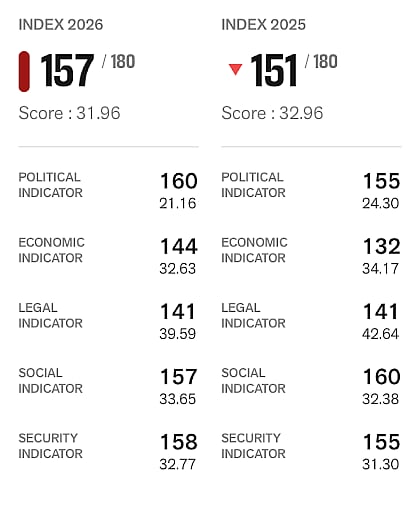
“With a rise in violence against journalists, highly concentrated media ownership, and outlets with increasingly overt political alignment, press freedom is in crisis in ‘the world’s largest democracy,’ ruled since 2014 by Prime Minister Narendra Modi, leader of the Bharatiya Janata Party (BJP) and embodiment of the Hindu nationalist right,” the index notes.
On the legal framework, the index notes that “anti-terrorism laws are increasingly used against journalists. The main opposition party, the Indian National Congress, and other regional parties have also used legal provisions against journalists for intimidation purposes and as retaliation. Modi has introduced several new laws that give the government extraordinary power to control the media, censor news and silence critics, including the 2023 Telecommunications Act, the 2023 Information Technology Amendment Rules, and the 2023 Digital Personal Data Protection Act.”
When India improved its ranking in 2024, the RSF’s report that year said some countries’ rise in the index was “misleading as they were the result of falls by countries previously above them”.
India’s legislative arsenal against journalists has been building for years: the Unlawful Activities (Prevention) Act and sedition-like charges deployed against critics; the Information Technology rules giving the government broad powers to flag and remove digital content; and, more recently, data protection legislation that press freedom advocates say create new mechanisms for official surveillance and suppression.
The Indian government has had a standard response to the press freedom index: the sample size is too small, the methodology is questionable, and the organisation is biased. In 2022, then Information and Broadcasting Minister Anurag Thakur told the Rajya Sabha that the government “does not subscribe to its views.” It is a safe bet that position has not changed.
There’s no better time to underline the importance of a free press. With World Press Freedom Day around the corner, power the independent media.
Newslaundry is a reader-supported, ad-free, independent news outlet based out of New Delhi. Support their journalism, here.