The Number on the Ticket
The base fare for one person, one week, peak season on the Palace on Wheels sits at roughly ₹4.5 lakh, and that is the entry point, not the ceiling. Suites classified as "Deluxe" push closer to ₹6 lakh. The train runs a circuit through eight destinations: Jaipur, Sawai Madhopur, Chittorgarh, Udaipur, Jaisalmer, Jodhpur, Bharatpur, and Agra. Seven nights. Eight cities. The Rajasthan Tourism Development Corporation and Indian Railways operate it jointly, and the rolling stock is genuinely old, the coaches were originally built in the 1980s, refurbished over the decades, and carry names drawn from the royal households of the former princely states: Alwar, Jaipur, Bikaner, Bundi.
That history is not decoration. The train has a provenance, and when you run your hand along the teak panelling in your cabin, you are touching something with an actual past, not a simulation of one. Whether that matters to you is the first question worth settling before you buy the ticket.
What the Fare Is Actually Paying For
All meals are included. So are excursions at each stop, entrance fees, a guide at every destination, and a personal attendant assigned to your coach, the staff-to-guest ratio is high enough that your butler will remember how you take your chai by the second morning. The food runs between competent and genuinely good: a mix of Rajasthani thali service and continental options, with particular care given to the dinner spread, which is usually taken in the restaurant car or at a heritage property during one of the off-train dinners in Udaipur or Jaisalmer.
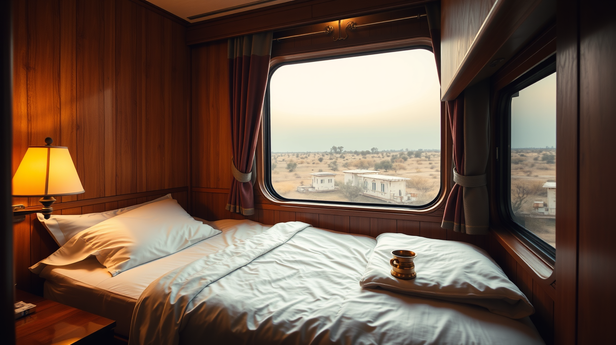
The cabin itself is small by any honest measure. The beds are fixed berths dressed in good linen. There is a window, a wardrobe, and a compact bathroom with a shower. The space does not expand with the price. What the fare is actually buying is not square footage, it is the removal of logistics. Every transfer, every queue, every decision about where to eat and how to get there has been lifted out of your hands. For seven nights in Rajasthan, you do not have to think. That is a specific luxury, and it costs what it costs.
Rajasthan at 3 a.m. Through a Train Window
The train moves mostly at night. This is the detail no one emphasises in the marketing, and it is the detail that changes everything. You arrive in Jaipur at dawn. You pull out of Jodhpur after dinner. The blue city, the pink city, you see them on foot during the day, and then the train carries you away through the dark while you sleep.
What you do see from the window, if you wake at the right hour, is the Thar at night: flat, enormous, lit by nothing but stars and the occasional single bulb burning in a distant dhani. There is no heritage in that view. There is only scale. Rajasthan is a large place, and the train is the only way to feel that largeness without spending days in a car. The luxury coaches cannot give you that. Only the distance can.
The Social World of the Train
The passenger mix on any given departure is roughly one-third Indian, two-thirds international, though this shifts in the shoulder season. The international guests tend to be older, European or American, on a checklist trip through India. The Indian guests are often celebrating something: an anniversary, a retirement, a significant birthday. The atmosphere in the common areas is cordial and slightly formal. People dress for dinner.
This social texture is worth knowing before you board, because the train is not a solitary experience. You share the restaurant car, the lounge car, the excursion buses. If you are travelling alone, or if you came for quiet, the constant managed sociability can feel like a second itinerary running alongside the first. The train rewards people who enjoy a certain kind of organised conviviality. It does not reward those who wanted to disappear into Rajasthan on their own terms.
What the Train Cannot Give You
Spontaneity is gone the moment you board. The schedule is fixed, the excursions are timed, and the cities exist, from the train's perspective, as curated two-to-four-hour windows. You will see the Amber Fort. You will not wander into the lane behind it and find the shop where an old man has been repairing silver anklets for forty years. The train is a frame, and frames exclude as much as they include.
The heritage it sells is also, in places, a performed version of itself. The folk dancers at the welcome dinner in Jaisalmer are professionals hired for the occasion. The turbans offered for photographs are props. None of this is dishonest, the train has never pretended otherwise, but it is worth knowing that the royal India on offer is a curated reconstruction, not an encounter with something still alive in its original form.
What is alive is the landscape, the food when it is good, and the occasional unscripted moment: a conversation with your attendant about his village near Bharatpur, the sun coming up over the Chambal basin while the train slows through a curve, the specific quiet of a Rajasthani morning before the excursion buses start.
The fare buys you access to those moments, but it cannot manufacture them. They arrive on their own schedule, which is the only schedule on the Palace on Wheels that nobody controls.