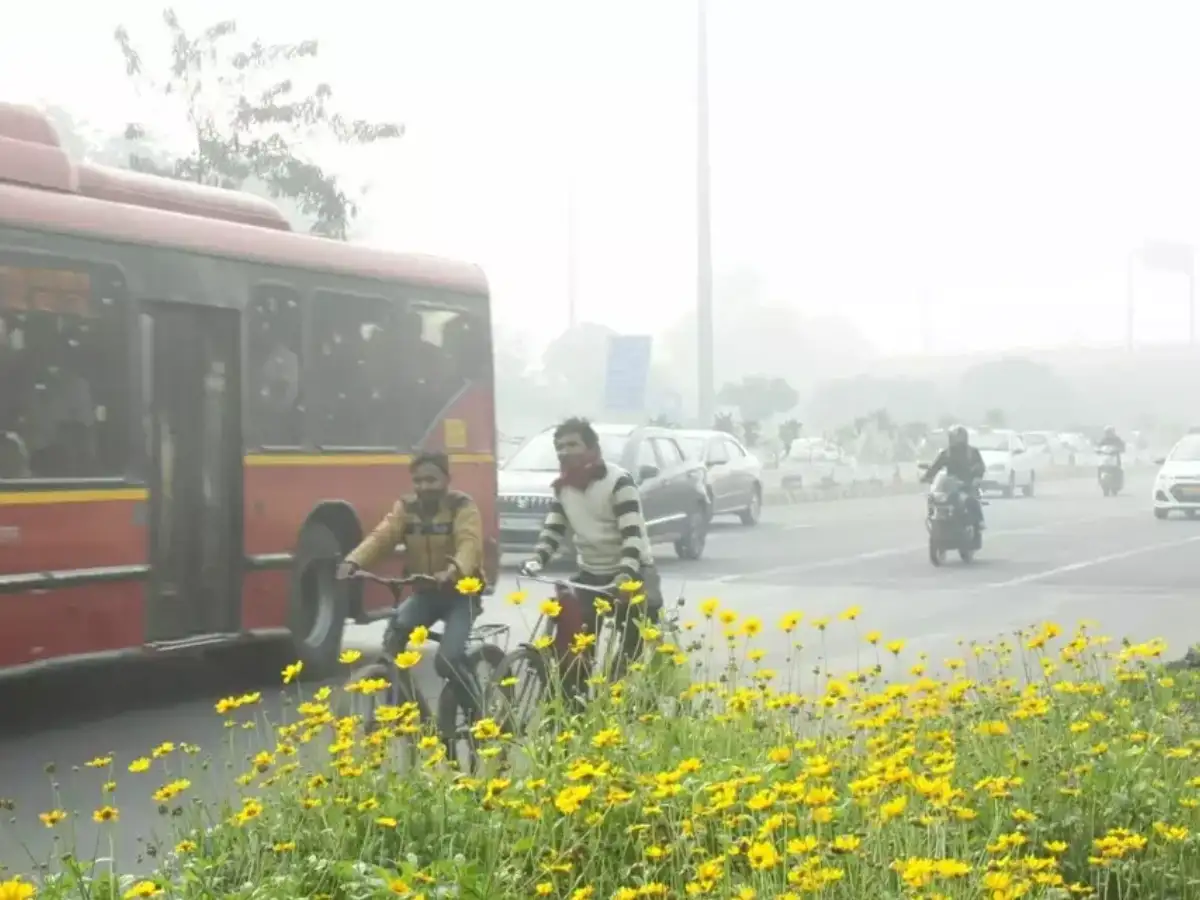
New Delhi, National Capital Region's particulate matter (PM2.5) is substantially affected by transboundary pollution from Pakistan, with almost 33 per cent coming from the neighbouring nation annually, according to a new report, which also said that the country strongly influences the air pollution in Punjab as well.
The NCR's annual average PM2.5 concentration is 67.9 g/m3 (microgram per cubic metre), with local sources contributing 28 per cent, driven primarily by residential activities, such as biomass burning for cooking, followed by industry, agriculture and transport.
The report, 'Beyond State Boundaries: Quantifying Interstate Air Pollution Transport and Sectoral Solutions in the Indo-Gangetic Plain,' also said that states in north and central India contribute about 12 per cent of NCR's PM2.5 concentrations, with natural and agricultural sources and residential, industrial and transport emissions forming the major share.
The report, released by the Centre for Study of Science, Technology and Policy (CSTEP), looked at the major sources of air pollution across the Indo-Gangetic Plain (IGP), the regions from which they originate, and measures to manage air quality at a regional scale.
The report also revealed that Punjab's annual average PM2.5 concentration is 77.8 g/m3. Among local sources in the region, the residential sector accounts for about 52 per cent of local PM2.5 pollution, followed by industry (13.8 per cent), natural and agricultural sources (11.6 per cent), and agricultural waste burning (7.9 per cent).
Much like the NCR, Punjab's air quality is strongly influenced by transboundary pollution from Pakistan, which accounts for approximately 40 per cent of its annual PM2.5 concentration, said the report released on Wednesday.
Other regions contributing to Punjab's air quality include neighbouring Indian states, Rajasthan, the NCR, and even lower IGP states. However, their contributions are comparatively less on an annual scale.
That's why standalone state- or sector-specific interventions yield limited gains, according to the report.
To tackle the situation, there is a need for combined emission reductions across residential, industrial, energy, transport, and agricultural waste-burning sources.
This can "deliver substantially higher annual and seasonal benefits, underscoring the need for a common framework aligned with state-level action," said the report.
It lists several recommendations, including developing a periodically updated, high-resolution national emission inventory with a city-level layer, and integrating crop residue management monitoring with real-time satellite-based fire detection.