We’re going to bring this blog to close for now. Here’s a summary of the latest developments:
- The first funerals of the 148 victims of an attack on a military school in Peshawar have taken place as Pakistan began three days of national mourning. More details have emerged about those killed including the school’s principal Tahira Qazi.
-
Pakistan’s rival political leaders have agreed to come up with a plan to combat terrorism within a week. Announcing the move after all party meeting in Peshawar Prime Minister Nawaz Sharif said there would be no more distinction between ‘good’ and ‘bad’ Taliban groups.
-
Sharif has reintroduced the death penalty for terrorism related cases, following what was Pakistan’s worst terrorist incident. He announced that he was lifting a moratorium on capital punishment.
-
Pakistan’s army chief General Raheel Sharif has travelled to Kabul for talks on how to tackle the Taliban with Afghan president Ashraf Ghani. “Vital intelligence” was shared at the meeting, according to a military spokesman.
-
A suspected Taliban attack on a bank in Afghanistan’s Helmand province, killed at least 10 people. The Taliban in Afghanistan condemned the attack on Peshawar underlining divisions in the movement.
-
Pakistani forces have launched at least 10 air strikes on the Taliban in the wake of the school attack. Prime minister Sharif vowed that the Zarb-e-Azb offensive against the Taliban in Pakistan would continue.
Death toll increased
The Pakistani authorities have stated that the death toll from the attack now stands at 148 people. The number of students killed remains at 132. Another 121 students and three staff members were wounded in the assault.
Lanterns have been lit for all 148 victims at a vigil in Karachi.
Pakistan Youth Alliance and @khudipk lighting 148 flying lanterns to pay tribute to the martyrs of #PeshawarAttack pic.twitter.com/i5GUyz5K7D
— Jibran Nasir (@MJibranNasir) December 17, 2014
Pakistan has shared “vital intelligence” with Afghanistan during the visit of army chief General Raheel Sharif to Kabul, according to military spokesman Asim Bajwal.
Army #Chief lands back at Psr.Essential intelligence shared with Afgn.Common resolve;Terrorists will be eliminated from wherever they go
— AsimBajwaISPR (@AsimBajwaISPR) December 17, 2014
A retired Afghan general claim edthe trip is a sham, according to AFP.
General Atiqullah Amarkhail dismissed the trip as an attempt to distract attention from the failure to prevent the attack in the northwestern city of Peshawar.
“The trip is no more than a manoeuvre by the Pakistanis to pressure the Afghan government and pretend those responsible for the deadly Peshawar attack are based in Afghan soil,” said Amarkhail.
Political rivals agree to draw up anti-terrorism plan
Pakistan political rivals have agreed to come up with a national plan on tackling terrorism, in the wake of the Peshawar attack, Radio Pakistan reports.
The leaders decided to form a Committee under the chairmanship of Interior Minister Nisar Ali Khan to prepare a National Plan of Action against terrorism within a week.
The Committee will have one representative each from parliamentary and other political parties. Representatives of the Armed Forces and intelligence agencies will also be part of the Committee.
The National Plan of Action would be presented before the national political leadership in seven days for approval. It will then be placed before the nation by national political and military leadership..
The resolution announced that there will be no discrimination between good and bad Talibans and the war against terror will continue with the national spirit.
#APC: #NawazSharif thanked all political leaders including Imran Khan for attending Conference http://t.co/MFMRJHOa4Q pic.twitter.com/IMgJT5RJ2h
— Radio Pakistan (@RadioPakistan) December 17, 2014
Updated
The Pakistani Taliban has posted photographs of six Islamic fighters they said took part in the Peshawar assault, AP confirms.
In one photo, the militants are seen wearing army fatigues, standing with a local Taliban leader in what the statement claimed one of the Pakistani tribal regions.
The Independent has more...
Revealed: These are the men who massacred 132 innocent children #PeshawarAttack http://t.co/5RitHATVta pic.twitter.com/NQu1z9JEMX
— The Independent (@Independent) December 17, 2014
No more distinction between 'good' and 'bad' Taliban
At his press conference in Peshawar, the prime minister announced there will no more distinction etween “good” and “bad” Taliban.
“We have resolved to continue the war against terrorism till the last terrorist is eliminated,” he said according to the Express Tribune.
Chatham House’s Gareth Price has background on the distinction:
The longer-standing complaint against Pakistan is that it picks and chooses between “good” and “bad” Taliban. The TTP—or factions thereof—are defined as bad because it targets the Pakistani state. Those who hold similar ideologies but operate outside Pakistan, in Afghanistan and India, or even target Shias within Pakistan are tolerated.
This partly reflects a hangover from the past, when Islamist groups in Kashmir and the Afghan Taliban were seen as useful instruments for Pakistan’s foreign policy; the use of proxy forces by Pakistan goes back to its independence in 1947. It also reflects the weakness of civilian governments; many radical groups also undertake popular social functions such as health care, education and flood relief, which help to cover up the poor capabilities of the Pakistani state. In addition, there is a logic in Pakistan politicians’ preferring that violence be displaced from Pakistan into Afghanistan, the path recently taken by the “Punjabi Taliban” in September this year.
Pakistan’s ambivalence toward the Afghan Taliban has also stemmed from a lack of belief in the solidity of the Afghan state.
Imran and Sharif in 'dialogue'
Images of Prime Minister Nawaz Sharif next to opposition leader Imran Khan at the all-party meeting in Peshawar have been broadcast on Pakistani TV.
A Sight We Have Wished To See Since Past Four Months. I Appreciate Both. #PeshawarAttack #UnitedAgainstTTP pic.twitter.com/05c5wiNUaP
— Maliha Mansoori (@MalihaMansoori) December 17, 2014
Nawaz announced that “dialogue can resolve all sorts of issues,” after inviting Imran for tea, the Express Tribune reported.
Imran interupted to say: “Our differences are not about our egos, it is about rigging.”
Here’s a summary of the latest developments:
- The first funerals of the 141 victims of an attack on a military school in Peshawar have taken place as Pakistan began three days of national mourning. More details have emerged about those killed including the school’s principal Tahira Qazi.
-
Prime Minister Nawaz Sharif has reintroduced the death penalty for terrorism related cases, following what was Pakistan’s worst terrorist incident. He announced that he was lifting a moratorium on capital punishment at an emergency all-party meeting in Peshawar.
- Pakistan’s army chief General Raheel Sharif has travelled to Kabul for talks on how to tackle the Taliban with Afghan president Ashraf Ghani. ISAF commander General John Campbell is also due to take part in the meeting.
-
A suspected Taliban attack on a bank in Afghanistan’s Helmand province, killed at least 10 people. The Taliban in Afghanistan condemned the attack on Peshawar underlining divisions in the movement.
-
Pakistani forces have launched at least 10 air strikes on the Taliban in the wake of the school attack. Prime minister Sharif vowed that the Zarb-e-Azb offensive against the Taliban in Pakistan would continue.
A suspected Taliban attack on a bank in Afghanistan’s Helmand province, killed at least 10 people, AP reports citing policemen and officials.
In the attack, in the provincial capital, Lashgar Gah, five suicide bombers raided the city’s branch of the New Kabul Bank. One of the attackers blew himself up at the front entrance to allow the other three in, said Omer Zawaj, the spokesman for the provincial governor.
Once inside, the other attackers fired at security forces, which arrived at the scene and surrounded the building, Zawaj said.
Helmand police spokesman, Fareed Obaid, said three police officers were among those killed.
“There are also 15 people wounded, including six members of the Afghan security forces,” he said, adding that the rest of the insurgents were killed in the gunbattle.
Afghanistan’s war with the insurgents, whose leadership is based in Pakistan, has escalated in recent months, and angered President Ashraf Ghani who has vowed to bring peace to the country.
The election of Ghani as president has led Afghanistan to shift course on the Taliban, according to Gareth Price senior research fellow at the foreign affairs thinktank Chatham House.
In an article for Newsweek he writes:
While his predecessor, Hamid Karzai, was quick to blame Pakistan for incidents in Afghanistan, Ghani has taken the view that stability in Afghanistan requires cooperation rather than confrontation with Pakistan, and he recently accepted Pakistan’s long-standing offer to help train Afghanistan’s military.
But for Pakistan, meaningful cooperation would require Afghanistan to take action against Pakistan Taliban groups in Afghanistan. And earlier this month Afghan and US troops did exactly that: In one drone, attack nine members of the TTP were killed in Kunar province.
In another sign of changing attitudes, in late November Pakistan took credit for targeting members of the Haqqani Network, a group linked to the Afghan Taliban. While the extent of its attack on the group cannot be verified, in the past the Haqqani Network appeared to have been spared the treatment meted out to the TTP and remained, in the words of U.S. Admiral Mike Mullen, “a veritable arm of Pakistan’s Inter-Services Intelligence agency.”
The attack in Peshawar is tragic and unlikely to be the last. But the region stands on the cusp of a potentially game-changing transformation in which the Afghan and Pakistan governments understand that their interests are best served working together rather than undermining each other.
That the TTP felt the need to launch its most deadly attack at this juncture is likely to reflect its concern about what this could mean.
AFP has more on the visit by Pakistan’s military command to Kabul.
Pakistan’s powerful army chief General Raheel Sharif who was accompanied by the head of the Pakistan’s main intelligence agency, the ISI, is set to meet Afghan President Ashraf Ghani and ISAF commander General John Campbell, according to a brief statement by the military.
Some of the militants who attacked the army-run school in Peshawar Tuesday spoke in Arabic, a senior security official told AFP, which he said suggested that they had links over the border in Afghanistan.
“The army chief is likely to take Afghan leadership on board on this issue,” the security official said, adding that the handing over of Pakistani Taliban chief Mullah Fazlullah, who is believed to be hiding in northeastern Afghanistan, may also figure at the talks in Kabul.
Afghanistan routinely accuses Pakistan of providing shelter within its borders to the Afghan Taliban, while Pakistan accuses Afghanistan of protecting members of the Pakistani Taliban.
Analysts said the visit was intended to further cooperation against militants group along the countries’ shared border.
“The army chief is obviously interested that Tehrik-e-Taliban chief Maulana Fazlullah and his group is arrested and handed over to Pakistan or eliminated so that they do not use Afghan territory for launching attacks against Pakistan as happened in Peshawar on Tuesday,” retired general and security analyst Talat Masood told AFP.
“General Sharif wants to strengthen military-to-military and intelligence-to-intelligence level cooperation between the two countries otherwise sanctuaries in Afghanistan will be used against Pakistan,” he added.
Pakistan’s powerful army and intelligence services are widely seen as being the driving force behind the country’s defence and foreign policies.
Updated
The Pakistan Cricket Board has called off a cup final match in Muridke as a mark of respect, but a limited overs international between Pakistan and New Zealand in Abu Dhabi is due to go ahead despite calls for it to be postponed.
There are plans to hold a two-minute silence at the match, and the proceeds will be donated to families of the victims.

Updated
More grim images from inside the school have emerged, showing classrooms riddled with bullets and carpets soaked in blood.
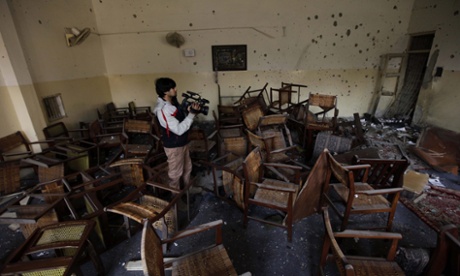
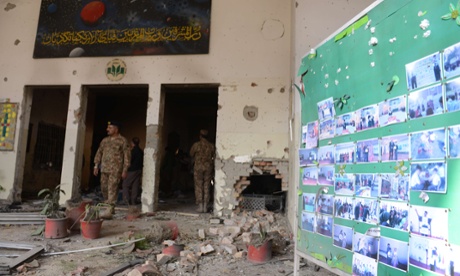
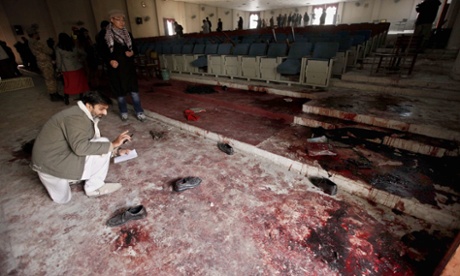
Prime minister Nawas Sharif has vowed to push ahead with an army offensive against the Taliban in Pakitan or Tehrik-e-Taliban. The group claimed responsibility for the attack on Tuesday, claiming it was revenge for an offensive launched against it in the summer named Zarb-e-Azb.
Speaking at an all party meeting in Peshawar today Sharif said Zarb-e-Azb “is successfully moving forward and Pakistan was making efforts for peace in the region”, according to the Pakistan Radio.
It added:
The prime minister stressed that the nation is waging jihad against terrorism and this mission will not be left unaccomplished.
He recalled that the government started dialogue with militants after evolving consensus of all political parties. But the government was left with no other option but to launch military operation against terrorists due to their intransigence.
Overnight, the body of the school principal, Tahira Qazi, was found among the debris, AP reports.
Qazi was inside her office when the militants made their way into the administration building 20 meters from the auditorium. She had ran and locked herself into the bathroom but the attackers threw a grenade inside, through a vent, and killed her, according to army spokesman Major General Asim Bajwa.
There have been widespread tributes to Qazi.
my 2 heroes ! martyred miss tahira qazi (my teacher/principal) n my nephew abdullah ,brave survivor #PeshawarAttack pic.twitter.com/OqJiG65vJo
— rahim khan (@rahimkhan) December 16, 2014
Mrs.Tahira Qazi, Principal Army Public School with her son & our uni friend Ahmad Qazi on his graduation. RIP Mam :'( pic.twitter.com/Tb0JlZNk81
— Khushal (@Khushal) December 17, 2014
Tribute to this Brave Lady Principal APS Tahira Qazi who was Burnt Alive by TTP Rascals. Pray for Her #PeshawarAttack pic.twitter.com/ih4xSBGh46
— Azhar Ansari (@azharansari) December 17, 2014
Images of some of the victims of the attack have been published, notes Omar Quraishi, an editor at the Express Tribune.
Our future murdered -- some of the Peshawar school victims pic.twitter.com/bpFCT8KuEJ
— omar r quraishi (@omar_quraishi) December 17, 2014
The Pakistan Taliban has identified the militants who carried out the attack on the school, according to reporter Harald Doornbos.
#break In statement, Pakistani taliban (TTP) claims these 6 men are behind #PeshawarAttack,7th man is commander: pic.twitter.com/PQrk2xXEks
— Harald Doornbos (@HaraldDoornbos) December 17, 2014
AFP has a grim graphic on the deadliest militant attacks in Pakistan since 2007.
Tuesday’s school massacre, which killed 132 children and nine members of staff, was the worst.
#INFOGRAPHIC Deadliest militant attacks in Pakistan since 2007 @AFP pic.twitter.com/k1USw9hFCb
— Agence France-Presse (@AFP) December 17, 2014
Pakistani military chiefs head for Kabul
Pakistan’s army commander General Raheel Sharif is heading to Kabul.
The trip is designed as public show of putting pressure on Afghanistan to do something about the TTP leadership hiding in Kunar and Nuristan provinces in the east of the country, according to the Guardian’s Jon Boone.
Sharif will be accompanied by other top brass in the Pakistani military, according to the Express Tribune.
The delegation is due to hold talks with Afghan president Ashraf Ghani, according to a military spokesman Asim Bajwal.
#COAS in Psr:Left for Kabul on special visit.Accompanied by DG ISI. COAS will meet Afgn President, ISAF Comd, will return to Psr
— AsimBajwaISPR (@AsimBajwaISPR) December 17, 2014
Before Tuesday’s attack the level of disapproval for the Taliban in Pakistan [TTP] was falling among Pakistanis, while a some even expressed support, writes Shashank Joshi an analyst at the Royal United Services Institute.
In an article for the Interpreter he highlights Pew research conducted in August.
At the time of the survey, 8% of surveyed Pakistanis held a favourable view of the TTP. This is a small proportion, and belies the notion of widespread popularity. Nonetheless, on a crude extrapolation, it would amount to a staggering 14 million Pakistanis. Although a much larger slice of the population holds negative views of the Taliban (59%), this disapproval rate has fallen steadily from a high of 70% in 2009, a year when the Pakistani army was engaged in intense fighting with the militants in the Swat Valley. Depressingly, it is the lowest level of disapproval in six years.
For all the horror of Tuesday’s events it is still unclear whether disapproval will now start to increase, Joshi says:
The question is whether the imagery and testimony from Tuesday – a teacher burnt alive in front of students, reported beheadings, and the Taliban’s promise that this is ‘just the trailer’ – will serve as a catalysing moment, reversing the trend in attitudes of the past few years, or whether it will go down in history as just one more vicious attack marking a downward spiral of violence.
Ziauddin Yousafzai, the father of Malala the Nobel peace prize winning school girl who was shot by the Taliban in 2012, has spoken on his family’s “trauma” over the school attack.
“My wife went unconscious,” he told BBC Radio 4’s Today programme.
AFP has more on the decision to lift the moratorium on the death penalty for terrorism.
“The prime minister has approved abolishment of moratorium on the execution of death penalty in terrorism-related cases,” an official from Sharif’s office said.
Hanging remains on the Pakistani statute book and judges continue to pass the death sentence, but a de facto moratorium on civilian executions has been in place since 2008.
Only one person has been executed since then, a soldier convicted by a court martial and hanged in November 2012.
Rights campaign group Amnesty International estimates that Pakistan has more than 8,000 prisoners on death row, most of whom have exhausted the appeals process.
The prime minister has been chairing an all party on the response to terrorism in Governor House in Peshawar, Radio Pakistan reports.
Sharif said the nation will fight the war against terrorism keeping in mind the faces of the innocent children who were subjected to the worst violence by terrorists in a school in Peshawar yesterday.
Suspected Taliban attack in Helmand
Suspected Taliban militants detonated a suicide bomb then stormed a bank branch in the southern Afghan province of Helmand, Reuters reports.
The militants engaged in a firefight with security forces while an unknown number of civilians were inside, police said.
A Reuters witness at the scene heard the blast and the gunfire. Employees who escaped said that when the attack happened, the bank was busy with government workers who had come to collect their salaries.
“According to our information, there were four Taliban, one of them detonated his explosives and three are fighting with security forces,” said Farid Ahmad Obaid, spokesman for Helmand’s police chief.
Earlier the Afghan Taliban condemned the school attack in Peshawar, exposing divisions in the movement.
Charlie Winter, a researcher on jihadism at London’s Quilliam Foundation has this translation of the Afghan Taliban’s condemnation of the Peshawar attack.
Statement from #Taliban in #Afghanistan condemns #Peshawar school attack at hands of Taliban in #Pakistan. #TTP pic.twitter.com/IR3b1Fj4NM
— Charlie Winter (@charliewinter) December 17, 2014
The BBC’s Mishal Husain has tweeted some of the images from inside the school that she was describing earlier.
Inside the auditorium where 100 children died pic.twitter.com/JOErM8uRaU
— Mishal Husain (@MishalHusainBBC) December 17, 2014
The principal's office where a suicide bomber blew himself up pic.twitter.com/jAYqKWOyjh
— Mishal Husain (@MishalHusainBBC) December 17, 2014
And here’s the man outside the school, whose children escaped because they were playing cricket in the grounds:
Hamid Khan, parent at the school. His children escaped as they were playing cricket in the grounds pic.twitter.com/f0TTOOhign
— Mishal Husain (@MishalHusainBBC) December 17, 2014
PM lifts death penalty ban
Prime Minister Nawaz Sharif has reintroduced the death penalty for terrorism related cases, in the wake of the school attack, according to Pakistani daily The Express Tribune.
It reported that he had lifted a moratorium on capital punishment for such cases.
PM Nawaz abolishes moratorium on death penalty as nation mourns Peshawar victims http://t.co/XWjYblLLxY pic.twitter.com/nehLtm5sFe
— The Express Tribune (@etribune) December 17, 2014
BBC Radio 4’s Mishal Husain has become one of the first journalists to enter the school since the shooting. She describes bloodstains running down white stone steps leading to the building’s auditorium.
On the way to the school she said she saw a small protest calling for a revenge against the Taliban.
A man at the school gates, whose children escaped, asked Husain “where in the Qur’an does it say you can target children like this?”
Updated
Guardian correspondent Jon Boone is on the quiet streets of Peshawar this morning.
The streets are unusually empty on what is, on most days of the week, an overcrowded, choked city. A mourning period has been called here, and there are only a few people outside.
But there are lots of funerals going on in this city today. We have just visited one, the joint funeral of two boys who lived together in the same part of town.
We are now at the main military hospital in Peshawar, and there are hundreds of family members waiting here outside, for opening hours to start so they can go inside to see their injured children.
Some of those in the hospital have relatively minor injuries, while others are in the critical care ward suffering gunshot wounds to their abdomens, or serious head injuries. We understand there are plans to move these critical cases to the country’s main military hospital in Rawalpindi.
Boone says there are representatives of Falah-e-Insaniyat Foundation (FIF), the charitable wing of Jamaat-ud-Dawa, out on the streets of Peshawar and at the city’s funerals, offering assistance and comfort to mourners.
Jamaat-ud-Dawa is the public face of Lashkar-e-Taiba, a proscribed terrorist group.
Updated
The Taliban's young victims are being laid to rest
There will be lots of funerals like these in Peshawar today
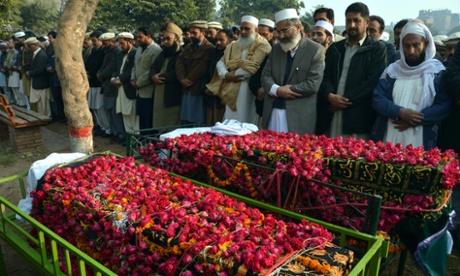
#PeshawarAttack | #Pakistan in mourning as #Peshawar buries its children http://t.co/uGCVThGWy1 pic.twitter.com/L0cLgF5qVo
— Abhishek Chauhan (@imabhishek268) December 17, 2014
Updated
Khan cancels shutdown...
Imran Khan, Pakistan’s cricket captain-cum-iconoclastic political leader, has cancelled his planned nationwide shutdown for Thursday.
Khan believes the 2013 election – which was a strong result for his previously-underperforming PTI party, but still delivered the PML(N)’s Nawaz Sharif a commanding majority – was rigged, and is demanding an independent audit of the poll.
Khan’s party is in government in Khyber Pakhtunkhwa, the province of which Peshawar is the capital.
His supporters had planned mass rallies and shutdowns that would “paralyse” Faisalbad, Karachi, Lahore and then the entire country, beginning Thursday.
Khan, whose electoral symbol is a cricket bat, has immense personal popularity in Pakistan, for his cricketing deeds and his anti-corruption politics.
He was visibly upset when he condemned the attack on the school.
There is no justification for this.
We are with the families of the victims. All of Pakistan is with them.
Updated
Editorials from newspapers around the world expressed despair and anger at the massacre of the children. Here is part of the New York Times leader which highlights the Pakistan army’s complicated relationship with the Taliban:
Wedded to an outmoded vision of India as the mortal enemy, the army has long played a double-game, taking American aid while supporting and exploiting various Taliban groups as a hedge against India and Afghanistan, and ignoring the peril that the militants have come to pose to Pakistan itself. The extent of cooperation among those groups in the tribal areas has made that game even riskier; the Pakistani military has long provided support for the Afghan-focused Taliban, even while trying to fight the Pakistani Taliban in recent years. Intelligence experts say the army is still collaborating with the Afghan Taliban in fighting the government in Kabul.
To defeat the extremists, Pakistan will need more than a military strategy. It will need responsible governance and an acknowledgment by top leaders that they cannot contain attacks from one terrorist group while enabling another one.
Updated
Lots of funerals are being held across Peshawar today. They began on Wednesday morning:
Body of 14 yr old Abdullah carried to local grave yard. People shouting 'shaheed'-martyr and reciting Quran #peshawar pic.twitter.com/6H04yDAnBv
— shaimaa khalil (@Shaimaakhalil) December 17, 2014

Updated
Unconfirmed at this point, but this appears to be America’s initial response:
Reuters: a drone strike in Afghanistan has killed 11 militants including four Pakistani Taliban
— Sky News Newsdesk (@SkyNewsBreak) December 17, 2014
Updated
Sherry Rehman’s sentiment is shared by many in Pakistan.
The Pakistani government – in particular the military and its intelligence wing, the notorious ISI – has for decades been accused of covertly supporting the Taliban and its destabilising attacks over the border in Afghanistan.
There is little appetite for conciliation or negotiation in Pakistan this morning.
Dear Pak Army, tear them apart. #PeshawarAttack #PrayForPakistan
— Ángel Di Maíra (@rahziAriaM) December 17, 2014
Killings of innocent children is not justified in any religion or culture. Its an act by depraved desperate and Godless men #PeshawarAttack
— Shekhar Kapur (@shekharkapur) December 17, 2014
Husain Haqqani, another former Pakistan ambassador to the US, says Pakistan’s policies of tacitly allowing terrorists to operate from its soil has been “disastrous”.
“The savage attack in Peshawar demonstrates the futility of attacking one group of jihadis while leaving others in place,” he writes.
Updated
Reuters has just filed its latest dispatch from Peshawar:
A day after the attack, Peshawar appeared subdued and many were still in shock, recalling the gruesome events and trying to soothe each other. More details of the well-organised attack emerged as witnesses came forward with their stories.
“The attackers came around 10:30am on a pick-up van,” said Issam Uddin, a 25-year-old school bus driver. “They drove it around the back of the school and set it on fire to block the way. Then they went to gate 1 and killed a soldier, a gatekeeper and a gardener. Firing began and the first suicide attack took place.”
Meanwhile politicians are beginning to ask what now needs to be done to stop the violence.
“People will have to stop equivocating and come together in the face of national tragedy,” said Sherry Rehman, a former ambassador to the United States and an opposition politician.
“There have been national leaders who been apologetic about the Taliban, who have not named the Taliban in their speeches.”

Updated
The school attack by Pakistani extremists has been condemned as un-Islamic by the Afghan Taliban
Tehrik-i-Taliban Pakistan (the Pakistani Taliban) should not be thought of as a single, homogenous organisation.
Within the terror network, there are splinter factions and schisms that have been highlighted by the deaths of leaders (usually by US drone attack) and disagreements over tactics in negotiation with the Pakistani government. The Tehrik-i-Taliban Pakistan lacks the strong central command structure of its Afghan equivalent.
Tuesday’s attack, in particular, has highlighted the division between Tehrik-i-Taliban Pakistan and the Afghan Taliban.
“The intentional killing of innocent people, children and women is against the basics of Islam and this criteria has to be considered by every Islamic party and government,” Afghan Taliban spokesman Zabihullah Mujahid said in a statement.
Updated
Pakistan wakes up to...

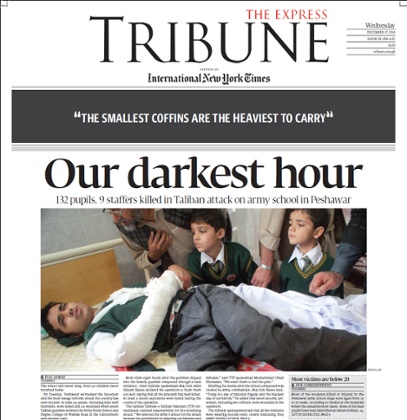
And in the Wednesday English-language papers in Pakistan, the headlines are a mixture of outrage and despair:
Front pages of the Wednesday editions of four Pakistani English-language dailies: pic.twitter.com/6cCqz15yeE
— Arif Rafiq (@ArifCRafiq) December 17, 2014
The reaction around the world is one of horror:
Updated
The city of Peshawar
A brief background on the city where yesterday’s horrific school attack took place:
Peshawar, in Khyber Pakhtunkhwa province, is about 180km west of Pakistan’s capital Islamabad, and less than 60km from the Afghan border. Historically, the frontier city has been a key transport route, the terminus of the Grand Trunk Road of India and a major depot for trade with Afghanistan.
While it is only a little more than a two-hour drive from Islamabad, Peshawar is a very different city to the middle-class capital. On the edge of Pakistan’s “tribal belt”, Peshawar is poorer, jobs are hard to find and sectarian violence has steadily increased over recent years. Many Afghan refugees, displaced by decades of violence in their homeland, live in slums and camps in and around the city. This year, the World Health Organisation declared Peshawar the world’s “largest reservoir” of endemic polio.
Updated
The day after...
It is morning now in Pakistan, and soldiers are back on the grounds of the Army Public School in Peshawar, where 141 people, including 132 children, were murdered by the Pakistani Taliban. Pakistan has entered three days of mourning.

Updated
While across the border in India...
Schoolchildren hold vigils for the students who were murdered in Peshawar:


Updated
In Islamabad...
A candlelight vigil for the victims:

Updated

Updated
Families in Pakistan are preparing to bury their children, killed on Tuesday by Taliban gunmen

Updated
In Syria & Gaza, and now #Peshawar - it is the mothers' faces that bear the most pain of slaughtered children. pic.twitter.com/GGxezqcNUg
— Hend (@LibyaLiberty) December 17, 2014
Taliban says attack was retaliation for Pakistan’s military operation against its strongholds
The Pakistani Taliban says its attack on the Army Public School in Peshawar was retaliation for the military’s ongoing operation against its strongholds in the borderlands of North Waziristan. It wanted to kill the children of soldiers.
“We selected the army’s school for the attack because the government is targeting our families and females,” Taliban spokesman Muhammad Umar Khorasani said. “We want them to feel the pain.”
In June, the Pakistani army launched “Zarb-e-Azb”, a “comprehensive operation against foreign and local terrorists who are hiding in sanctuaries in North Waziristan”.
The “foreign” reference is to Afghan fighters. The lawless, mountainous regions of the Afghanistan-Pakistan border are used as planning and staging areas for Taliban attacks across the two countries. After years of promising to drive militants from their hideaways, the Pakistani government has committed up to 30,000 troops to the operation. Pakistan believes it needs to secure the region before the end of Nato combat operations this year in Afghanistan.
Updated
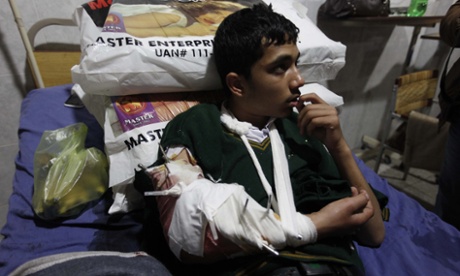
Updated
800 attacks on schools in three years
In Pakistan this morning, people are asking why was this attack allowed to happen.
Rafia Zakaria from Dawn filed this excellent report on Pakistan’s schools of sorrow.
Zakaria writes:
Outrage is an easy emotion in Pakistan and after a decade of terrorist attacks almost a habit; when the tears dry up as tears do, little changes.
Were we not locked into this cycle of act, outrage and forgetfulness, the imminence of an attack such as this one would have long been acknowledged, its probability seen as high, its likelihood necessitating preparation and security.
There were numbers that told of the possibility; a report issued by the Global Coalition for the Protection of Education earlier this year noted that in the years between 2009 and 2012 there were 800 attacks on schools in Pakistan.
Not one or two, but 800 warnings of the carnage to come, boxed away, set aside, pushed away to the back pages of newspapers, the recesses of consciousness.
Witness accounts are emerging from students who survived:
Shahrukh Khan, 16, was shot in both legs. He survived by playing dead as the gunmen roamed the school, shouting “Allahu Akbar” before opening fire. Khan said he felt a searing pain as he was shot in both legs, just below the knees.
I saw a pair of big black boots coming towards me, this guy was probably hunting for students hiding beneath the benches.
My body was shivering. I saw death so close and I will never forget the black boots approaching me – I felt as though it was death that was approaching me.
I folded my tie and pushed it into my mouth so that I wouldn’t scream. The man with big boots kept on looking for students and pumping bullets into their bodies. I lay as still as I could and closed my eyes, waiting to get shot again.
When I crawled to the next room, it was horrible. I saw the dead body of our office assistant on fire.
She was sitting on the chair with blood dripping from her body as she burned.
Khalid Khan, 13, was in a first-aid lesson in the main hall when two clean-shaven armed men wearing white clothes and black jackets entered the room.
They opened fire at the students and then went out.
The army doctor and soldiers managed to escape and we locked the doors from inside.
But very soon they came, broke the doors and entered and again started firing.
They killed most of my class mates and then I didn’t know what happened as I was brought to the hospital.
Jalal Ahmed, 15, studied biochemistry.
I was attending a lecture in our main hall. There are five doors in the hall. After some time we heard someone kicking the back doors.
There were gun shots but our teacher told us to be quiet and calmed us down. Then the men came with big guns.
Standing next to Ahmed’s hospital bed, his father, Mushtaq Ahmed, said: “He keeps screaming: ‘take me home, take me home, they will come back and kill me’.”
One nine-year-old boy, who asked not to be named because he was too afraid to be identified, said teachers shepherded his class out through a back door as soon as the shooting began.
The teacher asked us to recite from the Koran quietly.
When we came out from the back door there was a crowd of parents who were crying. When I saw my father he was also crying.
Reportage from AFP, Reuters, Al Jazeera and AP.
Updated
Political leaders from across the world have condemned the attack, and promised solidarity with Pakistan
US president Barack Obama described the gunmen’s assault as “heinous”.
“Our hearts and prayers go out to the victims, their families and loved ones. By targeting students and teachers in this heinous attack, terrorists have once again shown their depravity.”
Afghanistan’s president Ashraf Ghani said the attack was un-Islamic.
“The killing of innocent children is contrary to Islam.”
Indian prime minister Narendra Modi said in a series of tweeted statements: “It is a senseless act of unspeakable brutality that has claimed lives of the most innocent of human beings – young children in their school.”
British prime minister David Cameron told reporters the attack was “a dark, dark day for humanity ... There is not a belief system in the world that can justify such an act. I think what this shows is the worldwide threat that is posed by this poisonous ideology of extremist Islamist terrorism. It is nothing to do with one of the world’s great religions – Islam, which is a religion of peace. This is a perversion.”
German chancellor Angela Merkel said: “The news of the terrorist attack on a school in Peshawar has shaken me deeply. The hostage-taking and murder of children and youth is barbarity that cannot be surpassed”.
Australian prime minister Tony Abbott said he could not find words to describe his sorrow. “It is simply impossible to put into words the mixture of grief and fury that must be felt by people in Pakistan and indeed around the world at this latest terrorist atrocity.”
Updated
Education campaigner and Nobel peace prize winner Malala Yousafzai, who was shot by the Taliban in 2012, has condemned the “atrocious and cowardly” attack on the school.
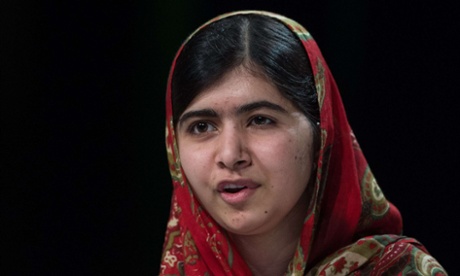
I am heartbroken by this senseless and cold-blooded act of terror in Peshawar that is unfolding before us.
Innocent children in their school have no place in horror such as this. I condemn these atrocious and cowardly acts and stand united with the government and armed forces of Pakistan whose efforts so far to address this horrific event are commendable.
I, along with millions of others around the world, mourn these children, my brothers and sisters – but we will never be defeated.
Updated
A summary of yesterday's events:
- The Pakistani Taliban killed 141 people, including 132 children, in an attack on an army-run school in Peshawar, a city in the country’s north-west. The attack was one of the deadliest in Pakistan’s history.
- Pakistani special forces mounted a rescue operation and battled the militants in the school, ending the siege and clearing the building of explosives. The army said there were seven terrorists, all wearing suicide jackets, and that the militants sought no demands but only to kill students.
- Prime minister Nawaz Sharif travelled to Peshawar and the army launched at least 10 air strikes on the Taliban. Sharif called the attack a national tragedy and promised to eradicate the terrorists. “These are my children and it is my loss,” he said. He announced three days of national mourning.
- Tehrik-i-Taliban Pakistan said it attacked the army-run school in retaliation for a government offensive in the north: “This is a reaction to the killing of our children and dumping of bodies of our mujahideen,” a spokesman said.
- Hospitals have been overwhelmed by the injured and dead, and survivors have recounted horrific episodes of the assault.
Updated
Jon Boone’s extraordinary reportage of the Peshawar attack is here. He writes: “Seven men wearing bomb vests climbed over an undefended wall and began a pitiless killing spree.”
Updated
The Guardian’s front page. Jon Boone in Peshawar: “We didn’t move because whoever moved got shot at.”
Very powerful Guardian front page on Wednesday in wake of #PeshawarAttack, via @suttonnick. pic.twitter.com/SqpgZbqcux
— Andrew Katz (@katz) December 16, 2014
Many of the photos being circulated are very graphic. The Guardian has chosen not to publish those.
Such a powerful and heartbreaking photo of grieving relatives of #PeshawarAttack victim by @bzohra @reuterspictures pic.twitter.com/xYturo3Epz
— Vaughn Wallace (@vaughnwallace) December 16, 2014
Harrowing pictures are emerging on social media from Peshawar yesterday
No, not checking if they got A's. Parents checking if their child is dead or not on these lists. #PeshawarAttack pic.twitter.com/wl4VkF84qA
— SkinnyCanWrite (@TwoTwoAlys) December 16, 2014
Updated
Brutal Taliban attack on Pakistani school
Pakistan, a country more damaged by terrorism than almost any other on Earth, is waking up this morning, still in disbelief at a brutal attack on its children as they sat in classrooms.
The latest information says that at least 141 people – 132 schoolchildren and nine staff members - were killed in the militant attack on an army-run school in Peshawar. Most of the victims were teenagers.
Just after 12pm Tuesday Pakistan time, up to seven unidentified men opened fire on students and teachers at the Army Public School in Warsak Road, Peshawar, in north-west Pakistan.
It is the worst terrorist attack in Pakistan in seven years, and has left a country in mourning, and a world in shock.
The Pakistani military has vowed to continue its offensive against the Taliban strongholds in the north-west of the country.
The Express Tribune reported: “It is our 9/11. It’s an attack on Pakistan’s future, its young sons and daughters.”
“The smallest of coffins are the heaviest to carry,” the father of one Pakistan’s young victims said.
Guardian correspondent Jon Boone is in Peshawar. He filed this report.
Updated