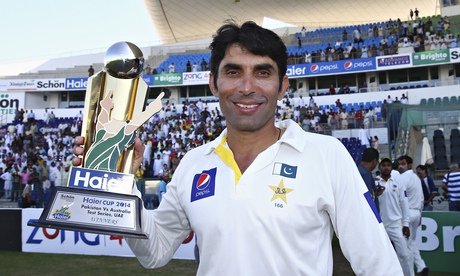
It has become so commonplace to discuss Test cricket as a kind of quasi political entity – either endangered (unjustly) or dying (deservedly) – that it is easy to miss the more everyday glorious details. End times or not, Pakistan’s stunning two-Test series thrashing of Australia in the Emirates, sealed with Monday’s 356-run victory in Abu Dhabi deserves to stand on its own as a wonderful sporting achievement.
With the next Ashes series only seven months away no doubt England will take note of the weaknesses exposed on the slow turning pitches of the Emirates. But really it is Pakistan’s success in defeating the No2 ranked Test team so decisively that should be celebrated. Beforehand the series had been billed by some as the moment the ICC’s crackdown on bowling actions that stray beyond the legal limit would begin to bite. “We are going to see a lot more conventional off-spiners doing the job in international cricket,” Glenn Maxwell said before the first Test. Pakistan, who have spent the last 20 years losing to Australia, had already lost their best bowler Saeed Ajmal to the biomechanics labs.
And yet here, with a spin-bowling attack bolstered by a pair of domestic veterans in Zulfiqar Babar and Yasir Shah, they proceeded to annihilate them on neutral ground, taking five Australian wickets for eight runs in 46 balls on the final morning to win by 356 runs, Pakistan’s largest Test victory runs margin.
The week before, the first Test had been won by 221 runs. And before that Australia had lost a three-day practice game against Pakistan A by 153 runs. This was nothing short of a disaster, a Test series during which Australia’s selection and performance looked off-kilter and in which those “orthodox off-spinners” Maxwell had talked up (Nathan Lyon and Maxwell himself) did the job with combined figures of three for 500. By the end, the differential between the two teams’ mean batting averages (80.15 plays 25.65) represented the biggest statistical shellacking in Australia’s Test history.
This is, on the face of it, a good thing: confirmation that familiarity, micro-coaching (Australia hired Muttiah Muralitharan to fine-tune their batting for this abject collapse) and indeed Pakistan’s own logistical disadvantages have not diluted the basic test of playing in new conditions against unfamiliar opponents.
Mainly, though, it is a wonderful achievement by this group of Pakistan players under the indestructible, brilliantly likable 40-year-old captain Misbah-ul-Haq. On pitches that are slower and drier than those at home, Pakistan took down the team that took down England and then South Africa with a spin attack culled from that reliably productive domestic set-up. And with some glorious batting performances, most notably by Younus Khan, the invisible colossus, who scored three hundreds in four innings and whose career, untelevised and beyond the immediate attention of the major nations, has thrived beneath the radar in recent years. He has slightly more runs at a better average from the same number of Tests as Garfield Sobers.
As for Misbah himself, the Mianwali master blaster (overall Test strike rate 42.97) stands shoulder to shoulder with Viv Richards – King Viv and King Mis – as Test cricket’s fastest centurion, a fact that is both joyfully unexpected and in its own way a little sad. In some alternative Misbah world, where Pakistan cricket is stable, thriving and rancour-free, perhaps this kind of thing, or something like it, might have happened a little more often.
What does it mean for the Ashes? Maybe lots. Maybe nothing at all. There are clearly some problems with Australia’s team that the excellence of the seam attack has camouflaged. Mitchell Johnson’s wicket taking was understandably diminished on slow pitches. More importantly, he found little support. Lyon took one for 202 off 55 overs in the final Test – disastrous figures, Jason Krejza figures – and Peter Siddle was tidy but docile. More than ever Ryan Harris, if he is fit, seems likely to be Australia’s key bowler in England next summer.
As for the batting, Michael Clarke was troubled by his fitness and beyond this there is undoubtedly a need for a new No3. It has been suggested by at least one person present that Maxwell’s efforts in the second Test have a fair case as the least convincing take on the Don Bradman position in Australia’s cricketing history.
Not that England will take too much encouragement from any of this. For a start, Test cricket is simply a very fluid business these days and Australia in particular are a team that has played in streaks. Before being tonked by Pakistan, they beat South Africa. Before thrashing England, they fell to pieces in India. Test cricket itself is a flighty business, results clearly dependent on form and momentum and where you are in your bespoke inter-format cycle.
It is a reversible process too. Outgunned in Abu Dhabi and Dubai, there is still every chance Chris Rogers, David Warner, Clarke, Steve Smith and perhaps even Mitchell Marsh – a multi-format man, a crick-athlete, one of those intriguingly straightforward modern players, all talent no backstory – could suddenly click as a batting order.
Plus there is little to suggest England will be able to recreate the same kind of pressure. England’s current No1 spinner is Moeen Ali, who good judges suggest can thrive as a serious Test bowler. But he is hardly likely to replicate in England the debilitating effects of a battery of desert twirlers.
Indeed there are probably only two things worth taking from this. First there is a genuine sadness in the continued spectacle of one of the most thrillingly talented of cricket’s small conglomerate of nations playing out its matches in front of a smattering of ex-pat taxi drivers. And secondly Test cricket’s current cartwheel phase – one minute you’re up, next you’re on your knees – is undoubtedly another symptom of format-crush, of jiggled wires, of a lack of settled timetabling. Some have already suggested these strange recent events, a whitewash here, an abject crumbling over there, really are the twitches and lurches, the hospital trolley defibrillations of a dying form. But this is to detract unfairly from Pakistan’s achievement, a triumph of high craft, joyfully received by cricket’s enduring power in exile.