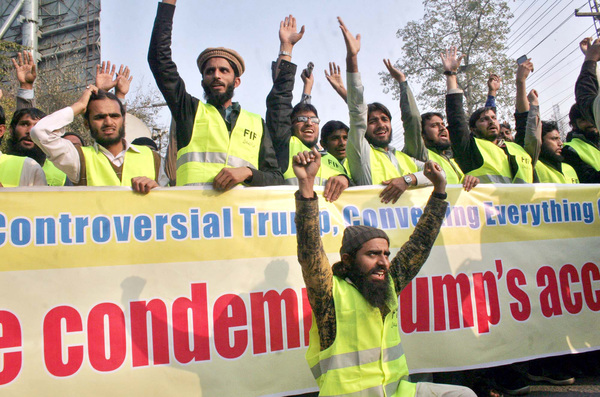
ISLAMABAD _ A day after President Donald Trump suspended security assistance to Pakistan following a series of threats, the Islamabad government called the decision "counterproductive" but said it would continue to fight terrorism and seek cooperation with the United States.
"We are determined to continue to do all it takes to secure the lives of our citizens and broader stability in the region," read a statement from Pakistan's foreign office.
Pakistan touted its role in fighting al-Qaida and routing militants from its tribal regions along the Afghanistan border, saying its security operations "served U.S. national security interests as well as the larger interests of (the) international community."
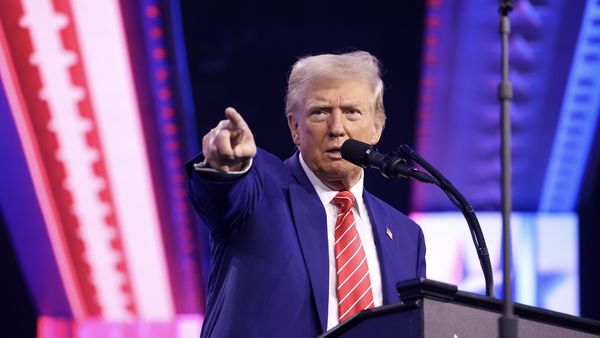
Trump announced Thursday that the U.S. would freeze at least $255 million in military aid after criticizing Pakistan, a long troublesome ally, for failing to take aggressive action against militants that attack U.S. and allied forces in Afghanistan.
In tweets this week, Trump railed against Pakistan's "lies & deceit" and said billions in U.S. aid over the past 15 years had been "for nothing." The State Department said the aid freeze would last until Pakistan "takes decisive action" against militant groups including the Afghan Taliban and the Haqqani network.
Pakistan's security establishment has long nurtured or maintained links to extremist groups, including the Taliban and the Haqqanis, that serve its strategic interests. Since 2002, the U.S. has often looked past those ties as it supplied Pakistan with $33 billion to help fight terrorism and as an incentive to keep open the air and land transit corridors that supply U.S.-led NATO forces in Afghanistan.
From a peak of $3.5 billion in 2007, the Obama administration cut the annual aid to about $1 billion as it grew frustrated with Pakistan's inability to rein in the Taliban and reduced the U.S. troop presence in Afghanistan.
But Trump is ratcheting up pressure on Pakistan even as he dives deeper into Afghanistan, raising the number of U.S. troops from 11,000 to 15,000 and increasing airstrikes and combat operations.
If Pakistan were to close supply lines _ as it did for several months in 2011 and 2012 after an incident in which NATO forces accidentally killed two dozen of its soldiers _ it could hurt the U.S. war effort. Sending supplies overland into Afghanistan through Central Asia costs several times as much, and would likely face serious opposition from regional hegemon Russia.
"If Trump wants to increase troop levels, I'm not sure he can engage in this back-and-forth with Pakistan," said Shamila N. Chaudhary, who served as Pakistan director on the National Security Council under Obama. "They're going to need those routes."
At the same time, Pakistan was likely viewing the aid freeze as a negotiating tactic and not the end of the relationship that both sides see as crucial to their security.
"They will all bounce back from this," Chaudhary said. "No one can afford not to talk at all. Pakistan has nuclear weapons. You can't cut them out of the discussion on how to end the conflict in the region, when they are a party to the conflict."
Trump's announcement was the latest twist in a relationship that has ricocheted from warmth to disgust in the 14 months since he was elected president.
In November 2016, Trump showered praise on Pakistan in a phone call with then-Prime Minister Nawaz Sharif, saying he was "doing amazing work, which is visible in every way." Then, last August, he demanded it "change immediately" its policy of harboring militant groups and invited Pakistan's archenemy, India, to play a greater role in securing Afghanistan.
In October, after Pakistani forces helped rescue an American woman and her family from captivity by the Haqqani network, Trump said Pakistan was "starting to respect the United States again."
Pakistan has long defended its counterterrorism record, saying it has spent $120 billion of its own resources and suffered because Afghan forces have failed to defeat militants on their side of the border. Tens of thousands of Pakistanis have been killed in terrorist attacks since 2001.
Ayesha Siddiqa, a Pakistani security analyst, said NATO's continued use of Pakistani land and air supply lines would be the subject of future negotiations, and that officials were not panicking about the aid freeze.
"I don't think Trump's threat will matter," Siddiqa said. "The money they knew would dry up someday."
Analysts say Pakistan has also been sanguine about its declining relationship with the U.S. because of cozier ties with China, which is developing a giant portfolio of infrastructure projects worth more than $46 billion.
Hamayoun Khan, a professor of strategic studies at National Defense University in Islamabad, said the U.S. was trying to blame Pakistan for its inability to secure peace in Afghanistan.
"They are trying to portray the Haqqanis as larger than life in Afghanistan while no guess puts the network's ground strength at more than 5,000 foot soldiers," Khan said. "I do not think anybody will buy the American argument that a guerrilla force of 5,000 soldiers is responsible for all its failures in Afghanistan."