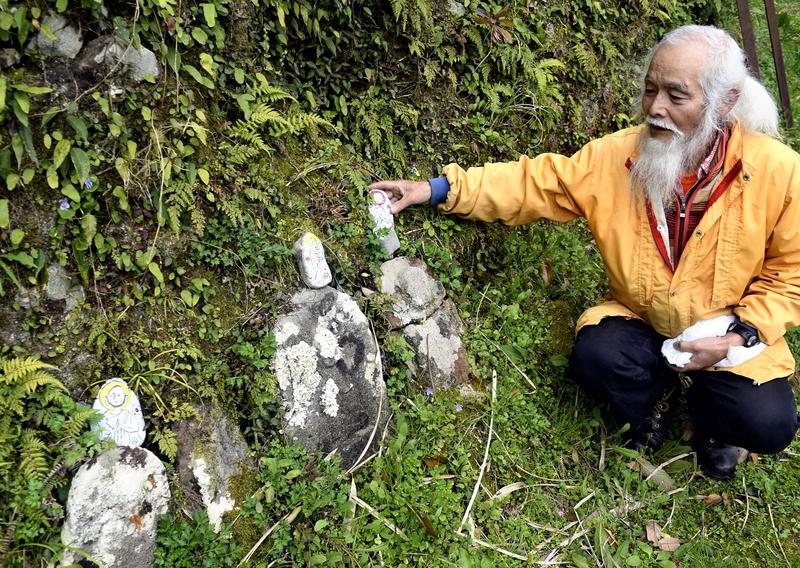
SHIMANTO, Kochi -- A local painter who does Western-style paintings has been drawing kannon bodhisattva, a Buddhist being known for compassion and mercy, on pebbles and stones, transforming them into offerings to stone Buddha statues and stone pagodas that sit along temple approaches in mountain areas in Kochi Prefecture. Hoping to express his gratitude to the paths, where he used to play as a child, Kosen Kunimi, 69, made about 150 stone kannon and placed them on the approaches after he was shocked to see how deserted the areas have become.
After graduating from Nakamura Senior High School in the prefecture, Kunimi opened a painting school and worked as a painter in Yokohama. However, about two years ago, he returned to Shimanto, hoping to draw the Shimanto River in his hometown.
After Kunimi returned to his hometown, he visited Kosanji temple in Shimanto and was surprised by how much it had changed since his childhood. The summit of a nearby mountain had been turned into a large park, and people now can reach the summit by car. However, a narrow approach to the mountain that climbers once used appeared to have become deserted as people no longer used it.
There was only an old signboard on the approach, and it was difficult walk there because it had been dug up by wild boars looking for food and pelted by heavy rain. Half-buried stone Buddha statues, pagodas and waymarks were among those left on the deserted path.
Feeling saddened by the path's devastation, Kunimi came up with the idea of offering a stone kannon to each stone Buddhist statue as a kind of representation of his thoughts.
"I can express my gratitude for being allowed to play there in my childhood," he thought. "I can work hard and revitalize this approach."
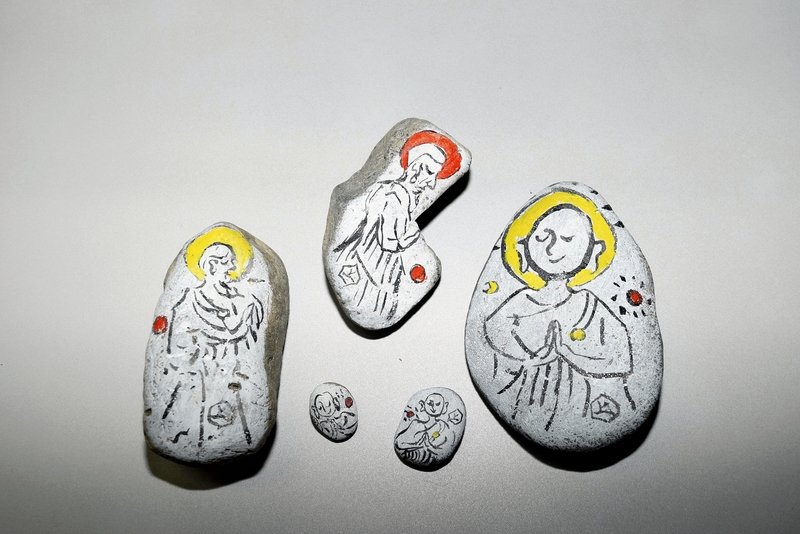
To make stone kannon, Kunimi picks up stones and pebbles from the riverside of the Shimanto River that flows in front of his home. The stones vary in size, from about a 500 yen-coin size to as large as the palm of his hand. After washing them with water and drying them, he puts on white acrylic paint to one side, then a gentle smiling kannon with hands clasped in prayer on top of the paint. Kunimi also made a guidepost for Kosanji temple by carving the kanji characters for the temple into a stone.
Kunimi carried stone kannon in his backpack and visited sites, placing them next to stone Buddha statues, stone pagodas and at the bottom of large trees. He said he did so hoping they will watch over people walking on the path.
The stones could be carried away by heavy rains as they're relatively small. They could also be buried in earth and sand, or someone might take them away. Despite this, Kunimi said: "If they are taken away, that means they will be somewhere else. That's no problem. I can just place a new one there, then."
With permission from the temple, he began placing kannon stones on the approach to Izumiji temple in Kuroshio, in the prefecture, and he also plans to place them next to stone Buddha statues in the city-center.
Read more from The Japan News at https://japannews.yomiuri.co.jp/