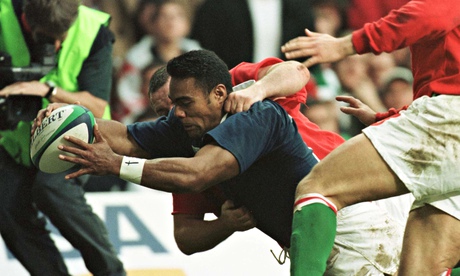
The World Cup may still be low key in terms of publicity, but a few of the overseas participants have arrived. Samoa are spending this week in Brighton, before Saturday’s encounter with the Barbarians at the Olympic Stadium, while Tonga are preparing for an encounter with Nottingham on Friday.
Next week Fiji face Canada at the Stoop, a short walk from Twickenham where they will open the World Cup against England on 18 September, or 19 September as it will be in the Pacific islands, when the match starts at 8pm. The World Cup is how the game’s governing body, World Rugby, makes its income and this year’s tournament is expected to swell its bank balance by £150m.
Much of the money is used to invest in developing nations and a significant amount of that goes into Fiji, Samoa and Tonga, three countries where rugby union is the national sport. None has the means to sustain the game on a professional basis so their leading players migrate to New Zealand, Australia, Japan and Europe, where some qualify to play for their adopted countries.
World Rugby’s help tends to be practical rather than directly financial, investing in systems, facilities and coaches to ensure that the money is spent on the game in the islands, but administration of the game on the islands has tended to be more chaotic than organised and the governing body has had to intervene over the years, notably in Fiji and Samoa.
Fiji, quarter-finalists in the 2007 World-Cup, when they were level in the quarter-final against South Africa in Marseille with 20 minutes to go, were a shambles in the 2011 tournament. World Rugby suspended funding to the Fiji union last year and later found, after an audit, that nearly £1m could not be accounted for in Samoa.
Funding was restored in Fiji five months later after an overhaul of the union’s management, while in Samoa, where politics and rugby also became intermingled to the detriment of the players, the union and the national squad this month agreed a deal that is the first of its kind for a nation outside the Six Nations and the Rugby Championship.
Last year, the Samoa players threatened to go on strike before their match against England at Twickenham in a dispute over transparency and governance. Even after the last World Cup, when Samoa had been involved in one of the matches of the tournament against South Africa at North Harbour, there was discontent.
After Samoa had been knocked out at the group stage, the then captain Mahonri Schwalger criticised the management of the squad, describing at as incompetent. He was immediately relieved of his position and dropped, but this month’s agreement, which gives players guaranteed rights regarding payment, standard of accommodation (they flew to London in business class) training facilities and general welfare.
Schwalger, who now runs a rugby academy in Samoa for youngsters who are not part of the elite system, said this summer that he had no regrets about speaking out. “The great Michael Jones [the former New Zealand flanker and Samoa coach] told me that you’ll never be in that position in the next 20 years. What you make out of it will make you who you are. I spoke out for one reason and that was the future of Samoan rugby.”
The islands bring colour to the World Cup. Without them the tournament would not only be duller but introverted, the best of the Six Nations against the Rugby Championship. All three have produced shocks in past tournaments, Tonga beating France four years ago, Fiji humbling Wales in 2007 while Western Samoa started it in 1991 defeating Wales in Cardiff on their way to the quarter-finals, and repeating the victory at the Millennium Stadium in 1999.
Fiji arrived in Britain as the Pacific Nations champions after defeating Samoa in the final, although Samoa say they were not at full strength. The Fijians are coached by a New Zealander, John McKee, who has brought order and focus. They may be in the most demanding pool, but they could well prove the awkward squad opponents England, Australia and Wales cannot take for granted, never mind that they have to overcome the considerable disadvantage of virtually all their players living abroad: how often do England point out the importance of having the national squad players being with Premiership clubs?
Samoa were seeded for the finals and are in a pool with South Africa, for the fourth consecutive tournament, Scotland, Japan and the USA. They may not have the depth to push to finish at the top of the pool, but they will target the Scots, who are their final group opponents in Newcastle on 10 October.
Tonga are locked with New Zealand, Argentina, Georgia and Namibia. They have the advantage of playing the All Blacks last and the Pumas third, giving them time to warm up against Georgia and Namibia, although their cause in 2011 was undermined by a defeat to Canada that ultimately deprived them of a place in the last eight.
The island teams are generally better prepared for a World Cup than a November tour because the squad has considerably more time together. Coaching influences from outside have, over the years, tempered their instinct to play with Sevens-style abandon and tackle lustily, but they have not lost sight of where they are from and what marks them out.
The stronger the three are, the better for the World Cup, where the forces of conservatism too often prevail. Wales have left out James Hook and England are sending Danny Cipriani back to Sale, two players of vision who might not have been starters for their sides but who would have offered something different from the bench.
Fiji, Samoa and Tonga will not be blighted by inhibition. Once they start to fully appreciate the value they bring to the World Cup and get their administrations sorted out, and once the rules on the release of players are enforced properly so that clubs who try to bribe players not to play for their country are exposed and sanctioned, so the old order, which is unhappy at England, Australia and Wales being in the same pool, will have more reasons to be fearful.
• This is an extract taken from The Breakdown, the Guardian’s weekly rugby union email. To subscribe, just visit this page, find ‘The Breakdown’ and follow the instructions.