This road trip did not start with a private jet.
The arenas have no luxury seats, no booming speakers, or scoreboards as tall as a five-bedroom home. For 27 years, Mark Boyle has perched courtside on glamor telling the story of the NBA’s Indiana Pacers on radios across the midwest. Now he has a card table behind a net. His bosses are kids in college. His broadcast partners are more than half his age. He is making nothing and yet he feels wealthy.
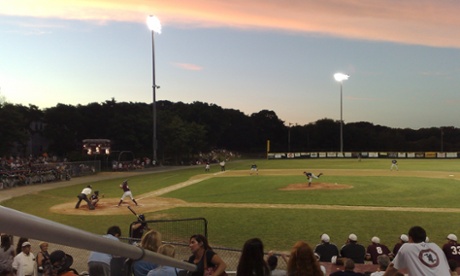
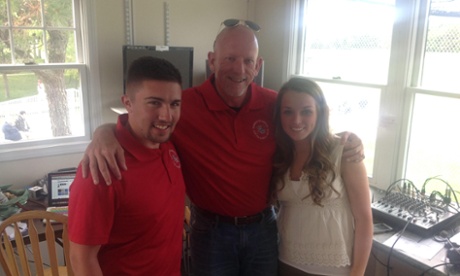
The Voice of the Indiana Pacers is this summer’s backup voice of the Yarmouth-Dennis Red Sox of the Cape Cod wooden bat college baseball league. His words will not boom throughout Indiana, trickling instead over the Cape Cod League’s Internet Network. He won’t even be Yarmouth-Dennis’s primary game-caller: that job belongs to Anthony Santaniello, who just finished his junior year at Hofstra University.
But Cape Cod is an adventure, and Boyle loves adventures. In past summers he has worked as a barista, hunted piranha in the Amazon and walked more than 500 miles across Indiana. He has almost a compulsion to not be defined by his primary job, resisting the trap of being locked into life as the Pacer Radio Guy. This is the struggle for anyone who becomes an icon in a place: they get caught in an identity that is not organic butcontrived, an image manufactured by someone else’s vision.
Mark Boyle is more than a rich, deep radio voice. Broadcasting Pacers games is a joy, but it’s not his life. Getting away satisfies the longing to be himself, to explore something that intrigues him, answering another curiosity burning in his mind.
“I’d say this was a whim, but something like this takes some planning,” Boyle told the Guardian.
It starts with a dream. Growing up in Minnesota, Boyle was drawn to the romance of baseball games crackling over his radio from faraway cities. This was before every game was on television, when images replaced words and the thrill of following baseball did not require one to know an inning-by-inning win probability. He pursued broadcasting with the hope of becoming a big league baseball play-by-play man, like the voices who spoke to him on those forgotten summer nights.
His jobs took him to other sports, and ultimately basketball grew into his calling, playing into his rare skill of delivering coherent descriptions of a game going fast. But he wanted to try baseball again, just to see what it was like. He had done it once before, back in 2005, when he spent his summer broadcasting games for the Billings Mustangs of the Class A Pioneer League. He rode the team motor coach around Montana, Idaho, Colorado and Utah, bouncing from press box to press box in a league where the closest drive was four hours away. He loved it.
“I wanted to do it again,” Boyle said. “I wanted to go somewhere I had never been.”
Finding another Billings was tough. The reason he was able to work in the Pioneer League is that its season only lasts two months. Most minor leagues run from April to September. That would not fit his NBA schedule. But the Cape Cod League, designed for college players who aspire to someday play professionally, is just seven weeks long. It’s also probably the quaintest and most famous of college summer leagues, with games confined to a curl of land jutting off the Massachusetts coast.
In November, Boyle wrote to the Cape Cod League teams asking for a broadcasting job. Steve Faucher, the president and general manager of Yarmouth-Dennism emailed back with a proposition. Boyle was free to come but he did know, of course, that all jobs in the Cape Cod league are volunteer positions? If he was fine with not being paid, the Yarmouth-Dennis Red Sox were pleased to have the play-by-play voice of the Indiana Pacers in their ballpark.
Boyle accepted but asked if the team could help him find a cheap place to live. Calls were made, a woman offered a loft in her home for $80 a week. Boyle arrived a little over a week ago and has been offering photos of his adventure on his Twitter feed.
These include a look at the yellow school buses that take the team to away games, a turkey-like bird he saw in someone’s yard and a screen shot of a text that read: “Mark, Pauline says to park in the driveway, she put weed killer in the stone drive.”
Boyle wrote: “I wonder if Vin Scully gets texts like these in the middle of his broadcasts.”
Boyle’s broadcast arrangement is unique for someone accustomed to carrying the bulk of a regular NBA broadcast.
Santaniello, the Hofstra student, does the play-by-play for six innings of the Yarmouth-Dennis games; Boyle does the other three. When he is not doing play-by-play, Boyle does color commentary. And all of this is fine with him.
He loves the idea of working with students. When he first started in the NBA, Marv Albert, the legendary announcer, and Bob Ryan, the revered Boston columnist, both approached him, offering to help him adjust to a new league. Their kindness stuck with him.
“Not that I’m comparing myself to Marv Albert and Bob Ryan but if I can do the same for someone I want to help them,” he said. “It’s gratifying when (young broadcasters) know who you are and want to pick your brain.”
He offers advice, but he is careful to tell the younger broadcasters that they have to find their own style. His approach would probably not work if he was trying to land a job in today’s world, where announcers are encouraged to root openly for the teams that employ them. He’s always thought of himself as a chronicler of the action, not a Pacers fan. This sometimes runs him afoul of people in the team’s marketing department, who suggest he should be more enthusiastic about the Pacers’ successes.
That’s not Boyle, though. And he refuses to be inauthentic in his broadcasts. Sometimes he sees other NBA teams’ announcers after a big victory and they seem so satisfied, as if the victory was as much theirs, as the players’ and he wonders: “Do I love it the same as they do?
“Once the game starts, I feel I’m working for the fans as much as the Pacers,” he said.
The kids at Cape Cod have listened when Boyle tells them these things. That’s all he can ask.
As far as adventures go, the Cape Cod Baseball League probably won’t be his biggest. It isn’t piranha hunting in the Amazon, which Boyle did with a handful of friends several years ago. This was the trip where their guide leaped into supposedly piranha-filled Amazon for a swim, terrifying Boyle and his group.
It probably won’t be as educational as the summer he spent working as a barista. After spending years in coffee shops, he wanted to know what it was like to work behind the counter. Starbucks wouldn’t consider his application but Hubbard & Cravens, a local chain, offered him a job.
“I have no doubt that I was their worst (barista),” he said.
Cape Cod won’t be as humiliating as losing to a 10-year-old at the US Open Chess Tournament, which happened one year. Nor will it be as taxing as walking the 518 miles across Indiana, something he did a few years back to raise money for the Indiana Children’s Wish Fund.
But this is 2015’s adventure, and three innings a night on Cape Cod are enough of a reminder of those nights in Minnesota when he listened to baseball on the radio and first imagined the magic of those faraway voices.