The automotive industry has been shaken by the pandemic but is now on the road to recovery faster than any other industry. The experience of overcoming repeated disasters, such as the Great East Japan Earthquake in 2011, has given the industry the strength and experience to overcome adversity. This is the first installment in a series that will explore how the auto industry plans to survive the new normal of the novel coronavirus era.
It was an unusual comment.
During a question-and-answer session at a Toyota Motor Corp. press conference on Nov. 6 to announce the half-year business results to September 2020, Toyota President Akio Toyoda mentioned U.S. electric vehicle giant Tesla, Inc.
"Tesla is making a profit on EV [sales] as well as on the updating of software [installed in its EVs]," Toyoda said. "There's a lot to learn [from Tesla]."
In 2019, Tesla's new car sales totaled about 360,000 vehicles. Although the figure represents only about 1-30th of the output of Toyota's, which sold about 10.74 million vehicles in the group as a whole, Tesla's market capitalization stood at about 40 trillion yen as of the end of October. Its market capitalization is far larger than that of the combined seven Japanese automakers -- Toyota, Honda Motor Co., Suzuki Motor Corp., Nissan Motor Co., Subaru Corp., Mazda Motor Corp. and Mitsubishi Motors Corp. -- totaling about 32 trillion yen.
Toyoda takes pride in the fact that Toyota is a full lineup auto manufacturer that produces hybrid vehicles (HVs) and fuel cell vehicles (FCVs) as well. While admitting that Toyota's reputation in the stock market is completely outclassed by Tesla, Toyoda did not hide a sense of rivalry with Tesla.
"The energy situation is different in different parts of the world. We will [eventually] be chosen as we hold various menus for electrified vehicles," Toyoda said.
--Improvements
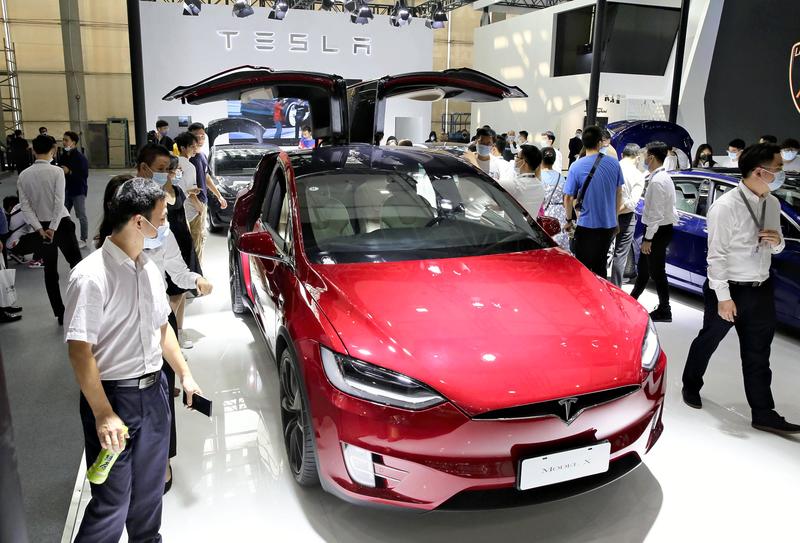
The strength of Tesla's EVs, in addition to the fact that they produce no emissions, is that their performance can be improved after the customer buys the car by updating the software installed. The conventional "common sense" concept -- that a new car is in its most valuable condition the moment it is delivered and that value declines over time -- does not apply.
In the past, there was a period when Tesla repeatedly closed the book with losses and its cash flow was in jeopardy. But with the mass production of its flagship car, the Model 3, which was introduced in the market in 2017, getting on a healthy track, the company's profits have improved.
Its early commitment to online sales also contributed to the company's success. Tesla secured a net profit of 331 million dollar (about 34.5 billion yen) in the July-September period this year, when novel coronavirus infections were spreading. Elon Musk, the chief executive officer of Tesla and entrepreneur who also leads the space company SpaceX, said that he has never felt more optimistic about the future of Tesla.
Amid the growing global momentum for decarbonization, it is believed that EVs will rapidly spread. This is a tailwind for Tesla, which specializes in EVs. In addition to currently producing vehicles in the United States and China, Tesla plans to start production in Europe in the future, The company estimates its annual production capacity to reach 1 million vehicles in 2021.
--Sales surge expected
China, the world's largest auto market, is aiming to promote EVs as a national policy. On Nov. 2, China set forth a plan to make EVs the mainstream of new car sales by 2035. Britain plans to ban the sale of new gasoline and diesel vehicles in 2030 and HVs in 2035. In the United States, former Vice President Joe Biden, a Democrat who won the presidential election, is expected to impose stricter environmental regulations.
Although there are issues that need to be tackled -- such as securing batteries to be installed in EVs and the development of charging facilities -- the trend toward "gasoline-free vehicles" is accelerating in many parts of the world, and there is a good chance that EV sales will surge.
Market research firm Fuji Keizai Co. estimates that global EV sales will increase from 1.67 million units in 2019 to 19.69 million units in 2035, making an about 12-fold jump.
Seeing Tesla's leap forward, Japanese companies are also trying to speed up development of new EVs.
Toyota is proceeding with the development of sport-utility type EVs jointly with Subaru, in which Toyota has a 20% stake. Nissan unveiled its new EV model Ariya at the Beijing Motor Show held in China from Sept. 26 to Oct. 5. Nissan plans to launch the model into the market in the middle of next year.
"Chinese customers are looking for a highly functional car," said Nissan President and CEO Makoto Uchida, who participated in the motor show online. "The Ariya, a collection of Nissan's advanced technology, is an EV that will meet the needs of Chinese [consumers]."
--Alliances
The development of EVs and FCVs that do not discharge emissions costs an enormous amount of money for research and development. Many companies have been battered by the novel coronavirus pandemic, and there is a growing possibility that firms that cannot furnish these R&D costs on their own will seek various types of alliances and cooperative ties.
In addition to Subaru, Toyota has concluded capital tie-ups with Mazda, and Suzuki, forming a loose coalition of the four makers. Honda is working on joint development of EVs with General Motors Co., and has invested in Contemporary Amperex Technology Co. (CATL), the world's largest manufacturer of automotive batteries.
Outside of Japan, Volkswagen AG of Germany and the United States' Ford Motor Co. have joined hands, and it is possible other partnerships will be formed.
"The novel coronavirus pandemic has accelerated digitization globally," said Shinya Omori, president of consultancy firm SC-ABeam Automotive Consulting. "The auto industry's response to next-generation vehicles has been pushed forward by about five years."
Read more from The Japan News at https://japannews.yomiuri.co.jp/






.jpg?w=600)