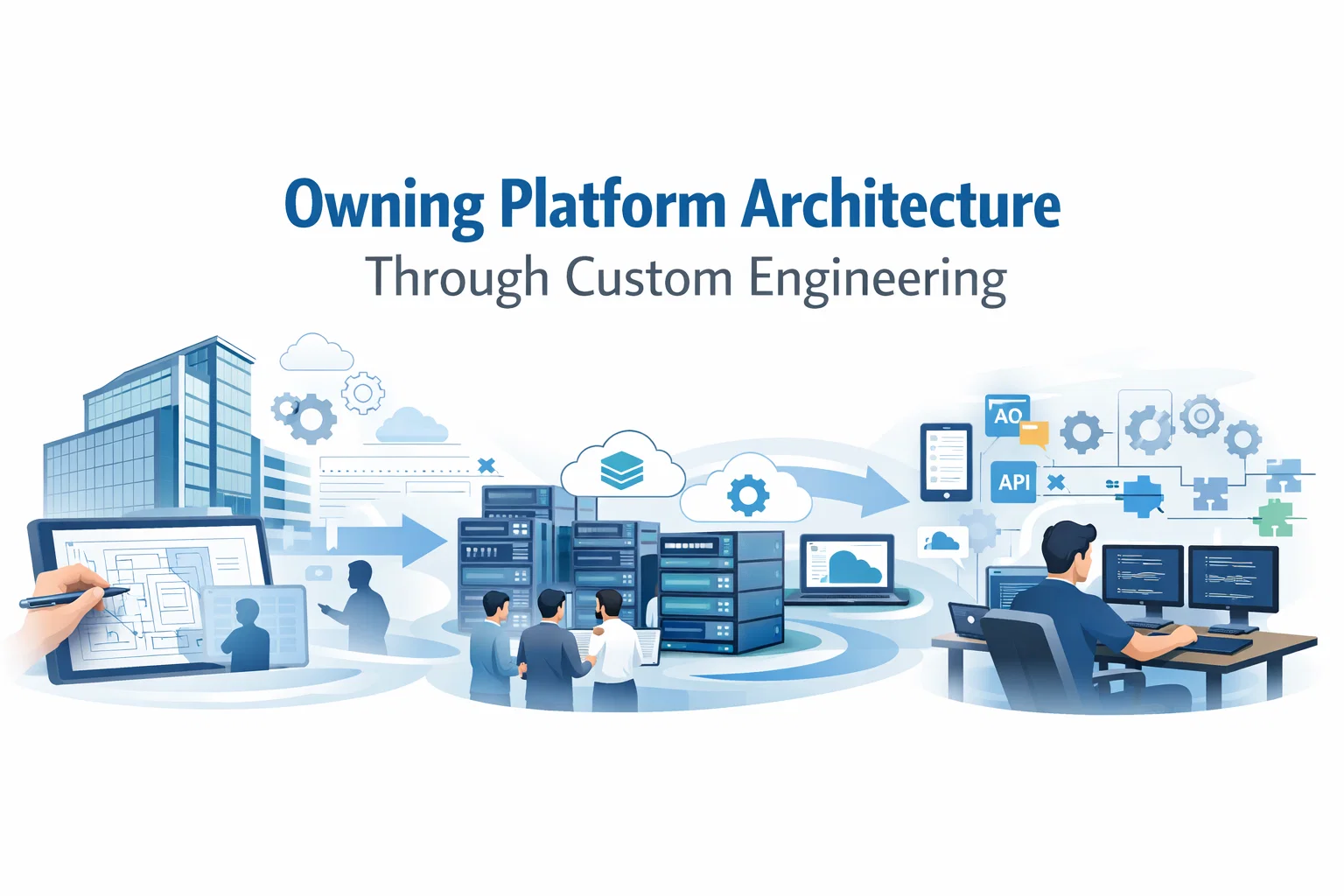
Platform businesses rarely stall because of weak demand. They stall because of architectural dependency.
In early stages speed matters, more than structure. Founders assemble products using third party APIs, subscription SaaS platforms, managed cloud services, and no code workflows. This approach reduces time to market and lowers initial capital requirements. According to CB Insights, thirty five percent of startups fail because they build products without validated demand, which explains why rapid experimentation is essential in the beginning.
However, once validation is achieved and growth accelerates, a different challenge emerges. The architectural decisions that supported early speed began to influence cost efficiency, performance stability, and innovation velocity.
This is the moment when many platform businesses begin shifting toward custom software engineering.
The Early Stack Is Built for Launch Not Scale
Modern startups benefit from an ecosystem of ready made tools that simplify product assembly. Managed infrastructure providers reduce operational overhead. SaaS platforms offer immediate functionality. Integration marketplaces connect services quickly.
While this composable approach accelerates product launches, research suggests it often introduces long term inefficiencies.
Gartner estimates that by 2026 organizations will overspend on cloud services by as much as twenty percent due to under optimized architecture and unused capacity. Flexera reports that companies waste roughly thirty percent of their cloud spend each year. At scale these inefficiencies directly affect margins.
What works effectively at ten thousand users may create structural strain at one million.
Growth Reveals Structural Constraints
As platform businesses scale, predictable pressure points appear.
First is escalating infrastructure costs. Usage based pricing models grow in proportion to activity. As transactions increase so do vendor expenses, sometimes faster than revenue growth.
Second is integration complexity. MuleSoft research indicates that enterprises use hundreds of applications across their operations. As dependencies multiply, maintaining consistent data flow becomes increasingly difficult.
Third is technical debt. Stripe reports that developers spend nearly one third of their time addressing technical debt instead of building new capabilities. For platforms that compete on innovation this slows momentum.
Fourth is performance sensitivity. Research from Akamai shows that even a one hundred millisecond delay can significantly reduce conversion rates. For marketplaces and SaaS platforms latency directly impacts revenue.
Fifth is data fragmentation. Harvard Business Review has highlighted that fragmented data architecture is a primary barrier to advanced analytics adoption. Platforms that rely on multiple disconnected systems struggle to leverage real time intelligence.
When these factors converge, incremental optimization is no longer sufficient. Architectural redesign becomes a strategic decision rather than a technical preference.
Recognizing the Inflection Point
The transition toward architectural ownership does not happen suddenly. It is often preceded by identifiable patterns.
There may be increasing friction when customizing workflows. Infrastructure bills may rise unpredictably. Engineering teams may spend more time integrating tools than building product features. Product differentiation may narrow as competitors use similar software stacks.
There are often clear signs your business may be outgrowing packaged software, especially when performance constraints and integration overhead begin affecting scalability and strategic flexibility.
At this stage the conversation shifts from tool optimization to system design. Instead of adapting business logic to fit vendor limitations organizations begin evaluating how technology should evolve around long term objectives.
Architecture Determines Competitive Advantage
In platform economics architecture is not an operational detail. It shapes strategic capability.
Multi sided platforms depend on real time processing, scalable backend systems, secure data handling, and extensible interfaces. The quality of the underlying architecture influences how quickly features can be launched, how efficiently infrastructure can scale, and how reliably systems perform under load.
McKinsey research shows that data driven organizations are twenty three times more likely to acquire customers and nineteen times more likely to achieve profitability. However extracting this advantage requires centralized data foundations and well designed systems rather than fragmented vendor dependencies.
Owning the architecture means owning the mechanics of growth.
What Custom Software Engineering Changes
Shifting toward custom software engineering does not require discarding all external tools. It involves designing core systems intentionally around business priorities.
This can include rebuilding performance-critical backend services, optimizing cloud workloads, and implementing custom built software systems that support operational scalability.
IDC reports that organizations that modernize core systems experience significantly faster release cycles and improved operational efficiency. Deloitte research further indicates that digitally mature companies are more than twice as likely to report strong revenue growth compared to less mature peers.
Digital maturity is not defined by how many tools are integrated. It is defined by architectural coherence and control.
When platforms design their systems around long term scalability, they reduce dependency risk and gain structural flexibility.
The Compounding Effect of Ownership
When a platform controls its architecture several advantages emerge.
Infrastructure can be optimized based on actual usage, product teams can iterate independently, and data governance becomes centralized, improving analytics and legal and compliance practices with modern AI. Performance tuning can also align with real user behavior.
Over time these advantages compound. Innovation cycles shorten. Cost predictability improves. Customer experience stabilizes. Strategic optionality expands.
Competitors that rely heavily on third party ecosystems may struggle to achieve the same level of differentiation or efficiency.
Final Perspective
Platforms often begin by assembling ecosystems of available tools. This approach supports experimentation and early growth.
However sustainable scale requires structural ownership.
Custom software engineering represents a strategic shift from dependency toward architectural control. It transforms technology from a collection of services into an integrated foundation aligned with long term vision.
In platform driven markets architecture is not invisible infrastructure. It is the engine of competitive advantage.
And the businesses that own their architecture are better positioned to own their future.