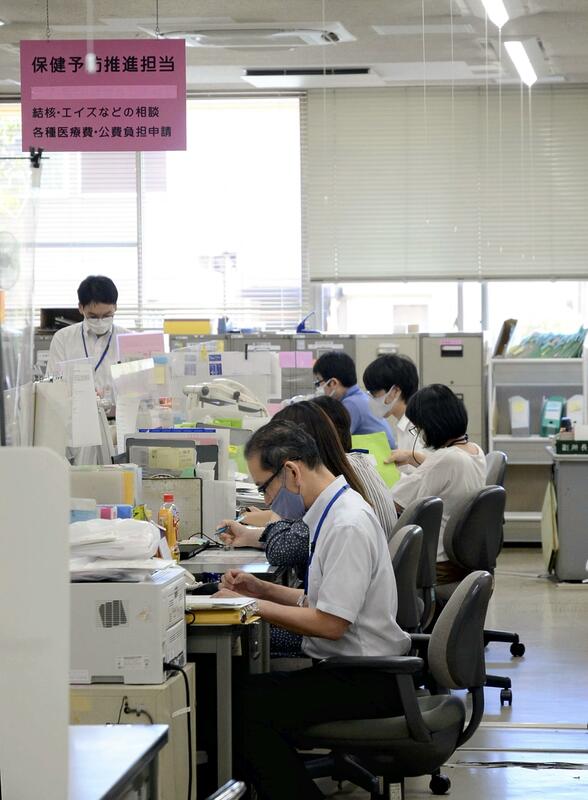
The recent surge in novel coronavirus cases has put a strain on public health centers, prompting facilities in Tokyo, Osaka, Okinawa and Saitama to scale back extensive contact-tracing procedures.
Since late July, the Naha public health center in Okinawa Prefecture has only conducted workplace contact-tracing surveys at medical institutions and companies where clusters have been confirmed. The center has instead relied on companies or the person infected to provide information about close contacts.
Newly confirmed cases in the area covered by the center sometimes top 150 a day. "There are so many infections it is difficult to conduct contact-tracing surveys as before," a city official said.
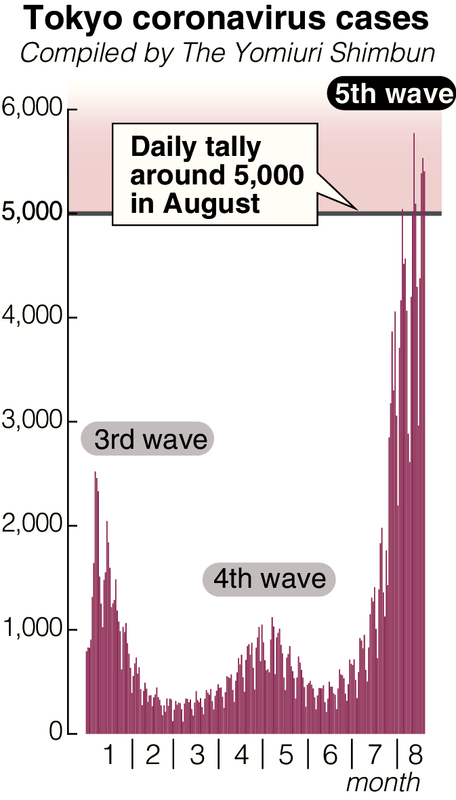
The number of coronavirus cases logged in Saitama Prefecture on Thursday exceeded 2,000 for the first time. About 50 staff members at a public health center in Kasukabe in the prefecture have been responding to a constant stream of phone calls.
"Staff members have been unable to take their full allocation of days off. We've managed to maintain morale, but we are in a critical situation," said the director of the center.
The daily tally in the area covered by the center increased from about 10 in the fourth wave this spring to about 80 in the current fifth wave.
Since the beginning of this month, there has been an increase in the number of patients who have been forced to recuperate at home as they have been unable to find a hospital to accept them.
The health center is responsible for checking the condition of the roughly 600 people in the area who are recuperating at home or designated hotels.
The infection situation was the same at other health centers in the prefecture, prompting Saitama Prefecture to scale back the extensive contact tracing on Aug. 6.
Previously, Kasukabe health center's contact-tracing efforts had involved checks on coworkers and acquaintances of patients, but now the focus is on people such as family members and workers linked to nursing care facilities for elderly people.
"Contact tracing is a significant way to contain the spread of infections, so we want to do it properly, but the reality is we can't keep up. It was a difficult choice," the director said.
Other municipalities are also scaling back contact-tracing efforts.
The Tokyo metropolitan government told public health centers on Aug. 10 to prioritize contact tracing at facilities where clusters are likely to occur, a policy it also adopted during the third wave in winter.
Meanwhile, public health centers in the cities of Kobe and Naha are also focusing contact-tracing efforts on the patients and their family members.
However, if the scope of the survey is scaled back, cases will be missed and asymptomatic people might spread the virus unwittingly.
"The reduction in contact tracing is unavoidable in some respects, but it will be difficult to grasp the number of cases and infections could spread further," said Prof. Toshiyuki Ojima of Hamamatsu University School of Medicine. "Information technology and outside personnel who are qualified as public health nurses must be utilized."
Read more from The Japan News at https://japannews.yomiuri.co.jp/