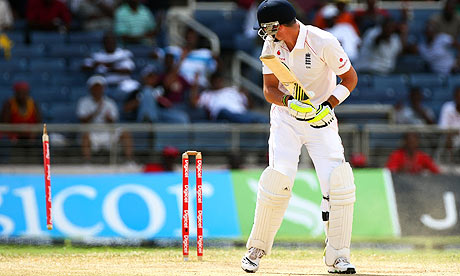
The England team took the charter yesterday from Jamaica to Antigua, leaving behind their Sabina misery – and best thing too. There is little point in hanging around at the scene and more to be gained by seeking a new life elsewhere. At the moment they are Steinbeck's Joads off to California, with the same level of optimism though they will not want the same disillusioned outcome.
The first Test showed an England team in disarray by the end but it does not mean that they cannot turn things around rapidly. We have seen them start a series before with all the spark of an old banger on a winter's morning only to cruise along when the engine warmed up. In fact, one thing that has characterised England cricket over the past couple of years has been an ability to scrap better than they once might have done when things go wrong.
Real disasters, a few of them anyway, have been turned around: in Hamilton last year; Lord's 2005; Trinidad 1994, which, as they were bowled out for 46 then and progressed to win memorably in Bridgetown next match, is the most apposite. We should no more take for granted that England will lose the series than should a cock-a-hoop West Indies. There is a way to go yet.
There is no doubt that West Indies were underestimated by England. The perceived wisdom was that there was a small nucleus of senior players and the remainder were vulnerable. This, of course, was always nonsense. The lack of success of West Indies in recent times has been more a reflection on the administrative malfunctioning, on conflict between players and board and on the regional differences than a lack of talent. There is plenty of that, as England have already found not just in Jamaica but on St Kitts.
One outcome of that underestimation has been the drafting into their squad of Lendl Simmons, the young left-hander who scored 282 for West Indies A, and the allrounder Ryan Hinds. A winning team will be changed and for the better. The Stanford Series had a positive impact beyond the money, for it demonstrated how proper preparation – the Stanford squad, seven of whom played in the first Test, were together for six weeks prior to the event – instilled a sense of responsibility and discipline and these ethics brought their reward.
They have a tight bowling unit and a spinner who became the first since the days of Lance Gibbs more than three decades ago to take eight wickets in a match. Add a reliable opening partner for Chris Gayle and a middle-order player and there is a formidable unit.
England would have gone through mixed emotions in yesterday's team meeting promised by Andy Flower. On the one hand, there will be the idea that Saturday's upheaval was a glitch and in no way indicative of a malaise – "just one of those days" as Ian Bell rather ill-advisedly put it. On the other, there is the realisation that they are not all they are cracked up to be. The problem lies in the batting, as it has done for a year or more. The England bowling at Sabina did not possess the cutting edge that West Indies found but, in part, that was down to the nature of the pitch relative to the physical attributes of the attack: Taylor and Benn were each of ideal build to exploit what help there was. England were never less than diligent but emasculated to an extent. In Antigua, at the Sir Viv Richards Stadium, they are likely to encounter something even more moribund than Sabina but without the turn. There is hard work in prospect.
A real concern, though, is the apparent over-reliance on Kevin Pietersen, an admission almost that his batting is head and shoulders above anything else in the side and that the rest are not worthy. They have become utterly dependent on him, so much so that, if he fails, as he did on Saturday, the natural reaction is not to step up in his place but to feel, if he cannot do it, how then can lesser players. Flower said he hoped this was not the case but one sensed he suspected in some that it might be.
The one thing England can no longer afford to do is to stick with the status quo, although the absence of a second batting option to Owais Shah, especially on a Caribbean tour when broken digits can be two a penny, is as bemusing as the inclusion of Adil Rashid, who showed in St Kitts that he is a world away from being ready for the top level. There are not many options. And which to drop? Bell, the obvious one, with the sublime game but a mentality so flabby that it might require liposuction? Or Paul Collingwood, with his limited skills but strong will? Or the new vice-captain Alastair Cook?
Something has to give. In 1994, determined that the selection merry-go-round that had characterised England cricket at that time should cease, Mike Atherton and Keith Fletcher kept faith with the same side and were rewarded. Times have changed. Continuity has been the norm, which is fine up to a point. But it has made some players bomb-proof and complacent. They dare not let things stand.