Over a meter of rain has fallen in areas of Kyushu since the downpours began earlier this month, according to the Japan Meteorological Agency.
About half these places have recorded more than double the average rainfall for the entire month of July. The agency continues to warn of the risk of landslides and other disasters.
From July 3 to 13, precipitation of 1,000 millimeters or more was recorded at 18 places in nine prefectures nationwide, according to the agency. Of these, 13 places are in Kyushu, and more than double the July average was recorded in seven out of nine locations where past data could be confirmed.
The largest amount was recorded in Hita, Oita Prefecture, at 1,249 millimeters, where the Chikugo River flooded. Also experiencing flood damage was Omuta, Fukuoka Prefecture, which received 1,029.5 millimeters of rain, recording 2.7 times more than in an average July. Yunomae, Kumamoto Prefecture, upstream of the Kuma River that experienced extensive flooding, received 1,243.5 millimeters of rain, whereas Taragi in the prefecture got 1,015.5 millimeters.
In the torrential rains in northern Kyushu three years ago that left 42 people dead or missing in Fukuoka and Oita prefectures, no place recorded more than 1,000 millimeters of precipitation the total period from June 30, 2017, to July 10, 2017. Asakura, Fukuoka Prefecture, where 33 people died, had the highest rainfall at 660 millimeters, while Hita, where three people died, had 500 millimeters.
According to Seiji Tashiro, the former head of the Shimonoseki Meteorological Office and now a senior research fellow at the Crisis & Environment Management Policy Institute in Tokyo, while the heavy rains that hit northern Kyushu three years ago were localized and concentrated over a short period, this year, the front stalled between high pressure systems on the continent and in the Pacific Ocean, resulting in recurring localized heavy rainfall.
While the Kyushu region is expected to experience a lull in rain for several days, Tashiro warned people against letting their guard down.
"The mountains and forests are now full of water," he said, "and even a small amount of rain could cause landslides or other disasters."
The Yomiuri Shimbun
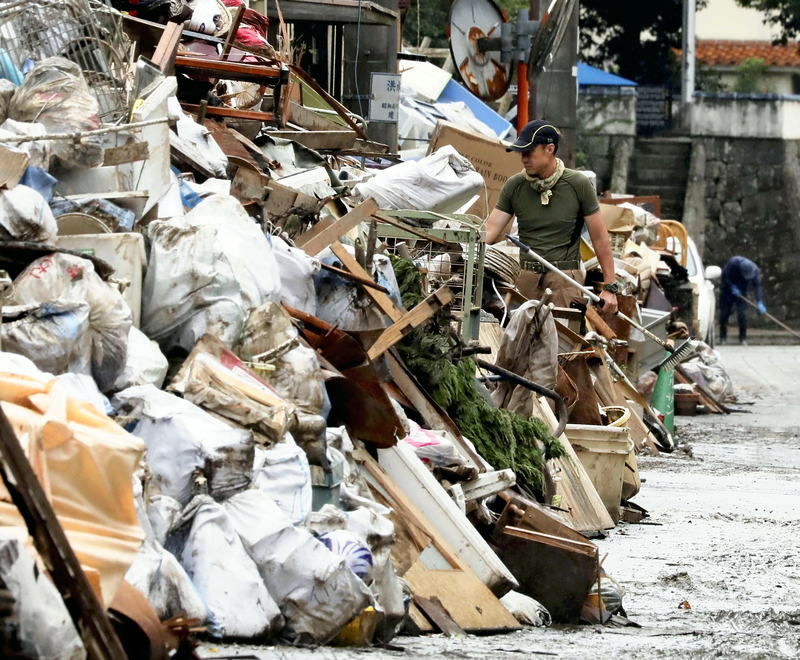
A large amount of disaster-related trash has piled up in a residential area in Hitoyoshi, Kumamoto Prefecture, as seen on Wednesday morning.
Read more from The Japan News at https://japannews.yomiuri.co.jp/