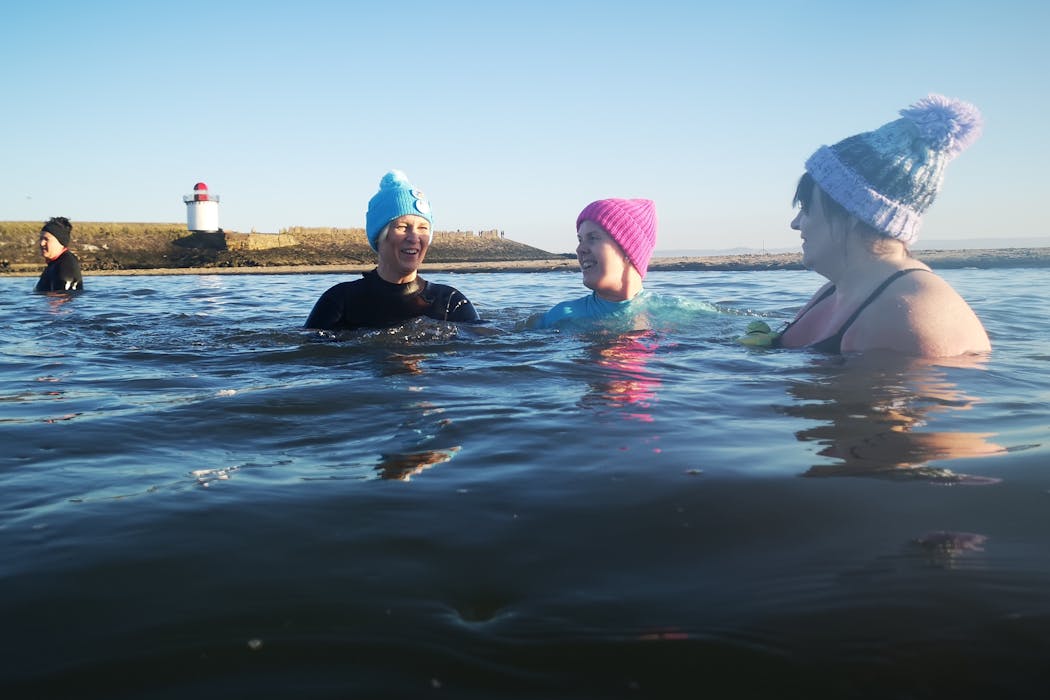
Centuries after the upper class flocked to the coast for therapeutic sea bathing, outdoor swimming is having a renaissance. Swimmers enter cold water for the many physical and mental health benefits it offers.
Despite the dangers – hypothermia, cardiac-related death and drowning – for many women, outdoor swimming feels like a safe space. My PhD research, which explored outdoor swimming in north-west England, found that some women experience their swimming as a form of liberation, from what they see as a male-centric culture, the male gaze and social convention.
Despite recent gains in women’s sport, men are still participating in higher numbers, especially in outdoor activities. However, approximately two-thirds of outdoor swimmers are women.
In this environment, stripping off at the water’s edge can feel like stripping back notions of how female swimmers feel they “ought to” look or behave.
This is particularly relevant in a context where more than half of women feel that the UK has become more dangerous in the past five years, and reports of violence against women are increasing.
While men are loved and valued members, founders of and advocates for outdoor swimming communities across the UK, female swimmers comment on enjoying a female-majority atmosphere. Compared to perceived male-dominated environments such as the city, where women may feel that they need to take precautions to ensure their safety, or change how and where they exercise during darker winter months, one woman described outdoor swimming as, “a sense of freedom that I don’t think I would necessarily have elsewhere”.
Outdoor spaces are widely perceived to be a male domain. The outdoors is where tropes of masculinity, including stoicism and the conquering of nature, are performed.
Through the practice of outdoor swimming, female swimmers are rewriting outdated ideas of how women might be, do and what they look like in the outdoors.
As late as the Victorian era, many outdoor sports were imagined to threaten a woman’s femininity and fertility. Recent research has shown that mainstream media often portrays women as passive or requiring male assistance during outdoor activities.
Outdoor swimming is a sport in which female physiology provides a significant edge, and women can feel athletic and empowered, no matter their body type.
Many of the swimmers in my research are between their 30s and 60s, and several are experiencing the menopause or ageing bodies. In each other’s company and in the water, patriarchal and capitalist ideals of a “good body” (slim, able-bodied and cisgender), are felt to wash away.
Female swimmers laugh heartily about their “bioprene”, a beloved euphemism for the body fat that allows them to outlast their husbands in cold water. As one swimmer in my study said:
When you’re swimming outdoors, there’s no glamour … it’s a levelling thing and I think in a world where we’re just bombarded with what we should be doing and what we should look like, it’s the way that people can just be themselves.
The outdoor swimming movement is known for its self-proclaimed non-conformist and subversive roots. For some female swimmers, their personal practice is a way to be unconventional. One swimmer commented:
I’ve got this concern about convention and what I ought to be doing, what people expect me to do, but I’ve got more concerned with what I need to do to find pleasure and peace.
For this swimmer, letting go of social norms is a way to find peace within herself.
Finding community
A sense of peace also comes in the form of the friendships that are forged in the water. Previous research has indicated that the social and communal elements of outdoor swimming are an important factor in the sense of wellbeing associated with the practice.
My research indicates that the femininity of some swimming circles can be a harbour for emotional intimacy.
One swimmer described how she and her fellow swimmers have had beautiful exchanges while immersed in the waves, including singing together:
That lovely little moment, which, had it been a male-dominated environment, we perhaps wouldn’t have felt comfortable to be like that. Lots of women around you, you just feel freer… it was spontaneous, it was beautiful.“
The rivers, lakes and seas of the UK offer energising and emboldening spaces where many women feel safe to be fully and unapologetically themselves. As outdoor swimming grows in popularity, and grassroots organisations such as Mental Health Swims have closed due to a lack of funding, nurturing female communities in the outdoors is increasingly important, such that more women may find safety, joy and more of themselves in the outdoors.

Abi Lafbery received funding from the Economic and Social Research Council, North West Social Science Doctoral Training Partnership, ES/P000665/1.
This article was originally published on The Conversation. Read the original article.