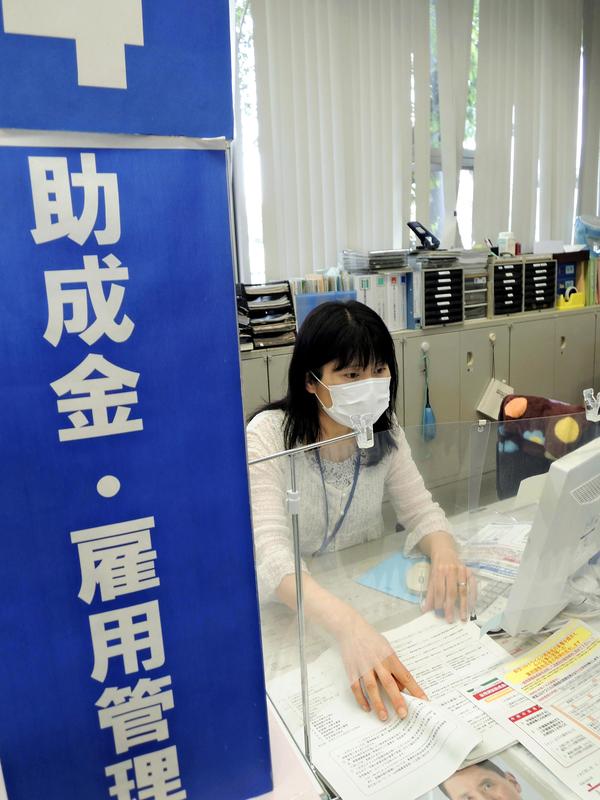
The novel coronavirus epidemic left 5.97 million workers on leave in Japan in April, nearly four times the level seen after the 2008 Lehman Brothers investment bank collapse. The April figure is up 2.4-fold from March, setting a record high since comparable data became available.
If the stagnation of business activities is further prolonged, many workers currently on leave could eventually lose their jobs, pushing up the unemployment rate.
-- Non-regular workers hit hard
According to a labor force survey released Friday by the Internal Affairs and Communications Ministry, the number of unemployed totaled 1.78 million in April in seasonally adjusted terms, up by 60,000 from the previous month, while the number of workers on leave surged by 3.48 million to 5.97 million in the same period.
People in the on leave category are defined mainly as those who are employed, but did not work during the period when the survey was conducted. In other words, they are either employees who have received or are scheduled to receive salaries or wages, or the self-employed who continued their businesses or suspended their businesses for less than 30 days. Statistically, they are included in the employed.
The April figure for this category includes those who voluntarily took time off from work, such as for childcare leave, but the increase is believed to be mostly a reflection of employees taking time off from work because their employers voluntarily suspended business operations or business conditions deteriorated due to the virus crisis.
ANA Holdings Inc. in April began to furlough about 6,400 flight attendants of its affiliate All Nippon Airways, letting them take several days off a month.
The increase in the number of workers on leave is particularly noticeable among nonregular employees. The number of temporary workers on leave totaled 3 million, up 4.3 times from December last year before the virus outbreak, compared to 1.93 million full-time employees, which only saw a 2.7-fold increase.
The government has expanded the scope of workers for which companies are eligible for employment adjustment subsidies by letting their employees, including part-time and other nonregular workers with shorter hours, take leave instead of terminating their contracts.
In the wake of the so-called Lehman Shock, subsidies programs did not include nonregular workers in its application conditions, and many of them lost their jobs at an early stage. The current subsidies program, therefore, seems to help, to a certain point, prevent such a situation from reoccuring.
In addition, as many companies had suffered from a serious labor shortage before the outbreak, they are believed to have decided to keep their employees on leave on the assumption that the epidemic will soon be contained.
"I hope workers will be able to return to their jobs as the economy becomes active, along with strong support from subsidies programs for business suspensions and school closures," Economic Revitalization Minister Yasutoshi Nishimura said at a press conference after Friday's Cabinet meeting.
-- Fears of second infection wave
If corporate activities continue to stagnate or a second wave of infection occurs, it will become even more difficult for those on leave to return to work. There are growing concerns that companies may have to start laying off employees if they are no longer able to keep them on leave. It is feared that nonregular workers will more easily fall victim to such moves, as they are under weaker legal protections compared with full-time employees.
A 30-year-old female employee at a major apparel chain store in Tokyo said she still does not know when to return to work, even though the store is scheduled to reopen as early as in June. There is uncertainty over the recovery of the store's customers, who are mainly foreigners. As a result, her wages have been cut by 30% to 40%.
The April unemployment rate was 2.6%, up 0.1 percentage point from March, when it had fallen for the second consecutive month. However, the figure remains at a low level compared with the period following the Lehman Brothers crisis, when the jobless rate surged to the 5% level.
"A significant portion of workers on leave due to the economic downturn will highly likely become unemployed," said Taro Saito, a chief economist of NLI Research Institute's Economic Research Department, adding that the unemployment rate is expected to rise to about 4% by the end of this year.
Read more from The Japan News at https://japannews.yomiuri.co.jp/