Paying by oneself for private PCR tests has become increasingly popular, as people want to know if they are infected with the novel coronavirus.
Several facilities have recently opened in central Tokyo offering low-cost polymerase chain reaction (PCR) tests using saliva and other samples. Although such testing is expected to help curb further spread of the coronavirus by helping people detect infections and receive treatment at an early stage, the accuracy and costs vary. Experts stressed the need for people to understand the nature of testing before undergoing exams.
-- Quick, inexpensive tests
"I was always worried that I might have gotten infected with the coronavirus without knowing it and passed it on to others around me," said a 21-year-old university student living in Arakawa Ward, Tokyo. "I feel safer if I can get a test at a reasonable price."
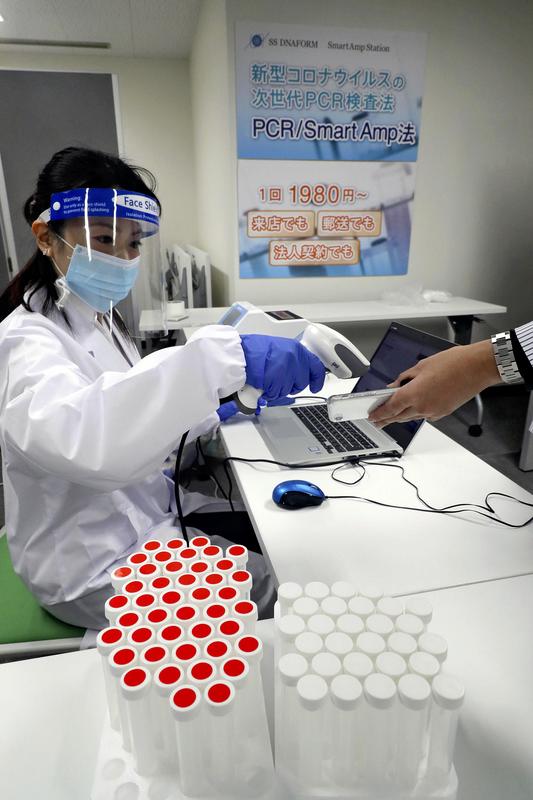
He took a test on Dec. 14 at SmartAmp Station Ekimae Kensa, a testing facility in Tokyo's Chuo Ward.
Applications for the test must be done online in advance, and it costs 1,980 yen. The whole procedure, including taking a saliva sample by oneself at the facility, takes only about three minutes.
Soon after, the sample is transported to a lab in Tokyo, and the results are sent to test-takers by email the next day.
The university student was notified of a negative result the following day.
The facility is operated by SS Dnaform, a Tokyo-based subsidiary of K.K. Dnaform in Yokohama, a venture company started by Riken. It uses a PCR testing method called SmartAmp. The unique method jointly developed by Riken and the Kanagawa prefectural government can quickly obtain test results.
The method detects the coronavirus' genes, among other things, to determine whether a person is infected. In typical PCR tests, the temperature is repeatedly heated and cooled to amplify the genes, but SmartAmp can detect genes at a constant temperature and provide results within 15 minutes to 40 minutes. A compact testing kit was also developed, which can be deployed at such locations as event sites.
"By doing everything from developing reagents to manufacturing testing equipment, we don't have to pay patent and other fees to outside parties," said SS Dnaform President Kazutaka Okubo. "This enables us to conduct tests at a low cost."
-- No doctor's diagnosis
Currently, people with novel coronavirus symptoms as well as those who have been in close contact with infected people are subject to administrative PCR testing paid for by the government. There have been limited opportunities for others to get tested.
However, now that restrictions have been eased on overseas travel, among other factors, demand has grown among businesspeople who want to confirm negative results before traveling. This situation has resulted in growing calls to expand opportunities for out-of-pocket testing.
Kinoshita Group Co., which mainly operates construction firms, opened a PCR test center near Tokyo's Shimbashi Station on Dec. 4. It uses a saliva sample and emails test results the next day. The company's test costs 3,190 yen.
The firm opened its second testing facility in the Kabukicho district in Shinjuku Ward, Tokyo, on Monday.
However, most of these facilities provide only test results, and doctors are not involved in the process. The Infectious Diseases Control Law stipulates that doctors must examine those undergoing a test, determine whether they are infected and report infection cases to health centers.
If a person receives a positive result from a private facility and does not consult a doctor, it is possible that authorities will fail to grasp the true state of infections and infected people may not be hospitalized or treated.
K.K. Dnaform calls people who test positive and urges them to see a doctor, while Kinoshita Group emails test results including a message telling them to visit a medical institution.
"Private testing facilities should cooperate with medical institutions," Health, Labor and Welfare Minister Norihisa Tamura said at a press conference held after Friday's Cabinet meeting, urging private testing operators to establish a system to ensure that people who have tested positive visit medical institutions.
-- Listing private institutions
The testing accuracy at private facilities also has surfaced as an issue.
In PCR testing, only 70% to 90% of infected people test positive, which likely leaves some test-takers with false positive and negative results. In particular, it is difficult to detect the virus immediately after getting infected.
The cost of out-of-pocket testing varies from 2,000 yen to 40,000, yen according to a survey done by the Health, Labor and Welfare Ministry. For this reason, the ministry plans to publish on its website a list of private facilities, among others, that offer such tests including their costs, testing methods and accuracy management.
"Even if a test-taker gets a negative result, it means nothing if the person engages in a high-risk activity the next day," Tokai University Prof. Hayato Miyachi said.
"Those who undergo tests shouldn't feel completely relieved even when they get negative results, and it's important for them to understand the characteristics and scope of the tests before using them," the professor of clinical examination studies added.
Read more from The Japan News at https://japannews.yomiuri.co.jp/
.jpg?w=600)