Entertainment awards shows have become renowned for highlighting political and social change as of late, with winners using their time on stage to raise awareness of important issues such as greater representation in film and gender equality.
The impact of Time’s Up was honoured at the 2018 Oscars, as numerous attendees wore special pins and badges to show support for the anti-sexual harassment and abuse movement.
A special video made in dedication to the movement was shown during the ceremony and introduced by Ashley Judd, Salma Hayek and Annabella Sciorra, all of whom previously accused Harvey Weinstein of sexual misconduct, which Weinstein strongly denies.
Several significant feminist moments also occurred at the 2019 Golden Globes, including empowering speeches given by actors Glenn Close and Regina King on the subjects of women finding personal fulfilment and gender equality in film.
With front runners for the 2019 Academy Awards including Lady Gaga for her role in A Star Is Born and Olivia Colman for her portrayal of Queen Anne in The Favourite, it’s likely the night will continue to serve as a platform to champion feminism in speeches.
From Patricia Arquette to Sandra Bullock, here are six of the best feminist speeches to have been delivered at the Oscars:
Frances McDormand pays tribute to all women working in the film industry (2018)
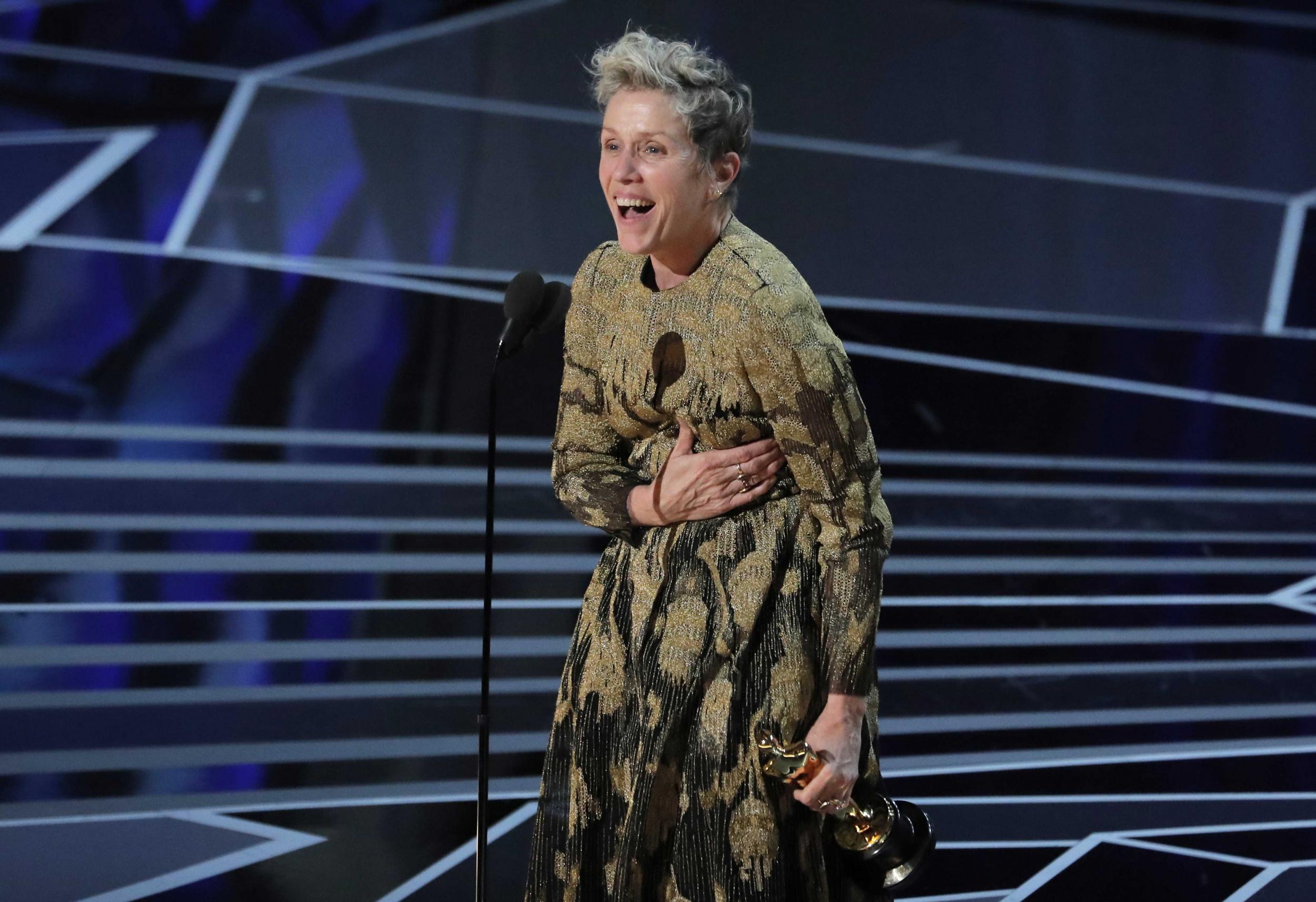
When Frances McDormand won the Best Actress Oscar in 2018 for her role in Three Billboards Outside Ebbing, Missouri, the actor used her moment on stage to champion all women working in the film industry.
After expressing her gratitude towards writer and director Martin McDonagh, her sister Dorothy McDormand, her husband Joel Coen and their son Pedro McDormand Coen, McDormand then called for every female Academy Award nominee in the room to rise to their feet.
“And now I want to get some perspective. If I may be so honoured to have all the female nominees in every category stand with me in this room tonight, the actors – Meryl, if you do it, everybody else will, c’mon – the filmmakers, the producers, the directors, the writers, the cinematographer, the composers, the songwriters, the designers. C’mon!” she said.
“Okay, look around everybody. Look around, ladies and gentlemen, because we all have stories to tell and projects we need financed.”
McDormand ended her speech by urging for greater representation in Hollywood by using the term “inclusion rider”, which is when a cast and crew is contractually required to hire a diverse workforce.
Patricia Arquette demands equal pay in America (2015)
Patricia Arquette’s Best Supporting Actress win at the 2015 Academy Awards for her role in Boyhood was a long time coming, having filmed the coming-of-age drama over a period of 12 years.
After thanking all the individuals involved in the film’s production in her speech, Arquette then proceeded to passionately discuss the need for equal pay in America.
“To every woman who gave birth, to every taxpayer and citizen of this nation, we have fought for everybody else’s equal rights,” the actor said.
“It’s our time to have wage equality once and for all, and equal rights for women in the United States of America.”
Arquette’s speech received rapturous applause, with stars including Meryl Streep and Jennifer Lopez captured on camera cheering in response.
Halle Berry makes history as first black woman to win Oscar for Best Actress (2002)
One of the most memorable Oscars moments of all time came in the form of Halle Berry’s 2002 acceptance speech, which she delivered after being awarded Best Actress for her performance in Monster’s Ball.
The enormity of the occasion wasn’t lost on Berry, whose sheer astonishment was apparent the second her name was read aloud by Russell Crowe.
As of 2018, Berry remains the only woman of African-American descent to have won the accolade.
The actor dedicated her award to all women of colour who may follow in her footsteps by making history.
“This moment is so much bigger than me. This moment is for Dorothy Dandridge, Lena Horne, Diahann Carroll,” Berry said.
“It’s for the women that stand beside me, Jada Pinkett, Angela Bassett, Vivica Fox. And it’s for every nameless, faceless woman of color that now has a chance because this door tonight has been opened. Thank you. I’m so honoured. I’m so honoured.”
Cate Blanchett highlights profits of female-led films (2014)
As Cate Blanchett stood on stage in 2014 to receive her Best Actress Oscar for her role in Blue Jasmine, she acknowledged the power that female-led films can have on cinemagoers.
After thanking the audiences who went to see the film, which depicts Blanchett as a Manhattan socialite going through financial difficulties, the actor expressed her appreciation for “those of us in the industry who are still foolishly clinging to the idea that female films with women at the centre are niche experiences. They are not.
“Audiences want to see them and, in fact, they earn money,” she added, to resounding cheers from the star-studded audience. “The world is round, people.”
While Blanchett’s speech received praised, some believe that her sentiments may have been overshadowed by her message of thanks for writer and director of the film Woody Allen, due to the accusations of sexual abuse that have been made against him.
Allen has repeatedly denied the allegations and has not been criminally charged.
Sandra Bullock pays homage to the selfless mothers of the world (2010)
This year marks a decade since the release of 2009 biographical drama The Blind Side.
The following year, Sandra Bullock won the Best Actress Oscar for her portrayal of Leigh Anne Tuohy in the film, a woman who adopted a boy living in poverty and supported him as he embarked on a career in American football.
Bullock used her time on stage to express her appreciation for all mothers who care for children and young people regardless of their background, including Tuohy, who was sitting in the audience.
“I would like to thank what this film is about for me which are the mums that take care of the babies and the children no matter where they come from,” the actor said.
“Those mums and parents never get thanked.”
Bullock went on to also thank her own mother, Helga Mathilde Meyer, who passed away in 2000.
Emma Thompson thanks producer for questioning gender conventions (1996)
The 1995 film adaptation of Jane Austen’s novel 1811 Sense and Sensibility depicts several antiquated gender norms associated with women, such as the need to rely on men for economic stability.
Emma Thompson emphasised this fact in her acceptance speech for Best Adapted Screenplay, as she expressed her gratitude towards the film’s executive producer Sydney Pollack.
“[Thank you] to Sydney Pollack for asking all the right questions, like, ‘Why couldn’t these women go out and get a job?’ Why indeed’,” Thompson said, to the amusement of the audience.
Thompson also won the 1996 Academy Award for Best Actress in the film, becoming the first person to win an Oscar for both acting and writing.