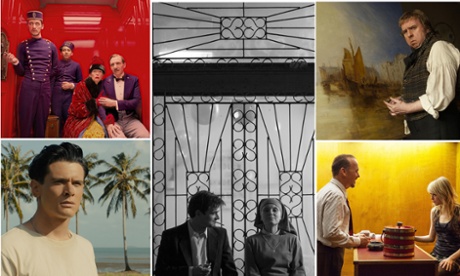
For the past five years, critics and industry folk have grumbled that the best cinematography Oscar was effectively rendering itself obsolete. As five straight CGI spectacles (four of them in 3D) claimed the prize, all taking best visual effects into the bargain, purists wondered where the line between the awards was to be drawn. Others suggested splitting the category in two, as the Academy did for black-and-white and colour films between the 1930s and 1960s. This year, however, the discussion was put on hold: for the first time since 2007, not one of the nominees is up for its visual effects, while all five make do with just two dimensions.
Not that it’s all out with the new. Celluloid sentimentalists, avert your eyes: for the first time in this category’s history, four of the five nominees are digitally shot. The lone holdout, unsurprisingly enough, is the one directed by US cinema’s chief purveyor of hand-crafted nostalgia, Wes Anderson. The Grand Budapest Hotel is the first Anderson film ever to score a cinematography nod; 63-year-old Robert Yeoman, whose CV includes all seven of Anderson’s live-action features as well as collaborations with Gus Van Sant and Noah Baumbach, is an overdue first-time nominee (he’s also the only American in the pack). So the case for a win based on assorted industry factors is there, but don’t overthink this: if Yeoman wins – and he might – it’ll be because of the ornate pastel-prettiness of his work and the film’s probable triumph in the design categories. The Academy often likes to indiscriminately hand its visual-crafts awards as a kind of package deal to a single film; if it’s that kind of year, this is the one.
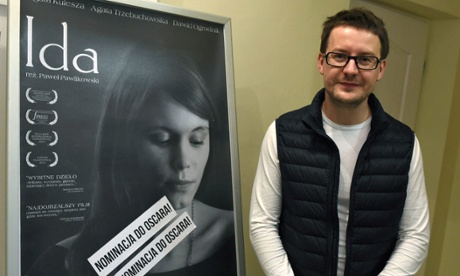
Yeoman’s analogue-orphan status would, one suspects, be a stronger factor in his favour if all Academy members knew about it; as it is, many would probably be surprised to learn that Ida, with its rich, stark black-and-white imagery and old-school Academy-ratio framing, is a digital effort. The cinematographers’ branch likes to throw in a monochrome nominee when they can – sometimes merely for the sake of form, as with last year’s dubious Nebraska nod – but the spectacle-inclined general membership hasn’t handed one the win since Schindler’s List 21 years ago. Lukasz Zal and Ryszard Lenczewski would be richly deserving exceptions to the rule: every shot here is both compositionally immaculate and narratively considered. Still, given that they’re the only contenders in the category without a corresponding bid from the American Society of Cinematographers (who somehow preferred the Sunday-telly stylings of The Imitation Game), one sadly suspects they barely squeaked the nomination.
Perhaps the Poles are just happy to have escaped with their names intact. Dick Pope – less of a challenge to American tongues, one would have thought – wasn’t so fortunate, as Academy president Cheryl Boone Isaacs’s now-infamous “Dick Poop” flub immediately became the biggest social media meme of Oscar nomination morning. “I’ve been called worse,” the 67-year-old Brit drily quipped in response. Not, one hopes, by Mike Leigh, to whom Pope has been an invaluable aide since Life Is Sweet, 25 years ago. Their collaboration, however, has reached a near-inarguable peak with Mr Turner, a ravishing cinematic counterpoint to JMW Turner’s own painting of light – all the more remarkable for being the pair’s first foray into digital. Though Pope was Oscar-nominated eight years ago for Neil Burger’s The Illusionist, this is the first time he’s received major awards attention for a Leigh film. America’s National Society of Film Critics deemed his work the year’s best; Academy voters may prefer a little more flash and dazzle.
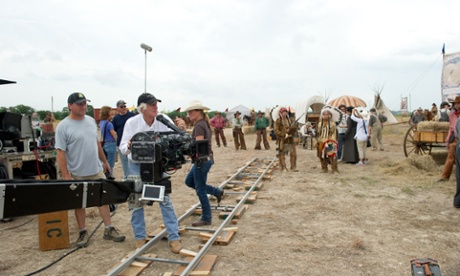
There’s not much of either – just a whole lot of honey-dipped handsomeness – in Unbroken; once tipped by many for best picture glory, Angelina Jolie’s snoozerific Louis Zamperini biopic is effectively, with its scant handful of technical citations, the ghost at this year’s Oscar feast. Yet some stubborn pundits are clinging to the possibility of a win here, their reasoning effectively running along the lines of: “Well, Roger Deakins has to win sometime.” True enough, with 12 nominations and no wins to date, the Coen Brothers’ favourite cameraman is as pointedly overdue an Oscar as any below-the-line artist in the industry today. (One more nomination and he’ll tie George J Folsey for the all-time cinematography duck.) As much as everyone would like to see that situation rectified, however, a win for the burnished blandness of Unbroken is not the answer; proficient as ever, it’s among the least singular work of his career, and in a film to which few want to hand Academy Award-winner bragging rights. Ah well, there’s always next time.
Only two years ago, Mexican master Emmanuel Lubezki’s Oscar-losing streak was as embarrassing a reflection on this category as Deakins’s; in 2012, when his visionary work on The Tree of Life lost out to the gilded expense of Hugo, it seemed he might never be on the voters’ wavelength. Last year, however, even they couldn’t ignore his vertiginous miracle-working in Gravity, and his sixth nomination proved the lucky one. It turns out, however, that Oscar-baiting cinematography stunts are a bit like London buses, and Lubezki is widely expected to take a second consecutive statuette for his fluid execution of the faux single-shot conceit of best-picture heavyweight Birdman. Though it’s a gimmick that owes much of its success to the invisible (and unnominated) work of the film’s editors, Lubezki’s athleticism with the camera is exhilarating; the Los Angeles Film Critics Association is chief among the many awards-giving groups to agree. Alejandro González Iñárritu’s film is an intriguing question mark in several major races, but this is one win it has under its wing.
Will win: Birdman
Should win: Ida
Hey, where’s ... A Most Violent Year? Or Selma? Bradford Young asserted himself as one of the most vital, versatile talents in the field with his lushly jaundiced images for JC Chandor’s New York crime drama and his crisp, incisive lensing of Ava DuVernay’s Martin Luther King biopic. With both films late arrivals in the race, however, Young never made up the distance.