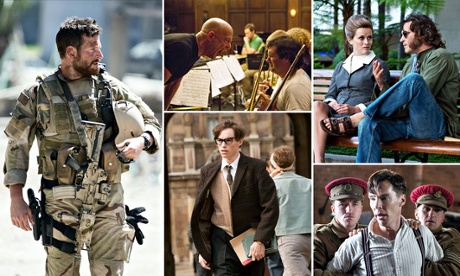
Unlike most critics’ groups and the Golden Globes, the Academy divides its screenplay prizes between adapted and original fare – an entirely reasonable distinction, though it results most years in uneven distribution of heat between the categories. Now, with the year’s two most nominated films (plus the bookies’ best picture favourite) jostling for position in the original race, buzz around its adapted counterpart is markedly quieter; indeed, the voters’ preference for original scripts this year seems so strong, they even found a way to nominate one in this category.
Meanwhile, with the usually telling Writers’ Guild of America awards overlapping with the Academy on only two films in the category, the winner will remain a mystery until the envelope is opened.
We begin with the film on which all bets are currently off: two months ago, following polite but hardly ecstatic post premiere reviews, pundits had largely written off American Sniper as a major Oscar player. That was before industry guilds threw their weight behind Clint Eastwood’s war-on-terror drama and the US public took to it like wildfire. Now, with a record-breaking $120 million in the bank Stateside and a heated media debate raging over its ambiguous politics, it’s the buzz film of the moment. Could that be enough to swing it the win here? Possibly. Based on Chris Kyle’s autobiography, actor-turned-writer Jason Hall’s utilitarian, sometimes heavy-treading script isn’t the film’s greatest strength, though it is getting its fair share of attention as viewers look for a pro- or anti-war message between the lines. Either way, “Oscar-nominated writer” isn’t a title Hall seemed likely to claim after penning Paranoia and the David Mackenzie-Ashton Kutcher misfire Spread.
Someone with little to prove by this point is Paul Thomas Anderson, who picked up his fourth screenplay nomination for his sprawlingly faithful, appropriately eccentric adaptation of Thomas Pynchon’s Inherent Vice. Two years ago, Anderson was blanked by the Academy for the initially hotly-fancied The Master; this time, after even dedicated fans accepted that this 70s stoner gumshoe yarn was probably too opaque for awards voters, the writers unexpectedly came through for him. Go figure. We’re glad they did, though. It’s not the most ingenious script of Anderson’s career, and it’s certainly not the most crystalline, but it’s handily the most ambitious effort in this year’s field. Typically, Anderson has played down his contribution in interviews, claiming he did little more than transcribe Pynchon’s dialogue – but the film has emerged as its own text, informed and shaped by two synchronous, similar voices. Naturally, it hasn’t a prayer.
Instead, many voters will find themselves hemming and hawing (or, shall we say, Turing and Hawking) between the year’s two tortured-British-genius biopics. For all the superficial similarities between them, The Theory of Everything is slightly more gracefully written; it’s also slightly less likely to win. Anthony McCarten’s adaptation of Jane Wilde Hawking’s memoir is sturdy rather than inventive in its structure, though it’s more even-handed in its characterisation than you might expect a portrait of Stephen Hawking to be; it’s a marital study rather than the bullet-point hagiography it might have been. Also, unlike several rival prestige biopics in the race – including two nominees in this category – it hasn’t been taken too noisily to task by historical fact-checkers. Save for McCarten himself, no one would be especially excited if he won this, but few would throw a fit.
You’ll hear more critical grumbling if Graham Moore takes it for The Imitation Game, and the smart money is currently on him doing so. Boosted by the campaigning muscle of Harvey Weinstein, this thriller-ised Alan Turing biopic racked up eight nominations and is evidently beloved by a large proportion of the Academy. This, however, is the only major category in which it’s not up against best picture heavyweights Boyhood, Birdman and The Grand Budapest Hotel; if conflicted voters are looking for an easy place to reward The Imitation Game, they’ll find it here. Moreover, it has the kind of tricky non-linear structure that is often mistaken for deft writing; the same goes for aphoristic soundbites like: “Sometimes it’s the people no one imagines anything of that do the things no one can imagine.” Never mind the script’s verbal anachronisms, factual recklessness and controversial soft-pedalling of its subject’s sexuality – its clunky quotability might just see it through.
First, however, Moore has to see off a scrappy spoiler in drums-sweat-and-tears drama Whiplash – a wild-card contender in this category in more ways than one, starting with its perplexing miscategorisation. If you’re wondering what Damien Chazelle’s semi-autobiographical script is adapted from, the answer is nothing at all. Though it was classed and promoted as an original screenplay by Sony Classics, the Academy quietly overruled the campaign. Why? Two years ago, a single scene from the screenplay was filmed as a short to attract backing for the film; the script may precede the short, but not in Oscar’s eyes. Will voters be wary of voting for an original interloper in the adapted race? Or are they content to vote for Chazelle’s punchy dialogue and propulsive narrative rhythm in any category they can? The rough-edged indie Precious surprised everyone by upending the smooth-talking Up in the Air in this category five years ago. Whiplash could well pull off a similar coup, but with the WGA and BAFTA having nominated it in the correct field, there’s no precursor to foretell such an outcome.
Will win: Whiplash
Should win: Inherent Vice
Hey, where’s... Under the Skin? In no earthly (or unearthly) realm was the Academy going to reward Jonathan Glazer’s visionary sci-fi stunner, but its radical reimagining of Michel Faber’s source novel – preserving its scope and spirit while translating its narrative into purely cinematic language – was by far the year’s most high-wire feat of adaptation.