
David Smith has filed this report from court in Pretoria today. That's it for today's coverage; the live blog will be back on Thursday morning when the court resumes. Thank you for reading.
The Guardian video team has put together this clip of Kim Martin’s powerful testimony today:
End-of-day summary
A day that began with wrangles over money and prison conditions ended on a highly emotional note as Kim Martin, a cousin of Reeva Steenkamp, took to the stand to be “Reeva’s voice” in describing how the loss has affected her family, after the victim’s parents, June and Barry Steenkamp, decided they could not give testimony themselves.
The court adjourned early today before Martin tomorrow faces what will surely be a gentle cross-examination by Barry Roux for the defence. Prosecutor Gerrie Nel has assured the judge that he intends to wrap up his questions for his “three or four” witnesses by Thursday afternoon, which – given the judge’s other commitments in coming weeks – would strongly indicate that we will hear the sentence on Friday.
Here’s a recap of today’s key developments:
- Kim Martin, the first cousin of Reeva Steenkamp, broke down as she told the court she had heard the news of the shooting on the radio while driving to work on 14 February 2013:
Then [the radio DJ] said: ‘Oscar Pistorius’ … and the minute he said his name I jumped in the front seat and I froze. And the next words were: ‘allegedly shot his girlfriend’. And I said to my husband, ‘I hope to god he’s cheating on Reeva.’
- In moving testimony, Martin told the court about the life of Reeva Steenkamp, who she said was a hard worker, a fun-loving and nurturing person, who supported her parents financially. She said the loss of her cousin had ‘ruined our whole family’. After breaking her back in a horse-riding accident after studying for a law degree, Steenkamp had pursued a modelling career because ‘life can be over so quickly’.
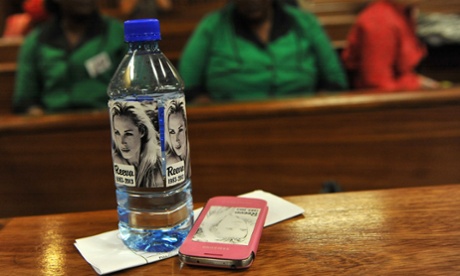
- Lawyers for June and Barry Steenkamp, parents of Reeva Steenkamp, have clarified details of the payments made to them by Oscar Pistorius since their daughter was killed last year. They say the R6000 monthly payments will be repaid and the Steenkamps will not pursue a civil claim against the athlete. Barry Roux, for Pistorius, told the court that his client did not want the money back and had given it “without conditions”.
- Nel has vigorously sought to undermine the picture painted by defence witnesses of a violent, overcrowded prison system in which Pistorius’s disabilities would not be catered for. There was not “the slightest possibility” that Pistorius’s prostheses would be confiscated, he told the court. The Department of Correctional Services has issued a statement calling the defence claims “inaccurate”.
- In cross-examination of the final defence witness, state prosecutor Gerrie Nel savaged claims by probation officer Annette Vergeer that South African jails would not be a suitable place for Pistorius. The facilities in prison would be the same if Pistorius had been convicted of murder, Nel said: would Vergeer even then have recommended he should not go to jail?
-
Nel warned that if the sentence imposed was too light, the public could be encouraged to take matters into their own hands.
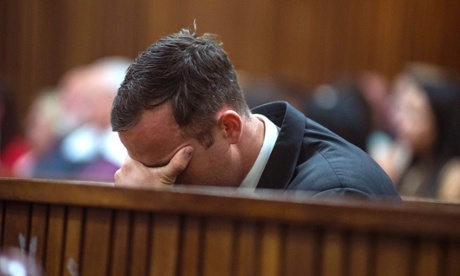
- There was an awkward exchange as Nel and Vergeer discussed the merits of the availability of condoms in prison, with Nel accusing the witness of discriminating against consensual sex between male inmates, and both avoiding mention of rape.
- South Africa’s two high-profile court cases collided, as Nel citedthe ongoing murder trial of Shrien Dewani, who was extradited from the UK to South Africa after the court in London agreed that jail conditions would be acceptable, as proof that Pistorius’s vulnerabilities should not spare him a prison sentence.
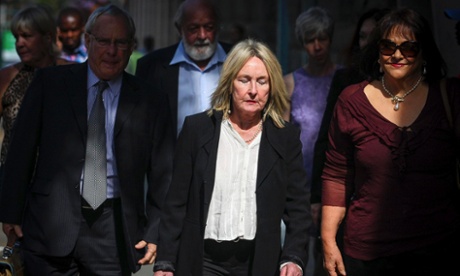
June Steenkamp has left court. Her niece Kim Martin told the judge today that her uncle and aunt – Reeva Steenkamp’s parents – could not testify in person because they feared they would “lose it” on the stand.
June Steenkamp leaves court after an emotional day 3 of sentencing hearing. pic.twitter.com/J9E4aFCEn7
— Milton Nkosi (@nkosi_milton) October 15, 2014
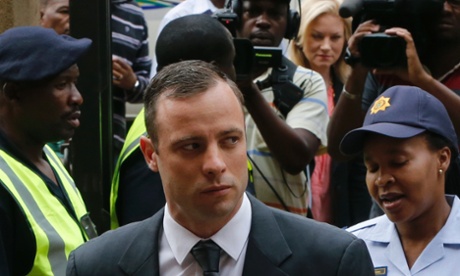
Oscar Pistorius leaving court on day 3 of sentencing hearing. He broke down when Kim Martin spoke about Reeva's life. pic.twitter.com/z0AGFdwzUO
— Milton Nkosi (@nkosi_milton) October 15, 2014
The Department of Correctional Services in South Africa has issued this statement to the media following exchanges in court about conditions in its jails:
The Department of Correctional Services has noted with concern inaccurate serious allegations that sought to cast doubt on the state of our correctional centres. The allegations from media reports emanate from the Oscar Pistorius trial that is underway at the North Gauteng high court. The reports seek to create an impression that our centres are fraught with, amongst other things, unhygienic conditions, gang violence and sodomy or rape.
In as much as our department respects the sub judice rule that applies to court proceedings that have not yet been finalised, the image of our correctional centres, our department and the government in general is at stake. We, therefore, deem it appropriate that we register our concern in this regard.
Out of respect for the sub judice rule, we will not comment further on the evidence as reported in the media; save to say that such allegations about the conditions in our centres are inaccurate. We are prepared to make our expert officials available to the court on issues relating to the conditions in our correctional centres as and when required to do so.
It is likely that Gerrie Nel will call on someone to testify to conditions in jails following claims by defence witnesses about the potentially injurious effects on Pistorius of a custodial sentence.
AFP has filed this report on the testimony of Kim Martin this afternoon:
Reeva Steenkamp’s cousin tearfully remembered an idyllic childhood spent with the law graduate and model, painfully recalling ‘the end of the world’ when Oscar Pistorius shot her dead.
Kim Martin told the South African judge – now weighing Pistorius’s punishment for unlawfully killing Steenkamp – of a caring and ‘fun-loving child’. Martin recalled how Reeva was the first baby she ever held, and of a joyful childhood filled with horse-riding and caring for injured animals.
Martin said the young Steenkamp once cared for a paralysed poodle named Jade, who she carried around, serving as its ‘legs’.
As Martin recounted her cherished memories, Steenkamp’s father Barry broke down in court, his shoulders shaking. Pistorius sat in the dock, also wiping away tears.
Through her good marks at school Steenkamp got a bursary, Martin said, in testimony designed to underscore the severity of Pistorius’s crime.
‘Aunty June was very strict, Reeva wasn’t allowed boyfriends,’ said Martin, adding that Steenkamp later became involved in an emotionally abusive relationship before she met Pistorius.
Martin said Steenkamp gave her very first pay cheque from modelling to her parents – who always struggled financially – to pay for her schooling.
Martin recalled driving to work and listening to the radio on Valentine’s day 2013, the day Steenkamp died.
When the announcer said that Oscar Pistorius shot his girlfriend, Martin remembered thinking: ‘I hope to God he is cheating on Reeva.’
When Martin saw her distraught mother she knew it was Reeva. ‘For me it was the end of the world.’
Asked why she was testifying, Martin fought through the tears: ‘I must be Reeva’s voice. I had to do this for Reeva, I owe it to her.’
#OscarTrial Kim Martin is sharing a long embrace with her uncle Barry in the gallery and chatting to the Myers family and Trish Taylor.
— Mandy Wiener (@MandyWiener) October 15, 2014
Court finishes for the day
Nel asks for the court to stop for today and resume in the morning. He says the witness is too emotional to be cross-examined today.
Roux says he doesn’t intend to cross-examine Martin. He wants to ask her two short questions. He thinks Nel should finish so that Martin doesn’t need to come back tomorrow.
Nel says he wants the extra time to consult with Martin first.
The judge says she will allow the break now, but reminds the court she is only available this week, and not for the following several weeks.
Nel says he is sure he will be finished with evidence by Thursday afternoon.
Court proceedings end for today. I will post a summary of today’s developments shortly.
Martin says they drove to the beach, which was very crowded, and found a table at a restaurant but “everything went wrong” with their order. Pistorius was agitated, she says; “he was obviously not used to Cape Town service!”
But she says she remembers thinking he was a very nice person. She did not notice much affection between the couple. Pistorius left the table to take a call and Martin asked her cousin if she was happy. Steenkamp replied: “Yes, but we need to talk.” But Pistorius came back and Martin says she never had a chance to quiz Steenkamp further.
That has bothered me for ever since then … What did she mean?
Martin is back to her meeting with Pistorius. She says she was excited and “a bit nervous to meet this famous person”.
I remember thinking, he’s just standing there … He came across quite shy.
Nel asks about a period Steenkamp spent living with the Myers family (some of whom are in court today) after she broke up with a previous boyfriend:
#PistoriusTrial Martin talks of Reeva living with the Myers family. 'She loved it.' Gina Myers is sobbing again now
— Alex Crawford (@AlexCrawfordSky) October 15, 2014
Martin says she met Pistorius once, with Steenkamp, on 2 January 2013 (a month before she was killed).
Steenkamp invited her cousin for coffee in Cape Town; she and Pistorius were flying down for a couple of days.
The previous Christmas had been the first she did not spend with her parents, Martin says, “due to work”. Nel points out that she did not spend it with Pistorius either.
Nel turns to Steenkamp’s work for abused women. Martin talks about the work she did for women’s rights:
Her thing was she wanted to stop girls allowing themselves to be in those [abusive] situations.
Her modelling career was also going from strength to strength, Martin says, and she was chosen to be the “face of Avon” and was on the cover of FHM. She was “extremely excited” when she was cast for the TV reality show Tropica.
Updated
Martin says she did not want to be here today but she had to be, to be Reeva’s voice. She felt she owed it to her cousin.
She is missing her daughter’s exam today, but her daughter understands why she needed to be in court.
Martin: "I know Reeva needs a voice. It's my way of being able to pay her back for what she went through." #Pistorius
— David Smith (@SmithInAfrica) October 15, 2014
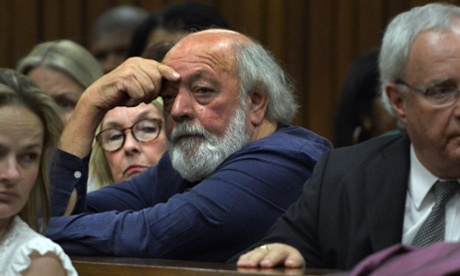
'Barry Steenkamp unable to take the stand'
Martin says she spoke to her uncle and aunt last night about giving evidence today. She wanted to know that they would be comfortable with her talking about them. She did not want to disappoint them.
They told her she had their blessing, and that she should be Reeva’s voice.
Barry Steenkamp told her he would love to take the stand but that he could not. “He would just lose it.”
Martin says she herself is on medication for depression and anxiety. Her children are receiving therapy. Her daughter has spent two weeks in an institution to help her cope; she and Reeva were very close.
Pistorius is bent over in the dock, his head in his hand, as Martin tells the court how her uncle’s health has suffered since Steenkamp was killed: he has had a couple of strokes. June Steenkamp has suffered a lot of stress.
Martin says June and Barry Steenkamp are strong and dignified people.
'It's ruined our whole family'
#PistoriusTrial Kim Martin: We were all like, why, why, why Reeva?' Describes the extended family falling apart, fighting, crying
— Alex Crawford (@AlexCrawfordSky) October 15, 2014
No one wanted to arrange the funeral, Martin says.
Nel asks how June and Barry Steenkamp reacted. Martin says her aunt was hysterical, she was medicated. Her uncle sat in the corner, “crying, crying, crying”.
It’s terrible. It’s ruined our whole family … Reeva was everything to them.
She looked after them so well … I didn’t think they’d be able to cope knowing that Reeva wasn’t there.
It was the worst experience I have ever, ever been through, Martin tells the court. She says she did not know how to face her uncle and aunt (Barry Steenkamp, in the court room, has covered his face).
#PistoriusTrial Alot of people in the court crying now. Hard listening to this pain
— Alex Crawford (@AlexCrawfordSky) October 15, 2014
An emotional #Pistorius is bent over in the dock.
— David Smith (@SmithInAfrica) October 15, 2014
Updated
Court resumes
Kim Martin is still on the stand. Nel is asking her about hearing the news on the radio that Pistorius had shot his girlfriend. It was not confirmed at that point that it was Reeva Steenkamp, she says.
Martin says she tried over and over to ring Steenkamp, but she wasn’t answering. She started to scream.
She got to her mother’s house; the door was open and her mother was hysterical.
And then I knew it was true.
It was for me the end of the world.
Martin is crying.
Nel asks Martin about the day Reeva Steenkamp was shot.
She and her husband were driving to work and the radio came on with breaking news.
Then he said: Oscar Pistorius … and the minute he said his name I jumped in the front seat and I froze.
And the next words were: has shot his girlfriend.
And I said to my husband, I hope to god he’s cheating on Reeva.
Kim Martin is very upset at this point. Judge Masipa tells her the court will take a break from what must be intensely upsetting testimony for her.
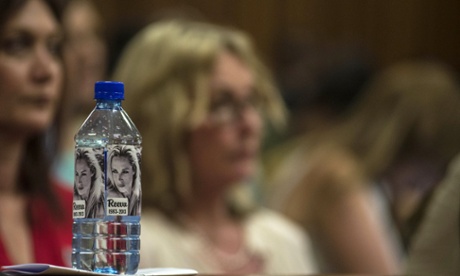
Martin is now talking about her uncle and aunt, Reeva Steenkamp’s parents:
Martin on Steenkamps: They were very generous. That's why they landed in financial difficulties. "Their home was always open to anybody."
— David Smith (@SmithInAfrica) October 15, 2014
Martin: Reeva was kind and generous. She got that from her parents @eNCAnews #OscarTrial
— Karyn Maughan (@karynmaughan) October 15, 2014
#OscarTrial Martin describing Reeva's distress about stray cats she had adopted and how she flew cat down to Martin in Cape Town.
— Mandy Wiener (@MandyWiener) October 15, 2014
The cat later escaped from Martin’s care:
Martin: "I was beside myself. I was so scared. I didn't know how to tell her. I know to her it's like losing a child." #Pistorius
— David Smith (@SmithInAfrica) October 15, 2014
When she eventually told Steenkamp, Martin recalls, her cousin told her she thought she was being punished for her break-up with Warren and that her life was out of control.
The cat came back about six weeks later.
Steenkamp found the break-up – combined with problems with her father’s health; he had diabetes – very traumatic, Martin tells the court. She told her cousin it was like a divorce.
Martin mentions a relationship Steenkamp had with a man called Warren: “She couldn’t have found a nicer guy.” But he was a workaholic and Steenkamp was ready to have children, Martin adds. The relationship came to an end.
Martin says Steenkamp sent money to her parents and covered their medical insurance.
Steenkamp came to live with Martin and her family in Cape Town for a while. Martin says her daughters “adored” Reeva, who ended up staying for around six months.
Martin is talking through Steenkamp’s early career as a model. She says her cousin was extremely happy, having fun, working hard and earning money.
Family was very important to Steenkamp, Martin says. She loved family gatherings.
Martin: "Reeva never ever wanted for love. That's where her love for family came from." As little as they had, they doubled it in love.
— David Smith (@SmithInAfrica) October 15, 2014
Updated
Reeva Steenkamp had a horse-riding accident as a young woman in which she broke her back and was in traction.
That made her take stock of her life, Nel asks. Martin agrees: Steenkamp decided she would finish her law degree but she would also pursue modelling because “life can be over so quickly”.
Steenkamp also wanted to support her parents financially, Martin says; she gave them her first pay cheque.
Martin says Steenkamp was, like her parents, a hard worker, who was always keen to get to school, an all-girls convent school in Port Elizabeth. She earned a bursary to study law and gained her LLB.
She says June Steenkamp was strict about relationships and Reeva only later began to have boyfriends. Her first relationship was with a jockey, who was “very emotionally abusive”.

Martin is giving very moving testimony about Reeva Steenkamp and how she is missed by her family:
#PistoriusTrial Reeva's father Barry seems to be crying. Must be hard listening to tales of his daughter's childhood
— Alex Crawford (@AlexCrawfordSky) October 15, 2014
For the *first time* in this trial, we finally get to hear a little about what Reeva Steenkamp was like, via her cousin. Deeply moving.
— Rebecca Davis (@becsplanb) October 15, 2014
Martin describes how Reeva took it upon herself to carry the family dog around after it was paralysed - "she became its legs".
— Aislinn Laing (@Simmoa) October 15, 2014
Martin says the Steenkamp family had to work very hard to keep their farm going, and struggled financially.
Martin: Reeva was the first baby I had ever held … I was 12 years old at the time … I was so nervous and scared that I would drop her.
Aunty June gave her to me and I held her in my arms and she didn’t even cry … There was a very strong bond from a very young age.
Reeva was a very fun-loving child … She was always like the little Pied Piper: we would follow her around … She would always look after everybody, even the adults.
Reeva from a young age stood out. There was just something about her.
Martin says the two families “spent all our time together”. She refers to Reeva Steenkamp’s parents as Uncle Barry and Aunty June.
Kim Martin says she is the first and oldest cousin of Reeva Steenkamp, 12 years Reeva’s senior. Their fathers are brothers.
Martin is blonde, with a strong jaw, is wearing a grey blazer rolled up at the sleeves and a black & white photo of Reeva on her breast
— Stephanie Findlay (@SJFindlay) October 15, 2014
Nel runs through the family connections, mentioning other siblings and cousins. Martin reveals that June Steenkamp’s oldest daughter, Simone, has moved back from the UK after Reeva was killed.
Updated
Court resumes for afternoon session
Gerrie Nel calls his first witness: Kim Martin, Reeva Steenkamp’s cousin. He asks that she not be televised, although we will hear her voice.
The Guardian video team has put together this clip from this morning’s proceedings, in which Gerrie Nel rebuts Annette Vergeer’s opinion that prison may be inappropriate for the athlete because of his disability, accusing her of providing misinformation:
There are several people present in court today who – reporters in Pretoria are suggesting – could potentially be called as witnesses for the state.
State consulted with Guil Yahav and Jared Mortimer over Pistorius night club incident yesterday. Not clear if they will be called @eNCAnews
— Karyn Maughan (@karynmaughan) October 15, 2014
Businessman Jared Mortimer was the man with whom Pistorius was involved in an altercation at a nightclub over the summer. Mortimer has claimed Pistorius was drunk.
Only state witness there is certainty on is correctional services official James Smalberger. @eNCAnews #OscarTrial
— Karyn Maughan (@karynmaughan) October 15, 2014
Reeva's close friend Gina Myers, Steenkamp family representative Kim Martens also potential state witnesses - as is Sam Taylor's mom Trish.
— Karyn Maughan (@karynmaughan) October 15, 2014
Patricia Taylor, mother of Samantha Taylor, an ex-girlfriend of Pistorius, recently published a book – Oscar: An Accident Waiting To Happen – in which she claimed the athlete was a deeply troubled and volatile young man who had to be coaxed out of anxious tears to collect a medal at the 2012 Paralympic Games.
Lunchtime summary
The court has taken an early lunch break while Gerrie Nel prepares to call the state’s witnesses. He’s told the judge he intends to call three or four witnesses, with one certain to be a representative of the correctional services – Nel has vigorously sought to undermine the picture painted by defence witnesses of a violent, overcrowded prison system in which Pistorius’s disabilities would not be catered for.
Here’s a rundown of this morning’s key developments:
- Lawyers for June and Barry Steenkamp, parents of Reeva Steenkamp, have clarified details of the payments made to them by Oscar Pistorius since their daughter was killed last year. They say the R6000 monthly payments will be repaid and the Steenkamps will not pursue a civil claim against the athlete. Barry Roux, for Pistorius, told the court that his client did not want the money back and had given it “without conditions”.
- In cross-examination of the final defence witness, state prosecutor Gerrie Nel savaged claims by probation officer Annette Vergeer that South African jails would not be a suitable place for Pistorius. The facilities in prison would be the same if Pistorius had been convicted of murder, Nel said: would Vergeer even then have recommended he should not go to jail? Vergeer conceded she had not seen the cells in her prison visit, but only the visiting areas.
-
Nel warned that if the sentence imposed was too light, the public could be encouraged to take matters into their own hands.
- There was an awkward exchange as Nel and Vergeer discussed the merits of the availability of condoms in prison, with Nel accusing the witness of discriminating against consensual sex between male inmates, and both avoiding mention of rape.
- South Africa’s two high-profile court cases collided, as Nel cited the ongoing murder trial of Shrien Dewani, who was extradited from the UK to South Africa after the court in London agreed that jail conditions would be acceptable, as proof that Pistorius’s vulnerabilities should not spare him a prison sentence.
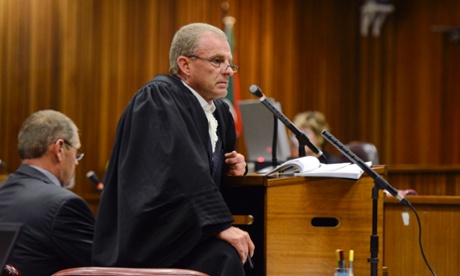
And some key quotes from Nel:
The court can do him a favour by sentencing him to prison … because it’s free. He would not have to pay for psychological treatment in the prison.
Should people be deterred from firing four shots through a locked door in the middle of the night? … That’s what we’re dealing with.
You say he’s a broken person. He’s a broken person because of what he did. We have to weigh that up against a broken family.
The court hearing will resume at 1.30pm South Africa time (12.30pm BST).
Arnold #Pistorius met Barry Steenkamp at court today. He says: "We had a chat. He's a good man. He's a good soul."
— David Smith (@SmithInAfrica) October 15, 2014
Nel says he needs some time to consult with his first witness. He says he will call “at most three or four” witnesses.
He says he won’t be long with his witnesses – I won’t take you at your word for that, says Judge Masipa, laughing.
Nel asks for a one-and-a-half-hour adjournment to prepare. The court will be back at 1.30pm South Africa time (12.30pm BST).
I will post a summary of the morning’s proceedings shortly.
When Pistorius sold his car, the defence team offered to pay the money into a trust account in case the Steenkamps later decided to accept the payment, Roux says. But the Steenkamps declined.
Roux reads the statement to the court. He breaks off to add that Pistorius made the monthly payments of R6000 (approximately £340/US$540) without conditions and he does not want it back, though he says it is up to the Steenkamps if they wish to repay it.
Roux has called all his witnesses but wants to deal with the statement of June and Barry Steenkamp, released this morning, about the payments made to them by Pistorius. You can read it here. Roux wants it to be read into the court record.
Nel moves on: has the witness followed the Dewani case?
(Shrien Dewani is currently on trial for the murder of his wife Anni on their South African honeymoon; you can read about it here.)
Nel points out that in extraditing Dewani, the UK court agreed that South African prison conditions were acceptable.
With that, Nel’s cross-examination is over.
Barry Roux, for the defence, asks Vergeer if she knows whether Dewani is being held in a South African prison. She says she doesn’t know. (Dewani is being held in Valkenberg psychiatric hospital, a high-security psychiatric hospital in the Western Cape.)

Updated
Vergeer says there is little privacy in prison, people would be exposed to sex without a choice #oscartrial
— Oscar Trial Channel (@OscarTrial199) October 15, 2014
Why is it a negative thing that condoms are available in prison, Nel asks Vergeer: are you discriminating against consensual sex?
She denies this, but asks: why would it be a positive factor? It is an all-male prison.
Nel says the witness is biased against prisons.
As Nel talks about "consensual, homosexual" sex in prison, #Pistorius glances up from his notepad in the dock
— Stephanie Findlay (@SJFindlay) October 15, 2014
You don’t want to send Pistorius to prison, based on “sweeping statements” about facilities in jail, Nel puts to Vergeer. She disagrees: she isn’t responsible for sending or not sending anyone to prison; she’s just here to give an opinion.
Vergeer agrees Pistorius is not a victim, but says he is not made of stone: he has emotions.
Nel: You say he’s a broken person. He’s a broken person because of what he did. We have to weigh that up against a broken family.
Pistorius is not a victim, Nel tells the court.
This witness has not had an easy morning: Nel has comprehensively taken apart her report to the court recommending that Pistorius should be sentenced to house arrest and community service:
#OscarTrial Vergeer looked quite shattered during the break after her relentless lambasting by Gerrie Nel. She's had a right thrashing
— Alex Crawford (@AlexCrawfordSky) October 15, 2014
Court is back in session
Day 46 of the hearing – and the third day of sentencing – resumes.
Probation officer Annette Vergeer is still on the stand for her cross-examination.
(The delay was apparently caused by a problem with the court recording machine, now resolved.)
Updated
Gerrie Nel indicated before the break that he expected his cross-examination of the final defence witness to be finished swiftly. This means we would then move on to the state’s own witnesses. It is likely there will be three, one of which looks certain to be a representative of the prison service, who will presumably vouch for the safety of Pistorius should he be jailed.
It looks less likely that June or Barry Steenkamp will take the stand, though some commentators in South Africa have suggested a friend of Reeva Steenkamp – perhaps Gina Myers – might do so.
We are still waiting for the court to resume; it’s past the 15 minutes allotted for the tea break but it’s usual for these breaks to run late.
Reporters in court in Pretoria say that Pistorius’s uncle Arnold was seen talking with Barry Steenkamp, father of Reeva, and the Steenkamps’ lawyer, Dup de Bruyn, during the break. Arnold Pistorius and Barry Steenkamp are reported to have hugged.
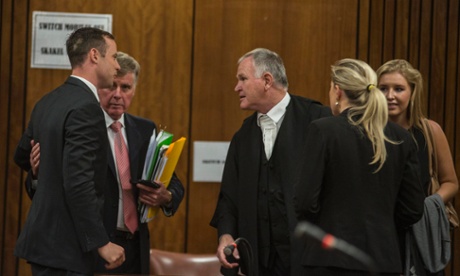
Asked June Steenkamp how she is as she left courtroom. "Surviving... Not good"
— Rohit Kachroo (@RohitKachrooITV) October 15, 2014
Nel asks for a tea break. He says he won’t be too much longer with this witness afterwards.
Court adjourns for 15 minutes.
So because he will have to walk on concrete floors and there are no shower rails, Pistorius should not be sent to prison, Nel asks Vergeer. If he has his prosthetic legs, he can walk: why should he be treated differently from other accused?
Vergeer says Pistorius could be pushed over, especially if floors are slippery.
Nel says he is concerned: is she saying that – whatever he does – he should never be sent to prison, because of the facilities? Even if he had been convicted of murder? The facilities would have been the same.
#OscarTrial Nel trying to corner Vergeer into admitting WHATEVER OP conviction, her opinion wd be he shdnt go to jail (as no facilities)
— Alex Crawford (@AlexCrawfordSky) October 15, 2014
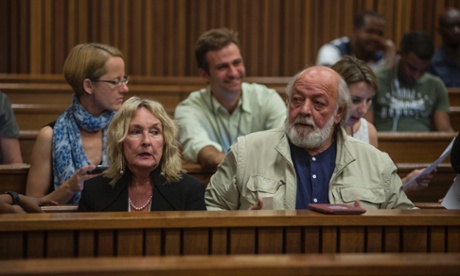
Nel: For community service to be effective, a person must be taken out of his comfort zone and not just do what he’s been doing all along?
The suggestion that Pistorius should work with disabled children would hardly be out of his comfort zone, Nel suggests. Vergeer says he could perhaps do voluntary work at a police station or museum instead.
Nel wants to know if Vergeer thinks society would be happy for Pistorius to get three years of house arrest, doing community service for a handful of days a month.
Vergeer says it is not about the opinion of society; the punishment should be about justice and serving a purpose.
Nel says that if society is not satisfied that justice has been done, that is when people take matters into their own hands.
Sixteen hours a month of community service is “shockingly inappropriate”, he tells the court.
Nel: We've sent people who committed fraud to prison. "They're not a danger to society?" Vergeer: "They're a danger to the economy."
— David Smith (@SmithInAfrica) October 15, 2014
Nel wants to know if Pistorius would be able to train and pursue an athletics career under correctional supervision; Vergeer confirms he would.
Nel brings up the case of Molemo “Jub Jub” Maarohanye, originally convicted of murder for causing the deaths of four children while drag-racing; his conviction was recently altered to culpable homicide – the same charge on which Pistorius has been found guilty – and given a sentence of 10 years in prison.
People do go to prison for culpable homicide, Nel points out, citing another case in which a school bus driver crashed into a train.
Don’t you think society would want a heavy punishment for the “horrible” death of Reeva Steenkamp, Nel asks.
Vergeer says it is not for society, but the court, to decide punishment.
Updated
Nel: Society demands that if you kill someone, there should be a harsh punishment.
Vergeer: I can’t dispute that … But we have to look at circumstances.
Vergeer continues to insist that Pistorius would not be able to carry on with his current psychological treatment if he is jailed. So anyone who is receiving treatment before he is convicted can’t be sent to prison, Nel asks her.
Another accused could pay for continuing treatment, Vergeer says: Pistorius might not have the funds. What if another accused did not have the funds, Nel asks her.
Nel: Then the court can do him a favour by sentencing him to prison … because it’s free. He would not have to pay for psychological treatment in the prison.
Nel concedes that not all South African prisons are “the best places in the world”. But he is taking issue with Vergeer’s characterisation of them. Prisoners are looked after, he says.
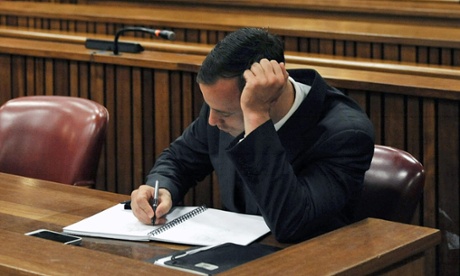
Nel finds more quibbles with Vergeer’s assessment of the prison system: doesn’t she know that psychological services must be available to all inmates, he asks. The witness is biting back on this one: you have to be realistic, she says – the quality of the service might not be enough for someone with Pistorius’s issues. There aren’t sufficient psychologists available.
We’ve moved back to the issue of Pistorius’s disability and the vulnerabilities Vergeer says would be exacerbated by a prison sentence.
Vergeer: It's not just the fact he's physically disabled. He needs to be bandaged. His personality, his vulnerability and all other aspects.
— David Smith (@SmithInAfrica) October 15, 2014
Do you have any statistics about disabled prisoners, Nel asks. She does not. Nel tells her there are, on average, 128 disabled people yearly entering prisons in South Africa. Prisons have been catering for disabled prisoners for 10 years. Vergeer says she “will have to take note of that”.
Nel swerves to a separate case in which Vergeer was an expert witness: the so-called Sunday rapist. (Johannes Jacobus Steyn was sentenced to five life terms in prison in 2012 for charges including murder, rape and kidnap.)
Vergeer was the probation officer for Steyn when he was convicted of indecent assault. He was receiving therapy and expressed remorse, she says, and she recommended correctional supervision – that is, not a prison term.
Nel: You had the view that he would not reoffend … he offended immediately thereafter.
Judge Masipa intervenes: it is the likelihood of reoffending that the court has to deal with, she says. It is not a certainty. Nel says he is not accusing the witness of anything.
Nel: You say the accused accepts he was negligent. What negligence does he accept?
Vergeer: That he fired the shots and a person was killed.
Nel: How do you know he accepts he was negligent?
Vergeer: He said to me he fired the shots that killed the deceased.
Nel is pushing Vergeer on the circumstances of Steenkamp’s death: did Pistorius tell her he intended to shoot through the door? Was it an accident, did the gun discharge by itself?
He was in shock, Vergeer tells the court; she can’t remember whether he told her he intended to shoot. The witness says the court has already heard Pistorius’s own version.
But Nel tells her he wants to know what Pistorius told her. Vergeer sticks resolutely to the judgment of the court.
Nel returns again to the moment #OscarPistorius fired those shots. It sometimes feels like he's trying to re-live the trial itself here.
— andrew harding (@BBCAndrewH) October 15, 2014
Nel: Should people be deterred from firing four shots through a locked door in the middle of the night? … That’s what we’re dealing with.
You are using a pro forma, Nel tells Vergeer: your report is a copy-and-paste number.
Vergeer says all reports must conform to a certain standard:
Vergeer: I went on a report writing course. We are bound to a certain extent in the way we draft reports. We have a standard pro forma.
— David Smith (@SmithInAfrica) October 15, 2014

Nel seems to be done on this point. He moves on to a new argument: the deterrence element of a sentence. What should other potential offenders be deterred from by this case, he asks.
Vergeer says she would start with the firearm offence. No, says Nel: let’s start with the culpable homicide. The witness says she would want others to think before committing an offence.
Nel now wants to know from Vergeer what Pistorius could do if, when imprisoned, his prostheses were taken and he wanted to complain. The witness says she knows there are avenues for complaint, but she doesn’t know what they are.
#OscarTrial Nel reads from the Correctional Services Act. 'On a daily basis someone must take account of complaints and deal within 7 days'
— Alex Crawford (@AlexCrawfordSky) October 15, 2014
Vergeer says she will make note of that. Nel is incredulous at what he is increasingly effectively painting as her paucity of knowledge of current conditions in South Africa’s jails. She also did not know that judges and magistrates can visit prisons to check on them.
Updated
Nel is still prodding Vergeer on the issue of the baths. Who told her there were none, he wants to know? The witness can’t say, but admits her report states there are no baths. This is based on one example, she concedes:
Nel: In a specific section in a specific facility, and you have elevated that to all prisons in South Africa?
Vergeer confirms she has not actually been inside the Pretoria prison, but only the visiting areas. There are single cells and baths for disabled prisoners, Nel tells her: yesterday, she told the court that Pistorius should not be jailed because there were no baths and he would be vulnerable without prostheses in the showers.
Vergeer says she saw no baths in a visit she made to a different prison two years ago.
Nel, like teacher chiding student for copying essay from internet, scolds Vergeer for condemning SA prisons without proper research.
— andrew harding (@BBCAndrewH) October 15, 2014
Nel says he finds Vergeer “so, so irresponsible” to come to court to testify without being fully informed about the prison system she is talking about. There are people in wheelchairs in prisons, he says. And he intends to call a witness who will vouch that there is not “the slightest possibility” that Pistorius’s prostheses will be confiscated.
Vergeer is facing intense pressure from Nel, and admits she cannot verify the position of the person she spoke to on the phone from Pretoria prison:
Nel: You come to the high court, you say I picked up the phone, somebody answered and this is what they said? You can't say their position.
— David Smith (@SmithInAfrica) October 15, 2014
Nel establishes that Vergeer is not familiar with the Correctional Services Act. He is surprised that she would come to testify without being aware of its details:
#OscarTrial Nel: a sentenced prisoner can apply for a single cel? Vergeer can’t say. (They can) BB
— Barry Bateman (@barrybateman) October 15, 2014
Isn’t she aware that no medical devices can be removed from a prisoner without permission of a doctor, Nel asks? (Yesterday, Vergeer said Pistorius’s prosthetic legs would likely be taken from him in prison.)
Nel: You should know everything about prisons because you’ve been commenting on prisons … and you don’t.
You don’t know the Department of Correctional Services have a policy on disability? You never thought of just asking them?
Nel is probing Vergeer’s research on the conditions in South African prisons – which yesterday she said were violent and overcrowded, with drugs, gangs, sodomy and Aids an everyday reality. The prosecutor queries whether any of her facts date from more recently than 2008. His implication is that conditions have improved since that time.
#OscarTrial The prosecutor is querying why Vergeer used the internet for her research rather than go direct to correctional services dpt
— Alex Crawford (@AlexCrawfordSky) October 15, 2014
This is the website Vergeer cited yesterday, about the management of South African jail.
Nel points out this site is a speech made by the general secretary of a union nine years ago.
Nel asks Vergeer if she is employed as a state official; she confirms she is, but has permission to work privately for the defence team.
As a state official, she could have requested additional information from other state departments, Nel says. Vergeer agrees, adding that she did so: a welfare officer at Pretoria prison.
Court is in session
Probation officer Annette Vergeer is still on the stand and prosecutor Gerrie Nel is straight back into his cross-examination.
Oscar Pistorius is already in the court room, along with his brother and sister, Carl and Aimee. Reeva Steenkamp’s parents, June and Barry, are also there.
The judge is expected to arrive very shortly.
Carl & Aimee Pistorius arrive at court #OscarPistorius pic.twitter.com/XJ28bYo5gS
— Khatija Nxedlana (@its_KhaTija) October 15, 2014
Steenkamp statement on payments from Pistorius
There was surprise in court on Tuesday as Vergeer disclosed that Pistorius has been making monthly payments to Steenkamp’s parents, June and Barry Steenkamp. Nel said: “Those monies will be paid back to the accused in full, every cent.”
My colleague David Smith reports:
After the hearing, the Steenkamps’ lawyer, Dup de Bruyn, explained that the payments had begun in March 2013, a month after the law graduate and model’s death.
‘When Reeva passed away, they [the Steenkamp family] were in financial straits,’ he said. ‘I conveyed this to Mr Pistorius’s lawyer. He came back with an offer of 6,000 [rand; approximately £340/US$540] a month for 18 months. When he started paying, we only thought it fair to make that public, but the request was from Oscar through his lawyers to keep it confidential. We honoured that request.’
Asked why they had accepted the payments, De Bruyn replied: ‘They needed it.’
But the payments have now stopped and will be repaid, he added, and they turned down the one-off sum [of R375,000]. ‘The offer has been made and rejected. The Steenkamps don’t want any money and there will be no civil case. They want closure.’
It looks likely, however, that the issue will rear its head in court again today:
Nel not accurate re payment to Steenkamps. Defense will give statement to court tomorrow says #OscarPistorius spokesperson @OscarTrial199
— Amalia Christoforou (@AmaliaChrist) October 14, 2014
And the Steenkamps’ legal team has this morning issued a fresh statement:
Certain disclosures in court yesterday have made it necessary to issue this statement … We have advised the parents to remain neutral in regard to sentence in the sense that they should not be seen to attempt to influence the sentence in any way.
After Miss Steenkamp (the deceased) was killed on 13 February 2013, the parents were in financial difficulties. This was mentioned to Mr Pistorius’s lawyers … We were contacted soon afterwards by Mr Pistorius’s lawyers with an offer that Mr Pistorius would contribute an amount of R6000 per month towards the parents’ rental and living expenses.
Payments took place from March 2013 until September 2014 … The request of Mr Pistorius, conveyed through his lawyers was that the matter be kept confidential. We have honoured this request.
We were therefore quite surprised yesterday when this fact was disclosed in court without any prior warning to us. The fact that the matter had been kept confidential at the request of Mr Pistorius’s legal advisers, has also not been placed on record.
It was always the intention of the parents that the amounts of R6000 would be set–off against any civil claim that they were going to institute. However once they had decided not to proceed with the civil claim, which decision was only taken during the past few weeks, it follows that the money will be repaid.
The Steenkamp lawyers also say that they approached the Pistorius team to discuss a possible financial settlement, but insist June and Barry Steenkamp were not aware of this:
When the parents were made aware of this offer, they considered it carefully but decided, for various reasons, that they did not want any payment from Mr Pistorius. This is also why we were instructed to advise that no civil claim would be instituted.
We place this on record to make it clear that a request for an offer emanated from our side, and not from Mr Pistorius’s side. He was responding to our request as to whether the civil claim could not be settled.
We agreed with Mr Pistorius’ legal advisors that this issue could be raised by them, but then in the context that it had been rejected.
Updated
Morning round-up
The high court in Pretoria is due to resume shortly to begin the third day of hearings to determine the sentence Oscar Pistorius will receive for the culpable homicide of Reeva Steenkamp.
So far this week, the court has heard testimony from four defence witnesses:
- Annette Vergeer, a probation officer and social worker, who said prison would “not assist him but break him as a person”. A custodial sentence, she insisted, would “be an excessive punishment with no benefits to him, society and the deceased’s family”. But her depiction of South Africa’s jails as violent and overcrowded, and ill-equipped to treat someone with Pistorius’ disabilities, was dismissed by the prosecuting team as out-of-date.
- Pistorius’s psychologist, Dr Lore Hartzenberg, who described him as “a broken man who has lost everything”. (“We are now dealing with a broken man, but he is still alive,” prosecutor Gerrie Nel pointed out.)
- Joel Maringa, a social worker for the correctional services department, told the court that convictions for culpable homicide often do not result in a jail term, and recommended that the athlete should serve a three-year period of house arrest and community service – a suggestion seconded by Vergeer, but lambasted by Nel as “shockingly inappropriate”.
-
Peet van Zyl, Pistorius’s manager, gave evidence about the athlete’s charity work (his contribution to societyis one of the factors that the judge may take into account when deciding his sentence), but agreed with Nel that such work was not uncommon for high-profile sports stars.

This morning, Nel is expected to continue his cross-examination of Vergeer, before moving on to call the state’s own witnesses. We know from comments made by Nel on Tuesday that one is a representative of South Africa’s prison system who will attempt to counter Vergeer’s testimony that Pistorius’s safety cannot be guaranteed in the country’s jails.
You can catch up on the key issues in the sentencing process here:
- What sentence could Pistorius receive?
- What sentence is expected?
- What happens at the sentencing hearing?
The Guardian’s David Smith will be in the courtroom in Pretoria and you can read his tweets @SmithInAfrica. I’ll be tweeting breaking news and key developments @Claire_Phipps.
The report on yesterday’s court proceedings is here. Tuesday’s live blog is here, and Monday’s here.
Today’s court hearing is due to start at 9.30am South Africa time (8.30am BST).
.jpg?w=600)