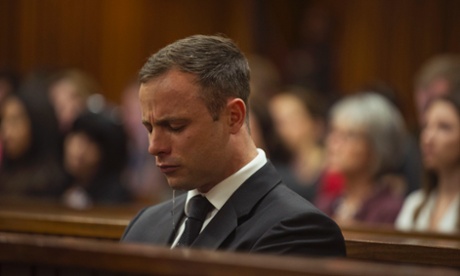
David Smith has filed this report from court in Pretoria on today’s developments. Plus here you can see video highlights of Friday’s court proceedings:
End-of-day summary
The defence and the state have now concluded their arguments in mitigation and aggravation of sentence. Now everything rests in the hands of Judge Thokozile Masipa, who will return to court on Tuesday morning to hand down sentence on Oscar Pistorius.
The defence case
- Pistorius’s legal team say he should not be sent to prison because he is also a victim of what happened on 14 February 2013:
There was an accused and a victim … and the accused became a victim. We have a man who negligently, in an anxious and vulnerable state of mind, killed the woman that he loved.
- Negative media coverage and lurid speculation on social media – which Judge Masipa said she would not take into account – as well as the prosecution’s treatment of Pistorius in court, had left him a broken man:
He was denigrated … a cold-blooded killer. He has lost everything. He doesn’t even have money to pay legal expenses. He has nothing left.
- Lead counsel Barry Roux said the judge should apply the principle of ubuntu, humane punishment, in allowing Pistorius to “make good” by doing something for society. The money he paid to the parents of Reeva Steenkamp shows he wants to take responsibility. A community service can be appropriate in cases such as this:
Is this a person you must remove from society? … We say no.
- Pistorius’s true sentence has been the loss of the woman he loved:
It’s deep and it’s permanent and it won’t go away … No punishment can be worse than the last 18 months.
- Sending Pistorius to prison, where he might not get proper medical care, could increase his risk of suicide and compromise the care he needs for his disabilities.
- Pistorius “absolutely” accepts the verdict of culpable homicide but his negligence in killing Reeva Steenkamp was born out of a genuine, if erroneous, belief that his life was at risk.
The state case
- Lead prosecutor Gerrie Nel said Pistorius must go to prison for at least 10 years:
The only, but only, reasonable sentence would be a long-term incarceration.
- In argument that veered close to implying Judge Masipa had made the wrong judgment in clearing Pistorius of murder, Nel said any sentence should acknowledge that the degree of negligence involved made the offence very close to murder.
- A community sentence would be “shockingly disproportionate” to the crime:
Society trusts the court to deal with criminals … To be harsh if it has to.
- Pistorius has “shamelessly” used his disability as an excuse and wants the court to think of him, not Steenkamp, as the victim in this case. The state does not believe he has shown remorse:
The fact that he’s sorry she’s dead is not remorse for what he did … It is not good enough.
- The court has had months of hearing and thinking about Oscar Pistorius. It now needs to think about Reeva Steenkamp and her family:
What could be worse than hearing your child died a violent death? I’ve thought about it: nothing. The deceased did nothing to contribute to her death. She did nothing. She died a horrific death … She had nowhere to go.
- The state believes Pistorius’s offer of a financial settlement to Steenkamp’s parents was “an attempt to influence sentence”.
- It is not the business of the court to worry about conditions in prison: Pistorius can be catered for.
That is all for the live blog for today. Live coverage will resume on Tuesday morning at 9.30am South Africa time (8.30am BST), when we expect sentence to be handed down. Thank you for reading.
Reuters has filed this report on the day’s hearing:
Oscar Pistorius should serve at least 10 years in prison for killing his girlfriend, Reeva Steenkamp, on Valentine’s day last year, the state prosecutor said at the close of the athlete’s sentencing hearing on Friday.
Judge Thokozile Masipa adjourned the session until Tuesday, when she is expected to sentence Pistorius.
The 27-year-old Paralympic and Olympic athlete, whose lower legs were amputated as a baby, was convicted of culpable homicide last month for the shooting of Steenkamp, a 29-year-old law graduate and model.
‘The minimum term that society will be happy with will be 10 years imprisonment,’ chief prosecutor Gerrie Nel told the hearing. ‘This is a serious matter. The negligence borders on intent. Ten years is the minimum.’
The defence and prosecution teams have spent much of the five-day sentencing hearing arguing over whether Pistorius should go to jail or be punished with house arrest and community service. Legal experts are split on the likely outcome.
A non-custodial sentence would be likely to spark public anger, fuelling a perception among black South Africans that, 20 years after the end of white-minority apartheid rule, wealthy whites can still secure preferential justice.
‘We shouldn’t fail the parents. We shouldn’t fail society. Society may lose its trust in the court,’ Nel said.
Defence attorney Barry Roux earlier said the sprinter should be given community service because he had shown remorse and had been punished enough since he shot dead Steenkamp through a toilet door in his Pretoria apartment. Pistorius said he mistook Steenkamp for an intruder.
‘He wants to make good as far as possible. Serious regard should be given to a community-based sentence so something good can come out of this,’ Roux said.
For those readers who think this trial – which began in March – has taken a long time to get to this point:
Lawyer @ulrichroux says that a normal S African trial with the amount of witnesses in Pistorius trial would have taken 3 to 4 years.
— Rebecca Davis (@becsplanb) October 17, 2014
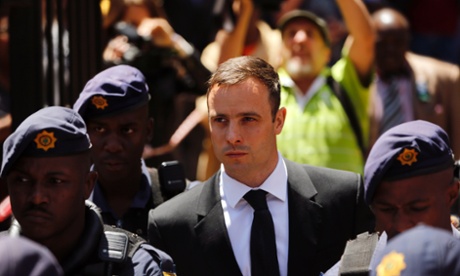
Pistorius leaves court in Pretoria after Gerrie Nel asked for him to be sentenced to 10 years in jail. pic.twitter.com/FVrWj8tglB
— Milton Nkosi (@nkosi_milton) October 17, 2014
It’s worth remembering that Pistorius is also facing sentencing for his conviction for the negligent use of a firearm, when he fired a gun in a crowded restaurant a month before he shot Reeva Steenkamp. Neither side dwelt on this issue during the sentencing hearing, understandably focusing on the far more serious charge of culpable homicide. But Pistorius could face a maximum of five years in prison on the firearms charge – although a suspended sentence or a fine on this count seems more probable.
Sentencing to be handed down on Tuesday
Judge Masipa thanks both sides. She has been impressed by how both sides have conducted themselves throughout the trial.
The court will reconvene on Tuesday at 9.30am South Africa time (8.30am BST) for sentence to be handed down.
Court adjourns for the day. I will post a summary shortly.
Updated
Nel springs up again: if all Pistorius needs in the shower is a “little bench … we can take a little bench to any prison”.
He is done now too.
Nel is finished. Roux has some points he wants to counter.
He says that in the shower room of Pistorius’s home, he has a bench to sit on rather than rails.
The money offered to the Steenkamps was done privately and not in expectation of a lesser sentence.
He refers to the video reconstruction of the killing made by the Pistorius team: that was never intended for public viewing and should not have been used by the media, he says.
That’s it from Roux.
State: 'Pistorius should get at least 10 years in jail'
Judge Masipa points out that Nel did not specify the length of prison term he would recommend.
Nel says the state would be happy with a minimum term of 10 years.
The prosecutor now wants to address Roux’s references to ubuntu (for a definition, see here). This case is too serious for such a principle, Nel says. It is not relevant. He dispenses with this very quickly.
Nel disputes claims that Pistorius’s prosthetic legs could be taken from him in prison. But, he adds, “with respect”, it is not the court’s role to decide on prison conditions, only on a suitable sentence.
If prisons can’t cater for him, we’ll come back to court, he says.
We don’t know what Pistorius will do if he doesn’t go to prison, Nel says. He may or may not return to athletics, or work for his uncle Arnold Pistorius. The suggestion from the defence is that he would work two days a month in community service. Is that enough?
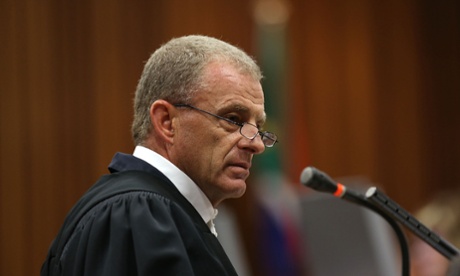
Nel explains to the court why Pistorius must go to prison. The accused did not fire just one warning shot, but fired four times. He was competent with a firearm but created this dangerous situation.
Updated
'Only reasonable sentence is incarceration'
Nel: We argue that the only, but only, reasonable sentence would be a long-term incarceration.
Judge Masipa intervenes: “You can take it from me,” she tells Nel, “all those paragraphs [on negative media coverage] will be disregarded.”
Updated
The media reports on this case are irrelevant, Nel says. Nobody forced Pistorius to read them. They should have no bearing.
#PistoriusTrial Nel reminds us OP has a 'black book' where he lists the journalists who he believes are negative towards him
— Alex Crawford (@AlexCrawfordSky) October 17, 2014
Once again, Nel references Shrien Dewani’s extradition from the UK to South Africa as evidence of the suitability of prisons. He pours scorn on the report from defence witness Annette Vergeer, accusing her of cribbing her research from the internet. Prison conditions are dignified, he says.
Nel raises Pistorius’s involvement in an altercation in a nightclub this summer. Not much evidence of remorse there, he says.
Nel's attack on Pistorius is vicious, and is raising blood pressure on the family benches, OP's father Henke clearing his throat angrily.
— Aislinn Laing (@Simmoa) October 17, 2014
Pistorius 'shamelessly uses disability as an excuse'
On to the issue of Pistorius’s disability, Nel notes that the athlete fought to race alongside able-bodied sprinters. It’s “shameless” that he now uses his disability as an excuse, he says.
He concedes he is on “dangerous ground” on this point but ploughs on.
The defence makes much of the lack of shower rails in prison, he says – there are no shower rails in Pistorius’s own home.
Nel disputes Roux’s claim that Pistorius has been open and honest about what happened on the night of 14 February 2013. He has given so many different versions, Nel says.
The prosecutor goes on: he is not convinced by Pistorius’s apparent remorse.
The fact that he’s sorry she’s dead is not remorse … It is not good enough.
Pistorius should apologise for firing the shots through the door, Nel says: he needs to be remorseful for what he’s done.
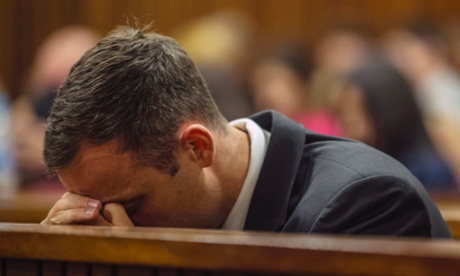
This case is not a momentary lapse in concentration, Nel says: it’s on the other end of the culpable homicide spectrum. We, the state, say the accused deliberately fired the shots, Nel says, acknowledging the state failed to prove beyond reasonable doubt that he had foreseen that he could kill the person behind the door.
[13.03BST edit: This paragraph was tweaked to clarify that it was the foresight that the state failed to prove, not the deliberate firing of shots, which the judge did accept.]
Updated
Nel is really on the attack here:
#OscarTrial Nel really cutting through the clutter here arguing that the crux is that OP armed himself and fired a gun four times.
— Mandy Wiener (@MandyWiener) October 17, 2014
Nel brutally stripping away any pity the judge might feel for Pistorius- the Steenkamps may never recover, he says, they're the victims here
— Aislinn Laing (@Simmoa) October 17, 2014
Nel says he has heard many voices saying “please don’t break the accused” with the trial, and the sentence. He broke a family, Nel points out. Sarcastically, he parodies the Pistorius account:
I’m a victim, feel sorry for me, the media victimised me.
When I wanted the media to capture my brilliant athletic performance, I loved them; when the media write about my trial it’s unfair.
Pistorius brought this all on himself, Nel says.
Nel: The accused’s actions were so grossly unreasonable, he acted so hastily, with such excessive force, that his actions bordered on dolus eventualis.
This wasn’t a road accident or assault, he says, or someone firing blindly. Pistorius fired into a toilet door “well knowing there was someone there”.
Nel says the state is not questioning the judge’s verdict of culpable homicide, but it does rather sound that way. He says there are several elements of the case that do not make sense and will remain matters of speculation.
Not to send Pistorius to prison would be paying lip service to the seriousness of the offence, Nel says. The worst thing you can do is take another person’s life: there is nothing more serious.
The punishment should acknowledge the sanctity of human life … It demands heavy punishment.
Court resumes
Gerrie Nel continues his argument. He turns to the shooting: Pistorius was “grossly negligent … bordering on dolus eventualis”. The sentence must reflect this.
Pistorius was cleared of murder by dolus eventualis (that he must have known he was likely to kill the person by firing) but Nel wants to suggest that the judge’s sentence should acknowledge that the degree of negligence involved takes the offence very close to a murder conviction.
Nel can't let go of the murder conviction he failed to secure, telling Judge #OscarPistorius actions "border" on lowest murder charge.
— andrew harding (@BBCAndrewH) October 17, 2014
What is ubuntu?
Barry Roux made repeated references to the principle of ubuntu and in particular a book called UBuntu and the Law. As this excerpt from the book explains:
Ubuntu expresses a conception of humanity and an ethic (a set of moral and political principles) which emphasise group solidarity, the interdependence of members of a society, and the interconnected value of human lives in community.
It derives from a Zulu phrase, umuntu ngumuntu ngabantu: a person is a person through other people .
Roux employed it to stress his argument that Pistorius ought to be given the chance to “make good” his crime by giving something back to society. Sending him to prison would not serve this aim, the defence argues.
Oscar Pistorius standing in the dock during this adjournment silently praying with his siblings
— Rohit Kachroo (@RohitKachrooITV) October 17, 2014
Court takes a short break now – back in 15 minutes.
If the court does not come up with a sentence that satisfies society, society might take matters into its own hands, Nel warns. Society would lose faith in the courts.
I’m really trying my utmost not to become emotional in my argument … But every right-thinking person would agree with me that there could be nothing worse than hearing your child died a violent death. What could be worse than that? I’ve thought about it: nothing.
The deceased did nothing to contribute to her death. She did nothing.
She died a horrific death … She had nowhere to go.
A community sentence is simply not appropriate, Nel goes on. Should the court sentence him to go home, stay in the “luxurious home” of his uncle Arnold Pistorius, leaving only to train, play sport, go to a doctor? That’s what we all do.
And for a few hours a month he will go and do community work, Nel asks. That is “shockingly disproportionate” to the crime he committed.
Nel turns to mercy. He understands mercy, he says. But is the court supposed to apply mercy because Pistorius could have made millions and now cannot? That cannot be an argument, Nel says: he caused it himself.
How much grief and trauma must a parent have endured to be unable to take the stand to talk about the loss of a daughter, Nel asks. The family will never get over this, he adds.
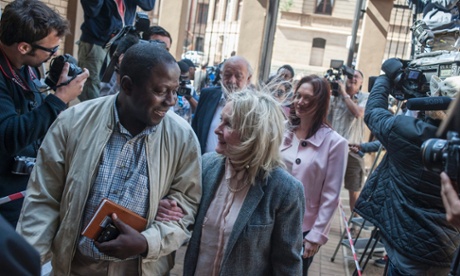
Pistorius does not react, keeps looking down.Roux shakes his head grimly at Nel talk of his client's "cheap offer" designed to sway sentence
— Aislinn Laing (@Simmoa) October 17, 2014
On the issue of the money paid to Steenkamp’s parents, Nel homes in on the word “offer”. It was an “offer for settlement” – not a gift or a token, he says.
Nel adds that he was “saddened” that the Steenkamps had needed to accept the R6000 a month from Pistorius because they were financially devastated on top of everything else they had been through.
He notes that the separate settlement offer had been made between judgment and sentencing.
Why not earlier? Why not later? … It was an attempt to influence sentence.
Nel says the testimony of Kim Martin, cousin of Reeva Steenkamp, was the voice not just of her family but of society. Every mother listening would have felt her pain, he says.
Nel runs through what happened to Reeva Steenkamp. She was not shot with regular ammunition, but “devastating” black talon bullets.
He defends showing the picture of Steenkamp’s body to Pistorius: it was important that he and the court saw what he did to her.
Nel: Society trusts the court to deal with criminals … To be harsh if it has to.
Firing four shots through a locked door into a tiny cubicle, knowing someone is in there – society will want to know what the court will do with that person, Nel says.
He wants the court to think about Reeva Steenkamp. The court has been thinking about Pistorius for months, his disabilities and anxiety.
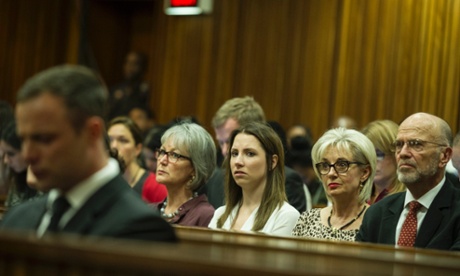
State begins final argument
Barry Roux has come to the end of his argument.
Gerrie Nel is on his feet. Sentencing is different to the main trial, he says. Society is involved and must be taken into account.
Roux: The accused so desperately needed to apologise. We have pointed out the letters written … We understood the emotions of the parents.
The Steenkamps’ lawyer thought it not appropriate to give the letters to the parents.
He cannot make it right but he wants to do something to assist in the healing process … It’s a genuine and positive effort.
Pistorius wants to do something good for the community, Roux says. Serious consideration should be given to a community service as part of that healing process.
Jails are very overcrowded, Roux points out. Community service helps ease the pressures on prisons.
Roux on prison sentence: "It can never be consistent with ubuntu, consistent with restorative justice. It would be retribution." #Pistorius
— David Smith (@SmithInAfrica) October 17, 2014
There are threats against Pistorius should he go to prison, Roux says. How would preferential treatment help him? It would make it worse.
Sending him to prison would smack of retribution.
Correctional supervision and community service is a real punishment, Roux says, but it is restorative: for the good of everyone. It does not need to be restricted to 16 hours a month, as witnesses this week had proposed.
Roux now turns to evidence from yesterday given by Zac Modise, acting head of correctional services. Modise conceded that a regular prison wing would not be suitable for Pistorius, Roux says. But Modise could not give assurances about the hospital section: how would he be protected from diseases? Must he stay in hospital and not get involved in outside work?
It can never be a suitable punishment by locking a person up in a hospital.
Roux says it would be appropriate if Pistorius had deliberately killed Steenkamp and needed to be removed from society. But his negligence needs to be balanced against his disability and vulnerability. There needs to be compassion.
Roux: "What's really significant is... when we see disability we don't realise the real impact and effect of disability." #Pistorius
— David Smith (@SmithInAfrica) October 17, 2014
Roux: "He's not just walking around on his prosthetics and it's fine. There's pain, there's treatment." #Pistorius
— David Smith (@SmithInAfrica) October 17, 2014
Roux reads from mental health reports on Pistorius that concluded he was not aggressive nor a danger to society.
Should Pistorius not receive proper medical care, his condition is likely to worsen and increase the risk of suicide.
#OscarTrial Roux: easy to stand here after an accused is guilty to say he is sorry - we refer you to the beginning, what witnesses saw. BB
— Barry Bateman (@barrybateman) October 17, 2014
Witnesses on the scene of the immediate aftermath of the shooting saw his remorse and distress. This remorse is genuine, Roux says.
Putting Pistorius in jail “would not be conducive at all” to helping with his anxiety and depression. He is suffering post-traumatic stress disorder.
Updated
The idea that a prison sentence would be the end to this tragedy is wrong, Roux tells the judge: “There is no ‘over’.”
The money offered by Pistorius to the parents of Reeva Steenkamp was private and sincere, Roux goes on. It shows the athlete was prepared to take responsibility for his actions, the lawyer says.
Now the Steenkamps want to return the R6000 Pistorius had been paying them monthly, he does not want that back. It can go to charity, Roux says.
He wants to make good. He can never make good. He wants to make good as far as possible.
Roux turns to Pistorius’ charity work, which Nel was rather cynical about earlier this week.
Lots of sports people do charity work, Roux concedes, but Pistorius went beyond that. His doctorate from Strathclyde University was not for athletics but for the work he did for others.

Updated
Pistorius 'has lost everything'
Roux: He lost a person he loved, his self-respect, most of his friends, his career, all his properties, all his money. He’s lost everything.
Is this a person you must remove from society? … We say no.
Roux moves on: the false stories heard in court that Reeva Steenkamp was screaming on the night she was killed must have caused anguish to her parents as well as the accused, he argues.
Judge Masipa intervenes. She is concerned about what the defence has said about the media. With evidence that has been put before the court, one can weigh and test it, she says. How can the court tell whether these allegations about the media are true?
Roux says, factually, the media articles he highlights were false. But I haven’t read those articles, the judge says.
It is a punishment in itself to read in the press that you are a cold-blooded murderer, Roux says.
Masipa says it is important that the court not be influenced by anything that has not properly been put before it. Roux says it is not the content of the media reports but their effect on Pistorius that he wants her to bear in mind.
Updated
The pain for Pistorius of having killed the person he loved will never go away, Roux tells the court:
It’s deep and it’s permanent and it won’t go away … No punishment can be worse than the last 18 months.
From the beginning, Pistorius told the truth, Roux says: other lawyers criticised the defence team for putting their version out so early, but the athlete insisted on it.
Roux says the parents of Reeva Steenkamp have said they want no vengeance: they are neutral on what the sentence should be and leave it in the hands of the court. He admires them for this.

Pistorius is a young man, Roux says, 27 at the time of the shooting. He doesn’t have the wisdom one would have in later years. On top of this are his disabilities and vulnerabilities. He is a first-time offender. He has lost his property and not earned a penny since the shooting. He has no sponsors now.
He is a person that is down-and-out, he is broken … There is nothing left of this man. But it’s far worse than that.
When you kill someone, you must live with the consequences, Roux says. But the consequences in this case were extreme:
The denigration, the humiliation, the ridicule, the blame, the false allegations – ongoing, worldwide. That’s what he was subjected to.
He stands there, giving evidence and crying, knowing the whole world is watching. He was absolutely exposed.
Roux: You cannot disregard the actual consequences of the negligence. We’re not trying to do that. It is absolutely tragic.
He cites other cases of culpable homicide in which shots were fired but the perpetrator did not go to jail. Community sentences have been used in such cases, he tells the court.
Updated
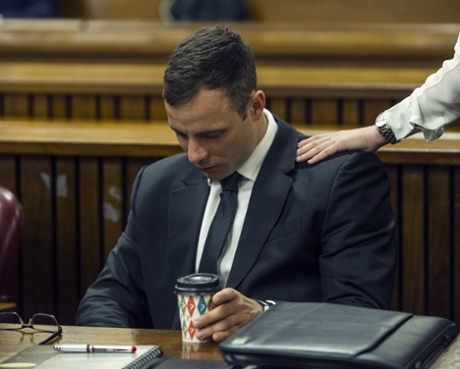
Roux cautions the court: the first instinct when something bad happens is to say someone must go to prison. But is there a fairer way?
Roux: First reaction is that offender must go to prison. "Be careful that you don't become trapped in that mindset. Society has moved on."
— David Smith (@SmithInAfrica) October 17, 2014
Imprisonment should be a punishment of last resort, he says.
The National Prosecuting Authority painted Pistorius as a cold-blooded murderer and made no apology when he was cleared of murder, the defence lawyer adds.
Roux turns back to ubuntu, humane punishment. He reminds the judge that she has said the penal system has shifted from retribution to rehabilitation.
Pistorius is crying in the dock now.
Pistorius was treated badly by the prosecution in court, Roux goes on:
The accused was forced to look at a photo of the deceased. He loved her. He felt horrible about her death. Horrible.
That’s not how we treat an accused.
He was denigrated … a cold-blooded killer.
He has lost everything. He doesn’t even have money to pay legal expenses. He has nothing left.
Roux says Pistorius sold his car – his last asset – not to help win a lesser sentence, but to try to make good with the Steenkamp family (he made a financial offer to Reeva Steenkamp’s parents, which was rejected).
Updated
Roux says Pistorius “never, ever” considered that it was Steenkamp behind the toilet door. And yet in the bail application, “he became a premeditated murderer”.
The media and social media were full of speculation, he says: that Pistorius had “crushed” Steenkamp’s head; that he was abusing steroids; that he was taking acting lessons before appearing in court.
Roux: Never, ever in the history of our law, or any other country, have I seen such unfairness. #Pistorius
— David Smith (@SmithInAfrica) October 17, 2014
Roux: There was an accused and a victim … and the accused became a victim.
He was charged and taken to the bail court on a charge of premeditated murder. There is no doubt the investigating officer gave false evidence.
We have a man who negligently, in an anxious and vulnerable state of mind, killed the woman that he loved.
Sometimes, Roux says, when considering a punishment, “we must just sit back and look again and ask: is that really what the law is about”.
There are elements of society that would want the death sentence for Pistorius, he says. But what is actually in the interests of society, taking into account all the facts of the case?
Roux is talking about the concept of ubuntu, humanity. He says the punishment should be about giving something back to society: the restorative justice principle.
Roux arguing Pistorius's punishment should be centred around ubuntu, an impt concept here in SA & a big rhetoric move
— Stephanie Findlay (@SJFindlay) October 17, 2014
Roux says, when it comes to sentencing, the judge must consider if there was any “deviousness [or] conscious unlawfulness … there was not”.
Pistorius bears a “high degree of negligence” but the athlete was compromised by his vulnerabilities.
The state will tell you about deterrence and retribution, Roux says. He refers to the “Jub Jub” case – rapper Molemo “Jub Jub” Maarohanye, who was jailed for 10 years for culpable homicide after he killed four children while drag-racing. The Pistorius case is completely different, he says: in getting in the car, Maarohanye consciously acted unlawfully. Pistorius did not, he maintains.
Roux reminds the court that Pistorius “genuinely, though erroneously” believed there was an intruder in his house, and that his life – and that of Steenkamp – was at risk.
There is no evidence, and nothing in the judgment, to contradict this, he adds. The judge agreed that he did not subjectively foresee that he would kill the person behind the bathroom door.
Roux starts by telling the court that the loss of a child – Reeva Steenkamp’s parents, June and Barry, are in court again today – is the greatest devastation.
But he wants the court to look at the context of this “tragic event”.
He says Pistorius has “absolute acceptance” of the judgment: the guilty finding on culpable homicide.
Court hearing begins
Day five of the sentencing hearing starts now.
Defence counsel Barry Roux says the Pistorius team has handed in to the court the written heads of argument but he has not yet seen the state version.
Prosecutor Gerrie Nel says he will find it and make it available “right now”.
Reporters in court in Pretoria say there is so far no sign of the three men involved in yesterday’s disagreement with the Pistorius family: Mikey Schultz, Jared Mortimer and Marc Batchelor.
#OscarTrial Clarity on the Schultz/Aimee incident yesterday. It was allegedly Schultz friend Mark Strydom who threatened Aimee, not Schultz.
— EWN Reporter (@ewnreporter) October 17, 2014
Both state and defence teams agreed yesterday – and assured Judge Masipa – that closing arguments would be wound up today. Each needs only to summarise the testimony the court has heard this week – it isn’t intended to be a re-run of the full trial.
But it seems highly unlikely – especially as she has the written heads of argument to consider too – that the judge will hand down a sentence today. Having previously told the court she was busy with other commitments for the next few weeks, we now understand she has cleared her diary for next week. The best bet appears to be that she will announce her decision on Tuesday.
Oscar Pistorius has arrived at the court for his sentencing hearing:
Pistorius arrives in court on Friday morning for closing arguments. Could this be his last weekend as a free man? pic.twitter.com/2RfDDx0x77
— Milton Nkosi (@nkosi_milton) October 17, 2014
Morning round-up
Welcome to live coverage of day five of the hearing to determine what sentence Oscar Pistorius will receive for the two charges of which he was found guilty last month: the culpable homicide of Reeva Steenkamp and illegally discharging a firearm in a crowded restaurant.
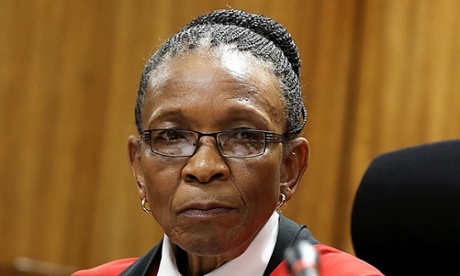
Thursday saw the last evidence from witnesses, as prosecutor Gerrie Nel brought this part of the proceedings to an early close. Today will see both state and defence present their final arguments to Judge Thokozile Masipa, who will then take a few days before handing down sentence, probably next Tuesday.
Yesterday also saw Aimee Pistorius, sister of Oscar Pistorius, allegedly threatened in the court room by Mikey Schultz, a self-confessed killer. He denied swearing at her, calling the Pistorius family “a bunch of liars”. A full report on that incident is here. As David Smith reports:
Schultz confessed to shooting dead businessman Brett Kebble in September 2005 but, with two accomplices, escaped prosecution in an immunity deal with the state effectively brokered by Gerrie Nel, now prosecutor in the Pistorius trial.
In other key developments:
- Defence counsel Barry Roux read out newspaper reports that prison gang leader Khalil Subjee, known as The General, had said he would order “a hit” on Pistorius. Zach Modise, the acting national commissioner for correctional services, giving evidence for the state, insisted Pistorius would be safe in the country’s prisons, which he said were the best in Africa.
- Roux won a concession from Modise that it would not be suitable to house Pistorius in a general prison wing and he should be guaranteed a placement on a hospital wing. But the defence raised concerns that there is only one resident doctor for the 7,000 inmates at Kgosi Mampuru prison, where Pistorius would be likely to serve any custodial sentence.
- Reeva Steenkamp’s cousin Kim Martin concluded her moving testimony on the effect of the killing on her family, saying Pistorius “needs to pay for what he’s done”. She told the judge:
I’m very fearful of the accused. I have tried very hard to put him out of my mind. We’ve even made a point of not mentioning his name in my house, because I didn’t want to spend any energy thinking about him.
I really believe Mr Pistorius needs to pay for what he has done. My family are not people who are seeking revenge. We just feel that to take someone’s life … needs sufficient punishment.
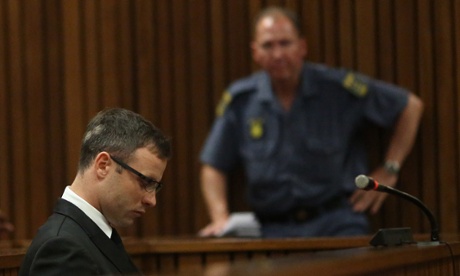
You can catch up on some key issues in the process here:
The Guardian’s David Smith will be in the courtroom in Pretoria and you can read his tweets @SmithInAfrica. I’ll also be tweeting breaking news and key developments @Claire_Phipps. David’s report on Thursday’s court hearing is here, and yesterday’s live blog is here.
Today’s court hearing is due to start at 9.30am South Africa time (8.30am BST).