You can read the report on today’s developments by my colleague David Smith in Pretoria here.
End-of-day summary
- Prosecutors have argued that Judge Thokozile Masipa – who acquitted Oscar Pistorius of murder and sentenced him to five years for the culpable homicide of Reeva Steenkamp – must allow an appeal against her findings.
- State prosecutor Gerrie Nel said the court had erred in its application of the principles of dolus eventualis, because the accused should have known that firing four shots through the door would result in death, even if he did not “wish the result”. Pistorius should have been found guilty of murder.
It’s inconceivable that he had any intention other than to kill that person or accepted that he may. It is an erroneous application of dolus eventualis.
- Nel said the five-year sentence imposed was “shockingly inappropriate” and a different court would be likely to impose a harsher punishment:
The sentence for what the accused did is inappropriate. It does not fit the crime.
- Nel said the element of mercy shown by the court in its sentencing was “over-exaggerated”. Pistorius should have received a 10-year sentence.

- There was a dispute over the relevance of case law, in particular the Seekoei judgment. The defence said Seekoei established that the state cannot appeal when an accused has been convicted on a lesser charge. Nel said it was not relevant because the state is contesting the murder acquittal, not the culpable homicide conviction.
- Barry Roux, for the defence, said the appeal had no prospect of success. He said the state had not got the result it wanted but was trying to secure an appeal based on issues of fact, not law, which is not permitted.
- Roux disputed claims that Pistorius would be out of prison after 10 months:
It is incorrect to say that it’s a light sentence – it’s not.
- The state also wants to appeal the possession of ammunition charge, of which Pistorius was acquitted. The defence opposes this request.
- Judge Masipa said she would give her ruling on Tuesday at 9.30am (7.30am GMT).
The liveblog will be back tomorrow with live coverage of the judge’s decision.
Some background reading in the meantime:
The prosecution’s written submission is here.
The defence’s written response is here.
Thank you for reading.
Updated
Defence lawyer Barry Roux looks to be in good spirits as he leaves the court:
Barry Roux says goodbye to me as Pistorius defence team leaves court today. We are back tomorrow for decision. pic.twitter.com/HMqCPU9wa9
— Milton Nkosi (@nkosi_milton) December 9, 2014
Court adjourns to tomorrow
Judge Masipa says she needs time to consider her decision.
Court adjourns to Tuesday at 9.30am South African time (7.30am GMT).
I will post a summary of today’s developments shortly.
The defence appears to be wrapping up very quickly. There is no case for appeal, Roux says. The state wants to appeal because it did not like the verdict. This was not what the prosecution hoped to achieve at the trial. But he says the law does not provide for that.
Roux is finished. Nel has nothing further.
Roux now skips to count four on the issue of possession. There was no animus, he says.
Roux refers to the state’s heads of argument – you can read them in full here.
He says the prosecution has got it wrong: it is trying to get the court to reconsider its own factual finding, “and you may not do that, my lady”.
Barry Roux sounding exasperated "Ma Lady, you absolutely, correctly dealt with dolus eventualis". #OsarPistorius
— Pumza Fihlani (@Pumza_Fihlani) December 9, 2014
The state cannot appeal, says Roux. Is it right or wrong that it cannot appeal on issues of fact? That’s not the point, he says: change the law if it’s not right, but this is where we are now.
The state is twisting things, he says, with its arguments over dolus eventualis.
Roux picking up steam. "If the factual findings found he did not intend to kill can the finding be dolus eventualis?" he says
— Stephanie Findlay (@SJFindlay) December 9, 2014
(A reminder: some background on dolus eventualis here.)
Roux says it doesn’t matter if the court’s findings about Pistorius’s lack of intention to kill were right or wrong (though he thinks them right). They are based on issues of fact so the state cannot appeal. They are arguing because they are unhappy with the findings, Roux says.
It’s rare in a murder case for there to be direct evidence of the accused’s state of mind, Roux says. The court must draw inferences. This is not a question of law, as the state has claimed. Even if the court had made an error, Roux insists, it would be an error based on a point of fact, not a point of law, and so cannot be grounds for appeal.
Courts have to draw inferences, Roux says. Often these inferences are based on circumstantial evidence.
A “proven fact” is not simply a fact that is before the court, Roux says. It is a fact that is proven to be true by the court in its judgment.
Roux: The state has no right to appeal on an error of fact. Even if it's wrong, and we say it's not. #Pistorius
— David Smith (@SmithInAfrica) December 9, 2014
If there is a conviction on a competent verdict – in this case, culpable homicide – there can be no appeal, says Roux. This is clear in Seekoei.
Roux turns to the case law, including Seekoei, which Nel said were hurdles for the state in this instance:
It’s not for the state to get over some hurdles. It must first get out of the starting blocks.
Roux disputes the state’s claim that Pistorius will be released from prison after 10 months. He says the regulations state that this is the first time that release under house arrest can be considered, and even then it is discretionary.
It is incorrect to say that it’s a light sentence – it’s not.
There is no prospect of success at appeal, Roux says.
Updated
Roux says that only where there is “serious misdirection” by a court can there be an appeal against sentence.
Roux: Every single point raised by the state in its application, we show in the record the court took took that into account. #Pistorius
— David Smith (@SmithInAfrica) December 9, 2014
Defence argument begins
Nel has finished his submission.
Barry Roux for the defence is on his feet. He refers to the papers already lodged with the court; you can read those here.
The defence opposes the state’s attempt to appeal against the murder acquittal and the five-year sentence for culpable homicide.

Nel says that if the judge’s finding were correct, then anyone could keep any ammunition in their possession. The court erred in saying there was no intent in this case. Possession is sufficient.
The implications of this acquittal has wide implications for the illegal ownership of firearms and ammunition, Nel argues.
The mere possession of the ammunition in his safe means Pistorius is guilty, he says.
#OscarPistorius Nel: refers to case law which states that no person may possess “any” ammunition unless they lawfully possess such firearm.
— Barry Bateman (@barrybateman) December 9, 2014
Nel turns to count four: the possession of ammunition charge, of which Pistorius was acquitted.
Seekoei is not relevant here because Pistorius was acquitted, he points out.
Pistorius pleaded not guilty to illegal possession of ammunition for which he didn’t have a licence, on the grounds that it belonged to his father.
It’s common sense, Nel says, that the line of distinction between matters of fact and matters of law is “very thin”.
Court resumes
Nel is back on his feet. He is discussing again the difference between matters of fact (on which the state cannot appeal) and matters of law (on which it can). The issue of Pistorius’s intention when shooting is a matter of law, he says.
State v Seekoei
For those wanting to know more about the Seekoei judgment and its relevance to Pistorius, here’s a handy primer:
This is a very useful explanation of Seekoei case and it's relevance to #OscarPistorius https://t.co/8CVWHV3Rs2
— Karyn Maughan (@karynmaughan) December 9, 2014
[11.50am GMT edit: it’s worth pointing out that the article linked to above was authored by Professor James Grant, who is now advising the prosecution.]
In essence, Seekoei established that the state can appeal against a high court judgment only if there is an acquittal. If there is a conviction on a competent verdict – in this case, Pistorius was found guilty of the lesser charge of culpable homicide – the state cannot appeal it.
Nel says Seekoei is not applicable here because the state is not appealing against the culpable homicide verdict, but against the acquittal on the murder charge.
Updated
Court adjourns for 15 minutes.
Nel asks for a break. He concedes that his argument is a complicated one. He still needs to deal with the appeal bid over count four (the possession of ammunition charge, of which Pistorius was acquitted).
Court adjourns for 15 minutes.
Updated
We have the facts, says Nel:
The accused walked, fired four shots, killed the deceased.
It’s very unlikely that an accused will come to court and admit they wanted to shoot, says Nel. The court has to make an inference from the facts, using legal tests.
Nel says court wrong to not take into account state of #OscarPistorius room - which he says show OP was lying @eNCAnews
— Karyn Maughan (@karynmaughan) December 9, 2014
Nel peppering his remarks to Masipa with "with respect" and "with utmost respect" as he tries to demolish her judgment. #Pistorius
— David Smith (@SmithInAfrica) December 9, 2014
Nel reads from the judge’s findings that Pistorius did not subjectively foresee that his actions would kill the deceased.
The court accepted one of a plethora of versions [of Pistorius’s defence], which the court was not entitled to do.
The court should have considered whether he meant to shoot whoever was in the toilet cubicle, whether that was Steenkamp or the supposed intruder.
The court asked the wrong questions of Pistorius’s actions, says Nel. Why did Pistorius shoot instead of moving away from the bathroom and the supposed intruder?
Nel: It’s inconceivable that he had any intention other than to kill that person or accepted that he may.
It is an erroneous application of dolus eventualis.
Dolus eventualis doesn’t mean that Pistorius accepted that he would kill someone, but that he may kill someone, Nel says.
Nel is hammering this point home. To prove murder, he says, the court does not have to believe that Pistorius wanted Steenkamp dead. It is enough to say that he intended to shoot at the person behind the door and that he did so knowing it could have fatal consequences.
The court found that the accused had the intention to shoot, but that he never intended to kill. What, then, was his intention, Nel asks.
Back on the four shots fired by Pistorius through the locked door:
"He has dolus eventualis, he has intention, even though he does not wish the result," says Nel about #Pistorius
— Stephanie Findlay (@SJFindlay) December 9, 2014
How would Pistorius not have seen that his actions would have fatal consequences, Nel asks the court. He was trained in firearms and knew there was someone behind the door. Even if he did not “wish the result”, he must have foreseen that death was the likely outcome of his actions.
Updated
Turning to the defence’s response to the appeal bid, which argues that the state is attempting to appeal on matters of fact (which is not allowed), Nel insists the appeal is sought on the basis of matters of law. It is about the application of principles to the facts, he says. There was an erroneous application of the law, he says.
Although Nel said he would not be replaying the trial today, the themes are very similar:
"The accused version was not only inconceivable but in fact impossible," says Nel about #Pistorius, citing multiple defences
— Stephanie Findlay (@SJFindlay) December 9, 2014
Pistorius should have been convicted of murder, Nel says. If the court has wrongly applied the principle of dolus eventualis, a conviction for murder is inescapable.
Nel says he doesn’t have to convince this court that he is right. He just has to convince them that there is a reasonable chance of success in the court of appeal.
Nel is rattling through various points of case law.
Nel argues that Seekoei ruling - from the 80s - has been superseded by a constitutional court judgement. No longer relevant @eNCAnews
— Karyn Maughan (@karynmaughan) December 9, 2014
Nel quotes more case law. This time a Basson case which went all the way to constitutional court. State was not allowed to appeal acquittal.
— Milton Nkosi (@nkosi_milton) December 9, 2014
Nel is saying that these hurdles to the state case should not be applicable today.
Nel argues that Seekoei is not only unfair to the state, it doesn’t make sense. It should not be applied here.
Nel reads in Afrikaans again and translates: because somebody has been convicted and sentenced, by the time an appeal is heard, the accused will have served part of his sentence. That’s par for the course, says Nel, whether it’s the state or defence which appeals.
The purpose of this application is the state saying there should be a harsher sentence and a conviction of murder.
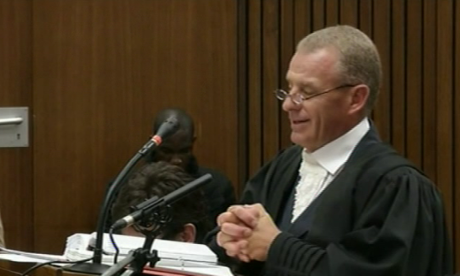
Nel is reading passages in Afrikaans. Back to English:
We are not appealing the conviction of culpable homicide. We are appealing – on a point of law – the acquittal for murder.
The gist of what has turned into a complicated monologue from Nel is that Seekoei determined that the prosecution could appeal an acquittal but not a conviction on a lesser charge (as happened with Pistorius). Nel says Seekoei is not applicable.
#OscarPistorius Nel arguing extensively about Seekoei case and whether this should mean a retrial. Nel argues it should not be followed.
— Mandy Wiener (@MandyWiener) December 9, 2014
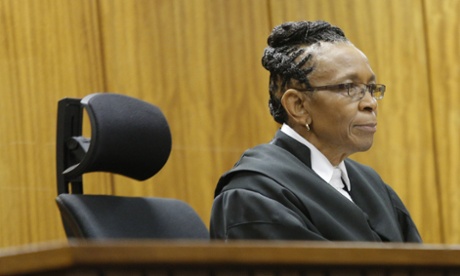
Judge Masipa is listening intently, hand resting under her chin. She needs to listen to why Nel thinks she was wrong. #OscarPistorius
— Pumza Fihlani (@Pumza_Fihlani) December 9, 2014
Nel acknowledges the assistance he has had from Professor James Grant in the case law.
Here’s a little bit of information from News24.com on the Seekoei judgment:
However, the state could encounter a “hurdle” because of the supreme court of appeal case, State vs Seekoei, which limited the state’s right of appeal.
The 1982 Seekoei case held that the state could not appeal if a conviction was made on a competent verdict.
#OscarPistorius Nel: dealing with the Seekoei judgment - case law related to appeal. BB
— Barry Bateman (@barrybateman) December 9, 2014
Nel says the court “may have erred” in its application of the principles of dolus eventualis (the argument Pistorius foresaw that his actions in firing four shots into the door could have led to the death of the person behind it, but went ahead anyway – which would have meant a conviction for murder).
The court should have taken account of the circumstantial evidence as a whole in determining whether Pistorius acted with dolus eventualis, Nel says.
The court erred, with respect, in finding that the accused’s version was reasonably possibly true.
Nel returns to a favourite theme from the trial: that Pistorius had more than one version of his defence, which could not all be true and were “mutually destructive”.
Judge Masipa wears a black not red robe today. Red is only worn for murder trials. Death penalty hangover. OscarPistorius @eNCAnews
— Annika Larsen (@AnnikaLarsen1) December 9, 2014
Prosecutor: Pistorius should be found guilty of murder
Nel moves on to the state’s challenge against the conviction of culpable homicide. Prosecutors want to revive the prospect of a murder conviction.
Nel says the state has “no problem” with the way the judge summarised the actions of Pistorius in her ruling. But the sentence is “shockingly inappropriate”, he repeats. There is a reasonable prospect of convincing another court to impose a longer sentence, he argues.
Prosecutor: Pistorius should have got 10-year sentence
Nel says the court imposed the shortest period of incarceration it could reasonably do. What could be less than 10 months?
There can be instances, says Nel, when a court shows too much mercy. That can be a misdirection. He says in this case the element of mercy was “over-exaggerated”.
Pistorius’s actions deserve to be punished, Nel says. He did not fire blindly: “He knew.”
Nel turns to the death of Reeva Steenkamp.
An innocent woman was shot and killed in most horrendous circumstances. The deceased must have been unbelievably fearful before she died … And it was caused by the gross negligence of this respondent.
The accused fired four shots. He knew there was someone in the cubicle with no escape.
Nel returns to the issue of Pistorius’s lack of remorse. The defence arguments against him being sent to prison at all – saying, for example, that there was a lack of shower rails in jail – shows he did not “carry through” his claims of remorse, Nel says.
Nel says that the attitude of Reeva Steenkamp’s parents to the sentence is irrelevant (they said they were satisfied with the five-year term). It should not be taken into account, he tells Masipa.

Judge Thokozile Masipa is sitting alone this time without the two assessors who flanked her on either side during the trial.
— Milton Nkosi (@nkosi_milton) December 9, 2014
There’s some background on the role of the assessors during the trial here.
Nel repeats the claim in the state papers that Pistorius’s actions bordered on dolus eventualis (read a fuller explanation of that here). The precedent set by this court is “shockingly low”, Nel says – someone with this degree of culpability and acting with such gross negligence should have a much longer sentence.
Nel: The sentence for what the accused did is inappropriate. It does not fit the crime.
The court did not take into account … what we said is that the accused does not have remorse.
He says the fact that Pistorius might serve only 10 months in prison is inappropriate. Masispa intervenes – release to house arrest is at the discretion of the commissioner, she points out. Nel agrees but says 10 months would be likely, according to regulations.
Nel says his job is to convince the court that a different court might make a different finding.
He wants to start with the five-year sentence – which papers lodged by the state in advance of today’s hearing called “shockingly light”.
Gerrie Nel begins.
He says the bid to appeal against the verdict is not meant to show disrespect to the court, “and is not a decision that was lightly taken”.
He won’t be arguing the case again, he adds.
Judge Masipa arrives
The court hearing is about to start.
The Pistorius and Steenkamp families are not in court.
We still haven't heard a definitive yes or no if #Pistorius will be in court, though defence say they haven't requested he attend
— Stephanie Findlay (@SJFindlay) December 9, 2014
Updated
Gerrie Nel, for the prosecution, and Pistorius’s lead defence lawyer, Barry Roux, are both in court.
Nel is in court, slams down his briefcase and whips a binder onto his desk, Roux doesn't look up from his notes to greet him #Pistorius
— Stephanie Findlay (@SJFindlay) December 9, 2014
#OscarPistorius Wits law Professor James Grant is sitting with the prosecuting team. He's been asked to assist them with the appeal.
— Mandy Wiener (@MandyWiener) December 9, 2014
James Grant is the author of this blog post, which sets out what he thinks were Judge Masipa’s errors in the original trial finding.
The defence's submission
Below is the response by the defence to the state’s request for leave to appeal. It disputes the basis of the request, claiming:
The state has no right of appeal … against incorrect factual findings by a trial court. The state can appeal only if the trial court gave a wrong decision due to a mistake of law.
Part of the state’s case is that Judge Masipa erred in her application of the principle of dolus eventualis. The defence counters that she did “correctly appl[y] the law to the facts”.
The state's submission
You can read below the full submission by the state setting out the basis for its request to appeal. It makes some key allegations:
- “The sentence of five years’ imprisonment … for the murder of Reeva Steenkamp in the circumstances of this case is shockingly light, inappropriate and would not have been imposed by any reasonable court.” (Note that it continues to refer to Steenkamp’s death as murder.)
- Judge Thokozile Masipa “erred in overemphasising the personal circumstances” of the athlete, as well as the fact that he seemed remorseful about the shooting in the immediate aftermath.
- Did the court correctly apply the principles of dolus eventualis – the notion that Pistorius foresaw that his actions in firing four shots into the door could have led to the death of the person behind it, but went ahead anyway – in clearing him of murder?
- It reminds the judge that she herself thought Pistorius to be a very poor witness.
- Under the criminal procedure act, Pistorius will qualify to be released from prison under correctional supervision after serving “a mere 10 months”.
Morning summary
A familiar scene at the high court in Pretoria this morning, as prosecutors, defence lawyers and Judge Thokozile Masipa reconvene to hear arguments over whether the state should be permitted to appeal the decision to find Oscar Pistorius not guilty of the murder of Reeva Steenkamp.
Pistorius was cleared of murder, but found guilty of culpable homicide (manslaughter) after Judge Masipa ruled that he acted negligently when he shot Steenkamp, his girlfriend, four times through a closed toilet door but that he had not intended to kill her.

The prosecution wants the judge to grant it permission to appeal this verdict, and the five-year sentence subsequently handed down.
If Masipa does agree to grant the appeal, the case will be move to South Africa’s supreme court of appeal in Bloemfontein. If she does not, the state can decide to petition that decision.
One person who is unlikely to make an appearance today is Pistorius himself. He is currently serving his sentence in the hospital wing of Kgosi Mampuru prison and is not expected to come to court.
Today, we will hear submissions from the prosecution and the defence. Masipa is then expected to give her decision – although delays have not been uncommon in this trial to date.
There will be live coverage throughout the day on this blog. My colleague David Smith is in court in Pretoria; you can follow us on Twitter for updates @SmithInAfrica and @Claire_Phipps.