Closing summary
- Judge Thokozile Masipa has allowed a request by prosecutors to appeal against the acquittal of Oscar Pistorius on the charge of murder:
I cannot say ... that the prospect of success at the Supreme Court of Appeal is remote … I am also of the view ... this might have a practical effect. The application therefore in respect of count one is decided in favour of the applicant [the state].
- But the judge refused to allow the state to challenge the five-year sentence imposed for the culpable homicide of Reeva Steenkamp:
I am not persuaded that there was any material misdirection or irregularity, or that on the facts of this matter the sentence imposed was shockingly inappropriate.
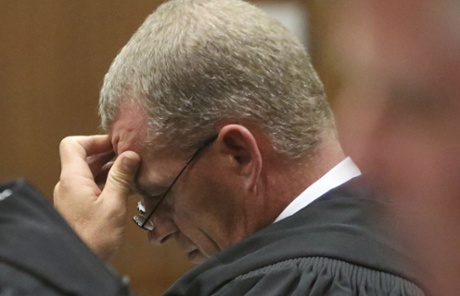
- South Africa’s supreme court of appeal in Bloemfontain will now hear the state’s case that Masipa – the original trial judge – erred in her application of the principles of dolus eventualis in clearing Pistorius of intentionally shooting dead his girlfriend in his home in Pretoria February 2013.
- The appeal could take place as early as February, but is likely to be later in 2015, raising the possibility that Pistorius could be out of prison under house arrest by the time the appeal is heard. You can read more about what form the appeal hearing is likely to take here and here.
- The judge refused to allow the state leave to appeal against Pistorius’ acquittal on the charge of illegal possession of ammunition. The state was also ordered to pay defence costs.
- The National Prosecuting Authority said it was happy with the judge’s decision on the murder appeal, and would consider whether to petition against her refusal to allow leave to challenge the sentence and ammunition charge.
- Brief – separate – statements from the Pistorius and Steenkamp families said they wanted justice to be done.
You can read David Smith’s report from Pretoria here.
That’s it for the liveblog for today and until the appeal hearing. Thank you for reading.
Dup de Bruyn, the lawyer for June and Barry Steenkamp, parents of Reeva Steenkamp, has issued a very brief statement on today’s decision:
All they’re saying is justice must run its course and they want to get on with their lives.
Updated
My colleague David Smith, who was in court in Pretoria today, files this report:
Oscar Pistorius could yet be convicted of murder and face at least 15 years in prison after a judge granted prosecutors the right to appeal against her verdict that he was guilty of the lesser charge of culpable homicide.
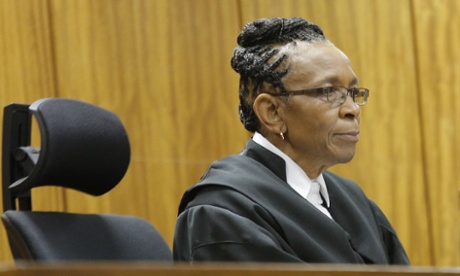
Judge Thokozile Masipa said she was satisfied that prosecutor Gerrie Nel had raised questions of law that a different court could interpret differently when considering the Paralympian’s intentions in shooting dead his girlfriend Reeva Steenkamp.
‘I cannot say … that the prospect of success at the supreme court of appeal is remote,’ Masipa ruled at the high court in Pretoria, South Africa. ‘The application therefore in respect of count one is decided in favour of the applicant.’
The decision is likely to be welcomed by Steenkamp’s parents, Barry and June, who strongly condemned the original verdict, as well as campaigners against domestic violence who believe it sent a dangerous message to society.
The matter will now go to the supreme court of appeal in Bloemfontein, the country’s judicial capital, but typically it can take at least a year for a case to be heard. By then Pistorius may already be out of prison and under house arrest.
A panel of judges at the supreme court will consider whether Masipa erred in not applying the principle of dolus eventualis, a category of murder where the perpetrator subjectively foresees the possibility of his act causing death and persists regardless. If it decides Pistorius’s actions fall within this definition, it can upgrade his culpable homicide conviction to murder, which carries a minimum 15-year sentence.
South Africa’s beleaguered National Prosecuting Authority (NPA), under fire after the collapse of the Shrien Dewani murder trial this week, welcomed the judge’s decision. Its spokesperson Nathi Mncube said he hoped the appeal would be ‘expedited’ but acknowledged that the process can take a long time. ‘The person who is accused, I’m sure, would like to know as soon as possible.’
Masipa dismissed separate state applications for leave to appeal against Pistorius’s five-year sentence and his acquittal on a charge of illegal possession of ammunition. Ncube said the NPA would consider whether to petition the supreme court of appeal directly on these counts.
Nathi Mncube, spokesman for the National Prosecuting Authority (NPA), has just been speaking to Sky News:
We got most of what we wanted. The main thing was to get the court to agree to the leave to appeal in respect of the murder charge.
Of course there were the other two issues on which the court did not agree with us today … the court felt there was no prospect of successful appeal in respect of sentence …
The process from now on is that we wait for the supreme court of appeal, who will give us a date for the prosecuting authority and the defence to submit our [written] heads of argument. We will then be given another date to come and argue the matter. The SCA will then deliver its judgment.
We all depend on the SCA for the dates. They decide the dates – it is not up to the NPA, it is not up to the defence … It could very well be as early as February next year.
Apart from Henke Pistorius, the two days of the appeal hearing have not seen the family members – of either Oscar Pistorius or Reeva Steenkamp – in court. But the athlete’s family has now issued a very short statement:
Pistorius family on Masipa judgment: “We note the finding of the Court and abide by the ruling."
— Mandy Wiener (@MandyWiener) December 10, 2014
There has not yet been a response from Steenkamp’s parents to the news that prosecutors will be able to renew their attempts to secure a murder conviction.
Henke Pistorius, the athlete’s estranged father, was in court today. He told reporters that his son “was taught that life can sometimes be unfair” but said he had faith in the justice system.
Oscar Pistorius was not in court – he is currently serving his sentence in the hospital wing of Kgosi Mampuru prison.
Prosecutors have welcomed the decision to allow them to challenge the murder charge acquittal. Nathi Ncube of the National Prosecuting Authority told reporters:
We’re happy.
Our argument was that he should have been convicted of murder, and then would have been sentenced to a minimum sentence of 15 years.
That is, of course, what we would like to happen.
It isn’t about winning – it’s about justice.
Nathi Mncube says the #NPA is happy with Judge Masipa’s ruling | Live on DSTV 405 pic.twitter.com/8YTyzSLEg8
— ANN7 (@ANN7tv) December 10, 2014
Updated
How an appeal might work
The supreme court of appeal (SCA) sits at Bloemfontain; from its website, here is some more information about the form the Pistorius appeal could take:
The court decides cases upon the record of the proceedings before the lower court and after considering the written and oral arguments presented. Witnesses do not appear before the court, and the parties need not be present during the hearing of an appeal. A written judgment is usually handed down shortly after the argument.
The court hears appeals on fact and since there are no jury trials, it has a relatively wide discretion to make its own factual findings. Because of this jurisdiction, judges have to read the record of the full proceedings in the lower courts …
The court sits in panels of five or three judges, depending on the nature of the appeal. The composition of the panels differs for each case. The senior judge on each panel presides in that case. There may be more than one judgment in a case if there is a difference of opinion. The decision of the majority is the decision of the court.
The dates on which the SCA sits are also fairly limited – the next session does not start until 15 February 2015.
Judge's comments
Judge Thokozile Masipa told the court she would allow the state’s request to appeal against Pistorius’ acquittal on count one – murder – on the grounds that there were issues of law, particularly surrounding the application of dolus eventualis, that needed to be clarified:
I cannot say ... that the prospect of success at the Supreme Court of Appeal is remote …
I am also of the view ... this might have a practical effect. The application therefore in respect of count one is decided in favour of the applicant [the state].
The application for leave to appeal against the sentence is dismissed.
Here’s a quick round-up from reporters on the scene in Pretoria:
Prosecution admits things take time at the Supreme Court of Appeal; #OscarPistorius could even be out of prison by appeal time.
— Nastasya Tay (@NastasyaTay) December 10, 2014
Mncube says state will argue for 15 year sentence for #OscarPistorius - if Appeal Court finds him guilty of murder @eNCAnews
— Karyn Maughan (@karynmaughan) December 10, 2014
Mncube says state will ask that #OscarAppeal be heard as soon as possible. On normal timelines, would be heard in at least a year @eNCAnews
— Karyn Maughan (@karynmaughan) December 10, 2014
South Africa’s National Prosecuting Authority (NPA) says it will take time to decide whether to petition the judge over her decision that it cannot challenge the five-year sentence for culpable homicide.
NPA spokesman Nathi Mncube says this case isn’t about winning – it’s about justice.
Updated
Here’s the response from James Grant, the law professor who advised the state on its request to appeal:
Whooohooo, legal history in the making, a lethal blow to that lumbering and lost Hippo (Seekoei)!
— James Grant (@CriminalLawZA) December 10, 2014
The defence said that the so-called Seekoei judgment established that the state cannot appeal when an accused has been convicted on a lesser charge (Pistorius wasd charged with murder, but convicted of culpable homicide).
Nel said it was not relevant because the state is contesting the murder acquittal, not the culpable homicide conviction.
There’s some background on Seekoei here.
This is a success for the prosecution – led by Gerrie Nel – which can now proceed with its appeal against the verdict that Pistorius did not murder Reeva Steenkamp.
It lost its application to challenge the five-year sentence for culpable homicide, although it could petition that decision.
The state was also ordered to pay defence costs.

Although the judge did not give the state leave to appeal against the five-year sentence for culpable homicide, my understanding is that if the supreme court of appeal did decide to overturn the acquittal on the murder charge – and if Pistorius were, after all, to be found guilty of murder – a different sentence could be applied at that point.
Spoke to Henke #Pistorius who said: "I don't want to say anything before it's decided, but it shouldn't have gone this far."
— David Smith (@SmithInAfrica) December 10, 2014
The case will now move to South Africa’s supreme court of appeal in Bloemfontein.
The key point of dispute is the judge’s interpretation of dolus eventualis and the application of its principles to the circumstances of this case.
The judge’s decision to rule out murder by dolus eventualis – that is, that Pistorius subjectively foresaw that his actions in firing four shots into the door could have led to the death of the person behind it, but went ahead anyway – has attracted questions and criticism.
That should be cleared up in the supreme court.
Court adjourns
That was a very short hearing but with some big news.
The judge has given the state leave to appeal against Pistorius’s acquittal on the charge of murder.
But the state was not given permission to appeal against the five-year sentence imposed, nor against the acquittal on the charge of possessing illegal ammunition.
The state was ordered to pay costs.
Updated
Masipa says that in respect of count four – the acquittal on the charge of possessing illegal ammunition – she does not give the state leave to appeal.
Masipa: Supreme court should consider whether the principles of dolus eventualis were correctly applied. #Pistorius
— David Smith (@SmithInAfrica) December 10, 2014
State can appeal murder acquittal
Masipa says this matter “is not an easy one”.
I have been persuaded that the questions are questions of law.
That being so, I cannot say … that the prospect of success at the supreme court of appeal is remote.
She allows the appeal on the murder acquittal.
Masipa now moves on to the state’s request to appeal the acquittal on the charge of murder.
The issue is whether the request is based on questions of law (the only permitted means of appeal) or “questions of fact masquerading as questions of law”.
Judge: five-year sentence was not inappropriate
Would a different court come to a different finding on the sentence, Masipa asks (this is Nel’s case).
In none of the submissions for the state did they show any misdirection that would vitiate the sentence, she says.
I am not persuaded that there was any material misdirection or irregularity, or that on the facts of this matter the sentence imposed was shockingly inappropriate.
She says this point “cannot succeed”.
She dismisses leave to appeal the sentence.
The parents of Reeva Steenkamp expressed a satisfaction with the sentence. Gerrie Nel, for the state, yesterday said it was irrelevant. Masipa agrees that defence cannot rely on the views of the Steenkamps in its opposition to the request to appeal.
This application will be treated only on its own merits, not on the basis that the case attracted public interest, Masipa says. Everyone is equal before the law.
Court begins
Judge Masipa begins right away reading her ruling.
#OscarPistorius That's a bit of a surprise. Oscar's father Henke has arrived in court. He's alone and holding his ubiquitous panama hat.
— Mandy Wiener (@MandyWiener) December 10, 2014
Pistorius and his father are estranged. It was Henke Pistorius’s ammunition that Pistorius claimed he was holding for safekeeping for the possession of ammunition charge of which Pistorius was acquitted. The state is also seeking leave to appeal that acquittal.
The legal teams have arrived at the high court in Pretoria. Pistorius himself will not attend. He is currently serving his sentence in the hospital wing of Kgosi Mampuru prison.
Gerrie Nel has arrived at the Pretoria High Court. Judge Masipa due to announce decision on his appeal application. pic.twitter.com/BTmYg6RYfF
— Milton Nkosi (@nkosi_milton) December 10, 2014
It doesn’t appear that Barry Roux, lead counsel for the defence, is here, but we are not expecting legal arguments today, just the judge’s ruling.
Pistorius defence team arrives in court for appeal hearing. pic.twitter.com/XU5pjMFVzE
— Milton Nkosi (@nkosi_milton) December 10, 2014
Updated
The Seekoei judgment
Yesterday also saw a dispute over the relevance of case law, in particular the Seekoei judgment, which is likely to rear its head again in the judge’s ruling.
The defence said Seekoei established that the state cannot appeal when an accused has been convicted on a lesser charge. Nel said it was not relevant because the state is contesting the murder acquittal, not the culpable homicide conviction.
There is some useful background on Seekoei here, in an article written by law professor James Grant, who is now advising the prosecution.
The defence's written response
Below is the response by the defence to the state’s request for leave to appeal. It disputes the basis of the request, claiming:
The state has no right of appeal … against incorrect factual findings by a trial court. The state can appeal only if the trial court gave a wrong decision due to a mistake of law.
Part of the state’s case is that Judge Masipa erred in her application of the principle of dolus eventualis. The defence counters that she did “correctly appl[y] the law to the facts”.
The state's written argument
With apologies to readers of yesterday’s blog who will have already seen this, you can read below the full submission by the state setting out the basis for its request to appeal. It makes some key allegations:
- “The sentence of five years’ imprisonment … for the murder of Reeva Steenkamp in the circumstances of this case is shockingly light, inappropriate and would not have been imposed by any reasonable court.” (Note that it continues to refer to Steenkamp’s death as murder.)
- Judge Thokozile Masipa “erred in overemphasising the personal circumstances” of the athlete, as well as the fact that he seemed remorseful about the shooting in the immediate aftermath.
- Did the court correctly apply the principles of dolus eventualis – the notion that Pistorius foresaw that his actions in firing four shots into the door could have led to the death of the person behind it, but went ahead anyway – in clearing him of murder?
- It reminds the judge that she herself thought Pistorius to be a very poor witness.
- Under the criminal procedure act, Pistorius will qualify to be released from prison under correctional supervision after serving “a mere 10 months”.
Opening summary
The high court in Pretoria reconvenes at 9.30am (7.30am GMT) to hear Judge Thokozile Masipa rule whether prosecutors can take their challenge to Oscar Pistorius’s conviction and sentence to the supreme court of appeal.
Yesterday the court heard arguments from state prosecutor Gerrie Nel that Masipa – the judge who acquitted Pistorius of murder and sentenced him to five years for the culpable homicide of Reeva Steenkamp – must allow an appeal against her findings.
The defence opposes the request and says the appeal has no prospect of success.
Here’s a brief summary of yesterday’s developments:
- Nel said the court had erred in its application of the principles of dolus eventualis, because the accused should have known that firing four shots through a toilet cubicle door would result in death, even if he did not “wish the result”. Pistorius should have been found guilty of murder.
It’s inconceivable that he had any intention other than to kill that person or accepted that he may. It is an erroneous application of dolus eventualis.
- Nel said the five-year sentence imposed was “shockingly inappropriate” and a different court would be likely to impose a harsher punishment.
- The prosecutor said the element of mercy shown by the court in its sentencing was “over-exaggerated”. Pistorius should have received a 10-year sentence.
- Barry Roux, for the defence, said the state had not got the result it wanted and was trying to secure an appeal based on issues of fact, not law, which is not permitted.
Judge Masipa will also announce today whether the state can lodge an appeal on the possession of ammunition charge of which Pistorius was acquitted. The defence opposes this request.
You can read an account of yesterday’s hearing by David Smith, my colleague in Pretoria, here. Monday’s liveblog is here.
This blog will have live coverage throughout today’s court hearing, and you can also follow us for updates on Twitter, should you wish, @SmithInAfrica and @Claire_Phipps.
Updated