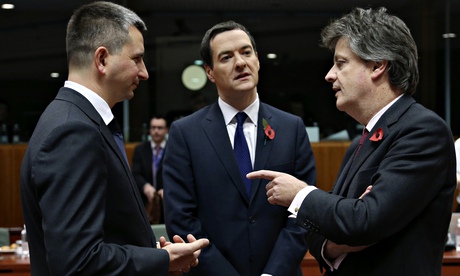
George Osborne has insisted he will negotiate a better deal for Britain after an “unacceptable” demand from the European Commission for the UK to contribute an extra £1.7bn to the EU.
As David Cameron indicated that Britain would reject a compromise plan, in which the £1.7bn would be paid in instalments, the veteran Tory ex-minister Ken Clarke described much of the anger in Britain over the extra payment as “synthetic”.
Osborne persuaded EU finance ministers to place the demand for an extra £1.7bn from Britain on the agenda for their monthly meeting in Brussels on Friday.
Britain has been given until 1 December to make the payments after a recalculation of the UK’s gross national income (GNI) based on figures provided by the Office for National Statistics which took greater account of areas of economic activity such as the charitable sector. The demand for the new payment was leaked at a summit of EU leaders in Brussels last month, prompting a furious response from Cameron.
As he arrived in Brussels for the meeting of finance ministers on Friday, Osborne said: “The demand that Britain pays £1.7bn on 1 December is unacceptable. I wanted that discussed at this meeting of European finance ministers. I wanted it on the agenda. It is on the agenda. I will make sure we get a better deal for Britain.”
The Press Association reported from Helsinki, where Cameron is attending a summit of northern European leaders, that Britain would not accept a compromise to stagger the payments. This would involve imposing punitive interest payments from 1 December if Britain fails to pay up.
Osborne is expected to call on finance ministers to agree to review the system which led to the upward reassessment of Britain’s GNI figures. Britain wants the European commission to ensure that the reassessment of the strength of various sectors of the economy, which led to the upward revision, was applied equally to all 28 EU member states.
Fellow EU leaders are suggesting that Britain, which has enjoyed a generous EU rebate for the past 30 years, needs to respect the rules, though there is some sympathy.
Alexander Stubb, the Finnish prime minister who is hosting Cameron and other fellow leaders in Helsinki, said at the summit: “We’ll have to have a look at the whole package and we have to put things into perspective. Remember the EU’s total budget for seven years is €1tn. This is basically a payment which dates back to 1995 so one could make calculations – well how much has the UK regained from the rebate? My message to everyone – Finn, Swede or Brit alike – the EU is not an accounting exercise. But these types of whacks of €2.1bn (£1.7bn) – I fully understand why it has become a problem.”
But Jakub Adamowicz, the European commission’s budget spokesperson, told the Today programme: “Britain has decided to adopt this standard that has triggered this sum only this year. Britain could have adopted this accounting standard with a GNI adjustment a lot earlier. If now all those payments kick in retrospectively from 1995 this is an issue which is for us, the European commission, a normal procedure. We, in our budget planning, have this exercise every year – the GNI adjustment. This is nothing new in 2014. This has been happening before.”
Kenneth Clarke said he had confidence in Osborne as a negotiator. But he largely endorsed the European commission’s view that the demand for the extra payment came from a British review of the understatement of the size of the British economy in recent years.
The former chancellor told Today: “The figures are based on what British officials came up with about the understatement of our GDP over recent years ... We’ve been doing this for years and the British always take the money back when it comes to our advantage.
“The ones who have missed out this time - we sometimes gain - are the United Kingdom and Italy. This isn’t Argentina, we aren’t governments who default on our debts, but we are perfectly entitled to start arguing about how the debt is arrived at and how it is paid.
“Had we come out as gainers and had the Germans had to pay a large sum of money and had some Germans said to us ‘No, no, no, we don’t like the result now. We supported this ... method but we didn’t know we’d lose, so we are not paying’, then the eurosceptics in the media and parliament here would have gone absolutely apoplectic.
“I normally believe [that] in a sane world common sense eventually prevails and I’ve always thought from the word go that a lot of this anger is synthetic and politics is getting in the way of common sense. If you want to keep the EU intact as an economic entity you have to pay your contribution, you have to have free movement of labour.”