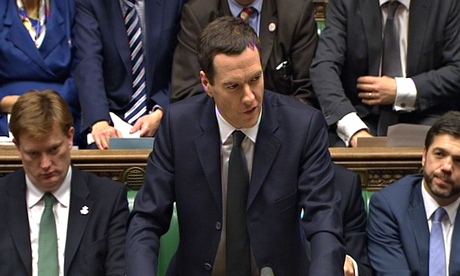
There is always a moment in the chancellor’s statements – an acceleration of delivery, a drop in volume, a flurry of numbers – when you know the bad news is being delivered.
In this autumn statement, the crucial figures were £91.3bn and £75bn – net borrowing this year and next – representing a definitive failure to make good the promise at the start of the parliament to eliminate the structural deficit.
The numbers were camouflaged in forecasts suggesting a budget surplus can be reached by 2019. So, the fiscal promised land is in sight; the economy is growing and jobs are being created at a record rate. The one thing that would really spoil things now, according to George Osborne, would be the election of a Labour government.
Stripped of the statistical prestidigitation, the chancellor’s message amounts to this: we failed to do what we promised in one term; so obviously we need another one.
He comes across like the builder, surrounded by rubble and crumbling plaster, explaining that the project won’t be completed as originally quoted but that a few weeks more should do the trick. As a pitch, it works if the homeowner fears it would cost even more in the long run to sack the current contractor and hire another lot.
Osborne cannot claim the economy is fixed but he can point to movement in the right direction. Growth is higher than in any other developed economy – forecast to be 3% in 2014 – and unemployment lower than was routinely forecast when Britain embarked on its austere path. His problem is that the rate of growth will then slow in the coming years, while revenues are already disappointing. Not enough of the new jobs are paying high enough wages for the Treasury to skim off a deficit-reducing dividend.
So the chancellor needs to find a lot more cash to balance the books, especially since the Conservatives have committed to a £7bn tax cut at some point in the next parliament. It still isn’t clear where that is coming from.
Today’s statement represents, we are told, a modest fiscal tightening. There is a £9bn windfall from measures targeting the unpopular rich: tax-avoiding multinational technology corporations and banks that offset their profits against losses sustained in the financial crisis. That is meant to symbolise the chancellor’s commitment to equitable burden-sharing (the old slogan “We’re all in it together” made a cameo appearance).
But the hardcore budget consolidation will still have to come from what were delicately referred to as “further reductions in government spending and welfare” – in other words, billions of pounds of cuts and a generation-defining reduction in the scale of state provision of services. What that looks like in practice the chancellor did not say, and hopes not to say this side of an election.
His priority before polling day is closing down the threat of Labour, which is where his big headline-grabbing measure comes in. A big reform of stamp duty has two political advantages: First, it appears to relieve an expense that many middle-class homeowners will have felt as a painful affront at a time of maximum domestic and financial stress. Second, it increases the amount paid – albeit only as a one-off levy – on the sale of very expensive homes (worth over £2m), thereby looking like a rival to Labour’s “mansion tax” – a rival that will be more palatable to people who live in valuable properties in the south-east of England who prefer not to think of their homes as mansions.
It is smart politics, as we have come to expect from the chancellor. He is trying to establish a cultural as much as an economic dividing line. On one side stand the Tories, releasing people from the oppressive burden of the state that preys on the fruits of their honest toil; on the other side stands Labour, itching to confiscate money from anyone and everyone who tries to get on in life. Osborne’s hope is that voters will be more afraid of Ed Balls’s tax rises than of his own (as yet undisclosed) cuts.
The economic job isn’t done to the timetable or the standard that was promised. It is, at best, half done. The chancellor’s great hope is to persuade people that the only other contractors in town are even worse cowboys than his crew.