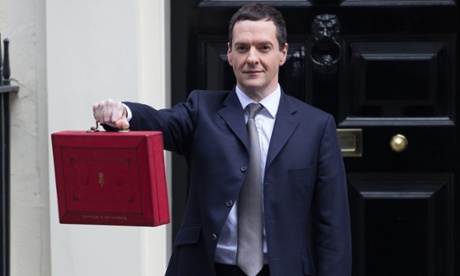
In the street last night I bumped into a friend who said: “I missed the budget, tell me what it was about.” Despite sitting through George Osborne’s bravura performance in the Commons press gallery, I struggled to answer. Judging by today’s papers and the chancellor’s performance on Radio 4’s Today programme I am not alone.
Of course it was a political budget, nakedly so. A general election is just seven weeks away. That’s why he barely mentioned the NHS – still toxic for the Tories – let alone utter the word “productivity”, the weakness of which is the single most damning feature of the much-trumpeted UK recovery. It is one which will doom us to low-skill penury if not better addressed.
So the Tory Daily Mail’s coverage reflects its Sun Shines on Savers splash headline – along with rivals, just as the Guardian’s witty Here Comes the Sun* riposte (the asterisk denotes an “or at least that’s what he wants you to think”) reflects profound scepticism on the centre left.
But rarely can I remember such a disparate range of verdicts as to what Osborne’s sixth budget meant, let alone his achievement – or lack of it – since the first of the six was unveiled shortly after the unexpected formation of the Tory/Lib Dem coalition following the indecisive election in May 2010. The Lib Dems are having their say today.
When the sun went down on the Mail’s evening joy (it had a montage of George as a sunbeam) it became clearer by breakfast what a ticking time bomb is the strange pattern of budget-proposed public spending cuts which a re-elected Osborne would impose between now and 2019 (when growth resumes ahead of the 2020 election). Even the Mail online is wobbling now.
As all grown-up commentators acknowledge today, even sympathetic ones, “strange deep cuts” (says the FT’s Chris Giles) are pencilled in for 2016-18. The Spectator calls them “butchery” for unprotected Whitehall departments, Labour predicts the protected NHS must suffer too, the chancellor – on Radio 4’s Today – chose not to provide details except to say that welfare benefits and tax dodgers (again) are his prime targets. Criminal charges even. Watch out, Tory donors!
The independent Office for Budget Responsibility (OBR), his own creation, is plainly frustrated at what it calls a “rollercoaster” scenario in which public spending figures have been massaged to prevent “back to the 30s” rhetoric (the analogy was originally the OBR’s own). The numbers are further boosted by a one-off sale of £20bn worth of public assets, chiefly those still-in-recovery banks.
It’s the sort of thing Gordon Brown used to do – and we know what happened to him. Osborne was again happy to dump blame for the recession on Brown’s boom and bust, not on the casino bankers who hoodwinked Brown (and George Bush) while also fooling themselves with their fancy risk algorithms. Miliband Labour has failed to nail that one.
Yet here’s the paradox. Tory camp followers boast how rigorous their own chancellor has been in pushing through his 2010 austerity strategy – even my level-headed old Guardian pal Alex Brummer, now the Mail’s City editor, is quite carried away here – and in the FT the US guru Jeffrey Sachs explains how Osborne saw off his Keynesian critics.
The Keynesians don’t see it that way. Even the agnostic Simon Jenkins concedes that and the left’s assertion that Osborne was forced to embrace a less austere Plan B is backed by the stubbornly large budget deficit. It’s down from 10% at the peak of the bank crash to 5% or roughly what the last chancellor, the sensible Alistair Darling, had in mind for 2015. Under his 2010 Plan A macho Osborne had promised to eliminate it by now.
After he initially squeezed the life out of the incipient recovery in 2010-11, I’m delighted that Osborne proved flexible enough (“sensible midcourse adjustments” as the FT’s editorial grandly puts it) to let borrowing take some of the strain. Lack of demand, as companies and voters paid down their own debts, made it sensible for government to sustain demand in the economy and not make things worse as the eurozone’s austerity merchants proceeded to do just across the Channel.
It’s risky and needed to be done in parallel with downward pressure on spending and that debt mountain, the legacy of the bankers’ smash more than of Gordon Brown’s excessive borrowing in the boom years. But pace and timing is all. The Americans, whose failure to save Lehman Brothers in 2008 was the biggest avoidable error of the recession, managed the turn-around better than us under Obama, the eurozone worse.
It’s OK to borrow sensibly when near zero-interest money is cheap, if people will lend to you. Banks are still pretty hopeless towards small business loans, but Osborne keeps pumping up prices in the overheated housing market with subsidies instead of house building. He did so yesterday again. Ministers are wiser to invest in productive long-term goals: scientific research , infrastructure (Swansea Bay’s tidal barrage) and – of course – the English regions.
Belated enthusiasm for English devolution is another of George Osborne’s successful U-turns. Good. He’s a Cheshire MP, but he got the “northern powerhouse” stuff in the end, the East Anglian powerhouse in Cambridge too. Plus rural broadband, boosted yesterday. Excellent.
But as the FT’s venerable pundit Martin Wolf explains, the recovery is fragile and built on the very debt the chancellor purports to scorn, not least in the persistently large trade imbalance. As for his target of achieving a financial surplus by 2020, given low interest rates and the need to invest, Osborne’s “fixation with debt is ridiculous”.
That’s the FT talking, not the Guardian’s sceptical Larry Elliott. Here’s the Guardian’s Philip Inman on the ways the young are suffering. But Philip Aldrick, the economics editor of the Times (paywall), also explains that pensioners will pay for their new freedom to cash in and spend their annuities, a policy that will generate £1bn for the Treasury and may ruin some OAPs. Better off oldies will pay a further £1.8bn when the lifetime pension pot allowance is cut again, he correctly notes too.
There’s lots more like this in the small print which will tumble out, it always does, over the next few days before a final verdict on the budget is assembled. Osborne has played a weak hand skilfully, credit to him for that. The economy is growing, there are more jobs out there, more created in Yorkshire than in France.
But I will wager that Osborne’s central claim that households will be £900 better off in 2015 than they were in 2010 will come to haunt him. When you add such a claim to “walk tall” talk and the boast that the British economy could overtake Germany’s if things go well, it sounds like Reagan-era hype.
To that in wary 2015 the response must surely be one of uneasy mistrust among voters as well as pundits. Optimism is always infectious, but many of us would welcome less hype and more realism.