Get all your news in one place.
100’s of premium titles.
One app.
Start reading
The Japan News/Yomiuri
Politics
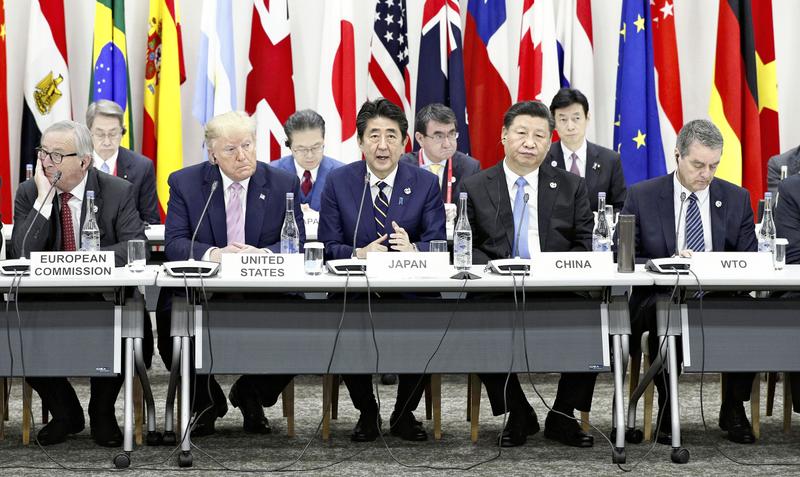
Tomoko Tsuda and Hiroyuki Tanaka / Yomiuri Shimbun Staff Writers The launch of the "Osaka Track" declared by Prime Minister at an event, on the sidelines of the Group of 20 summit meeting, Friday served as a trigger for the world -- which involves the United States, China, Europe and emerging nations as well -- to deploy political tactics over rule-making of global data flows. However, Japan has already faced a tough road ahead due to difficulties in forming a consensus between the United States and China. The meeting on the digital economy took a tinge of a prelude to the U.S.-China summit talks Saturday as U.S. President Donald Trump and Chinese President Xi Jinping sparked off each other behind the scenes over U.S. move to shun China's telecom equipment giant Huawei Technologies Co. During the meeting, Xi said creating a market environment that is fair and without discrimination is the most important condition to draw up international rules. Xi's comment apparently was an attempt to pressure the Trump administration's move to shut out Huawei from the global market. In response, the U.S. president said, "We must also ensure the resilience and security of our 5G networks." Trump's words showed that he aims to ensure reflection of U.S. strategies to into account U.S. strategies toward Huawei in the international rules on the ground of security concerns. Being caught in the gap between the United States and China, Japan is struggling to somehow serve as an intermediary between the two countries. As part of efforts to increase the influence of the digital economy event as much as possible, Japan strongly have insisted from the beginning on the attendance of the leaders of the United States and China -- the world's two major powers -- at the digital economy event. Foreign Minister Taro Kono asked the attendance of Xi to the event during a telephone conversation with his Chinese counterpart Wang Yi on Wednesday. Kono also asked the U.S. government about Trump's attendance at the event. Adapting the schedule of the two leaders, Japan moved up the opening time of the event, and eventually the meeting was attended by Trump and Xi. Japan also worked hard to reach a consensus on the wording in the declaration. According to a Japanese government source, the United States requested to use the wording, a "high-level agreement" in the Osaka Track declaration. The United States apparently wanted to give pressure to China by including the wording a "high level" U.S. intention to use the word "high level" is apparently to give pressures to China. Should the wording be used in the declaration, many emerging nations as well, not only China, will not likely be able to join the Osaka Track framework. The Japanese government, which aims to promote the Osaka initiative in the international community, was not able to accept the U.S. request. They finally reached a consensus on Friday morning. Abe had direct negotiations with Trump during the Japan-U.S. summit talks, saying he wanted to bring negotiations to a successful close that any country agrees. Economy, Trade and Industry Minister Hiroshige Seko also directly negotiated with U.S. Trade Representative Robert Lighthizer, and agreed to add an expression, "with the participation of as many WTO Members as possible," as part of efforts to give consideration to developing countries. Other participating countries did not just maintained an expectant attitude about the U.S.-China conflict. About 80 WTO member countries will start a negotiation on the international rules. But India, which is not a part of negotiation countries, did not even send a delegate to the event. As India wants to keep data just within the country in a bid to develop its digital industry, it absolutely cannot accept discussion by the member countries that allow cross-border data flow. The more the information is collected from many users, the more the data become valuable, and thus the Chinese government has claimed the right to self-management of utilization of data so that China can enlock its own data. India, the second most populous country with about 1.3 billion following China, is believed to have a similar intention as it took an action in an undisguised way. Meanwhile, the European Union prioritizes privacy protection and demands for a protection of personal information strictly as they hold off the United States that is home to GAFA -- or Google, Apple, Facebook and Amazon. The 80 or so countries are expected to hold a meeting as early as July to narrow down the point in the hope of having fruitful results in the WTO ministerial meeting in June next year. Japan will face a rigorous test of its competency on how it can search for common ground as mediator. Pool photo /The Yomiuri Shimbun U.S. President Donald Trump, left, Prime Minister Shinzo Abe, center, and Chinese President Xi Jinping attend an event of digital economy in Osaka on Friday.

'Osaka Track' opens new chapter for global data flow

(Credit: The Yomiuri Shimbun)

The launch of the "Osaka Track" declared Friday by Prime Minister Shinzo Abe at an event on the sidelines of the Group of 20 summit meeting opened a new chapter in diplomatic bargaining over rule-making for global data flows.

The bargaining involved many countries, from the United States, China and Europe to emerging nations. Yet Japan, which hopes to get results with the Osaka Track, already has a tough road ahead due to difficulties in forming a consensus between the United States and China.

Friday's event on the digital economy had the tinge of a prelude to the U.S.-China summit talks Saturday -- U.S. President Donald Trump and Chinese President Xi Jinping have clashed behind the scenes over the U.S. move to urge Japan, European nations and others to shun Chinese telecom equipment giant Huawei Technologies Co.

During the event, Xi said that the creation of a market environment that is fair and without discrimination is the most important condition for drawing up international rules. Xi's comment was apparently made to pressure the Trump administration over its move to shut out Huawei from the global market.

In response, the U.S. president said, "We must also ensure the resilience and security of our 5G networks."

Trump's comments suggested that he wants to ensure U.S. strategies targeting Huawei on the grounds of security are reflected in the international rules.

Caught in the middle between the United States and China, Japan has been struggling to serve as an intermediary between the two countries.

Trying to increase the influence of the digital economy event, Japan insisted from the beginning on the attendance of the leaders of the United States and China -- the world's two major powers. Foreign Minister Taro Kono requested that Xi attend the event during a telephone conversation with his Chinese counterpart Wang Yi on Wednesday. He also asked the U.S. government about Trump's attendance.

Adapting to the schedules of the two leaders, Japan hastily moved up the event's start time, and eventually both Trump and Xi attended.

Japan also worked hard to reach a consensus on the wording in the Osaka Track declaration.

According to a Japanese government source, the United States requested the use of the phrase "high-level agreement."

The United States apparently wanted to put pressure on China by including the word "high-level" in the declaration.

Should this wording be included in the declaration, there are concerns that not only China but many emerging nations will not be able to join the Osaka Track framework.

The Japanese government could not accept the U.S. request given that Japan aims to promote the Osaka initiative among the international community. They finally reached a consensus on Friday morning when Abe held direct negotiations with Trump during their summit talks, saying he wanted to bring negotiations to a successful conclusion with which any country can agree.

Economy, Trade and Industry Minister Hiroshige Seko also had direct talks with U.S. Trade Representative Robert Lighthizer, and agreed to add the expression, "with the participation of as many WTO [World Trade Organization] members as possible," to give consideration to developing countries.

Meanwhile, other participating countries are not simply observing the U.S.-China conflict.

About 80 WTO member countries will start negotiations on the international rules. But India, which is not one of the negotiating countries, did not even send a delegate to the event.

As India wants to keep data within its own country in a bid to develop its digital industry, it absolutely cannot accept discussions by the member countries to allow cross-border data flows.

The Chinese government has claimed the right to self-management of data utilization so that it can also keep its data within its borders, as the more information is collected from many users, the more that data becomes valuable.

India, the second most populous country following China with about 1.3 billion people, is believed to have a similar intention, judging by its blatant behavior.

The European Union, for its part, prioritizes privacy protection and demands companies strictly protect personal information as a warning to the United States, which is home to Google, Apple, Facebook and Amazon.

The 80 or so countries are expected to hold a meeting as early as July to narrow down the points of contention in the hope of getting fruitful results at the WTO ministerial meeting in June next year.

Japan will face a rigorous test of its competency in searching for common ground as a mediator.

Read more from The Japan News at https://japannews.yomiuri.co.jp/

Sign up to read this article
Read news from 100’s of titles, curated specifically for you.
Already a member? Sign in here
Related Stories
Top stories on inkl right now
Our Picks
Fourteen days free
Download the app
One app. One membership.
100+ trusted global sources.