MIYAKE, Nara -- The National High School Baseball Championship celebrated its 100th tournament this summer, and the winning teams of professional baseball's Central and Pacific leagues have just been decided. As players take to the field and chase the white ball, they are supported by the craftsman of Miyake, Nara Prefecture.
Nara Prefecture is said to account for about 80 percent of the nation's production volume in baseball gloves, with Miyake as its production center, drawing on high-level skills developed over almost a century.
Entering the workshop of Yoshikawa Kiyoshi Shoten, a baseball glove manufacturer established in 1952, I was welcomed by the smell of leather. Masahiko Yoshikawa, 60, the second-generation head of the company, was working with his two sons -- Takamasa, 32, and Masatoshi, 30.
The craftspeople cut bull leather sheets and sew sections by machine before forming the parts for fingers with cylindrical irons. They then thread leather cords into the gloves and make the entire shape three-dimensional to complete the glove.
Most of the process is done manually, allowing the production of up to 300 gloves per month.
Yoshikawa's sons used to be company employees, but joined their family business about five years ago. Masatoshi, who worked at a company manufacturing construction materials, once asked his father to send baseball gloves from his workshop to children in Fukushima Prefecture who were affected by the 2011 Great East Japan Earthquake.
Yoshikawa sent about 20 brand-new pieces of gear, each of which bore the kanji character for dream. The children were thrilled, prompting Masatoshi to decide to carry on his family business.
As an artisan, Yoshikawa did not teach his sons, but let them learn on their own by watching him. The sons said they initially struggled to sew straight leather pieces with machines.
"I don't want to put an end to the skills that have been passed on from my grandfather," Takamasa said.
Working while seated, Masatoshi said as he rubbed his lower back, "You don't have to be nimble-fingered, you have to be patient."
At just 4.06 square kilometers, Miyake is the smallest town in Nara Prefecture, with a population of nearly 7,000. According to the town's historical records and other documents, Japan's manufacturing of baseball gloves began when Mizuno Shoten, which was established in Osaka and is known today as Mizuno Corp., asked Miyake native Tokujiro Sakashita to create them. Sakashita started making baseball gloves with local craftspeople in 1921.
They later developed into Miyake's local industry as skilled artisans were fostered. The business also took advantage of a baseball boom in the post-World War II era, and exports to the United States also enjoyed a sharp increase.
Masahiko recalled the town's heyday: "Craftspeople filled the train cars, and when they got off at [nearby] Tajima Station every morning, the cars became almost empty. I also heard that passengers could smell leather when they arrived at the station."
However, the so-called Nixon shock hit Japan in 1971, under which a fixed exchange rate of 360 yen to the dollar was replaced by a floating exchange rate system. This was a huge blow to Japan's export industries.
In addition, companies in South Korea and Taiwan, which enjoyed large pools of lower-wage workers, put more focus on manufacturing baseball gloves, and Japanese sports gear makers relocated their production bases overseas.
All these factors had a serious impact on domestic manufacturers, and the production volume of baseball gloves in Nara Prefecture slumped to 1.05 million in 1990 from 2.15 million in 1979.
Aiming for a 'perfect fit'
In recent years, the number of young baseball players has been on the decline, mainly because of the nation's falling birthrate. Miyake used to be home to more than 100 glovemakers for the sport, but the number has now decreased to about 20, due partly to a shortage of people to take over these businesses.
Amid these challenges, some craftspeople have been searching for new ways to survive.
Among them is Takao Yoshida, 43, the third-generation head of another maker that began full-fledged sales of its original brand Junkei-Glove about five years ago.
Baseball gloves are often sold under the brands of major sports gear makers, to which smaller manufacturers ship their products. However, Yoshida decided to sell his company's wares under its own brand, aiming to produce top-quality gear from the perspective of the user.
In a bid to lower prices as much as possible, Yoshida does not sell his gloves via a wholesaler, but visits sports gear shops nationwide to promote the products. Currently, about 60 shops have Junkei-Glove products on their shelves.
One element Yoshida focuses on is the string for sewing the inner parts of the gloves. Using hard strings can enhance gloves' endurance, but they make it difficult for players to catch the ball.
After trying various kinds of string, Yoshida decided to use aramid fiber, which is so tough it is used for making bulletproof vests. He obtained a patent for developing a method using the fiber.
Yoshida also focused on the quality of the leather. Five or so gloves are commonly assembled from a single sheet of leather, but he does not compromise on this point.
"If I can cut enough pieces to assemble three gloves [from one sheet of leather], that's fairly good," Yoshida said. "I often cut pieces just for one item."
Yoshida has been producing baseball gloves for two decades. "As more and more progress has been made in society, something that received a perfect score of 100 yesterday may only get 90 points tomorrow," he said. "I'll be left behind unless I make progress on my own. I'll lose my advantage unless I do something that overseas rivals can't do."
His ultimate goal is to produce gloves that perfectly fit a user's hand as soon as they put them on.
In three years, Miyake will mark the 100th anniversary of its baseball glove production, which almost overlaps the history of the high school championship.
"Thanks to your gloves, we were able to play at Koshien Stadium," said a letter Yoshida received, referring to the venue of the competition in Hyogo Prefecture. The letter was sent from Asahikawa University High School's baseball team, which competed in the national championship as a representative for northern Hokkaido.
Yoshikawa, who plans to pass on his family business to his sons in the future, said, "I hope we'll maintain our techniques, even if we become the last remaining manufacturer of baseball gloves."
Access
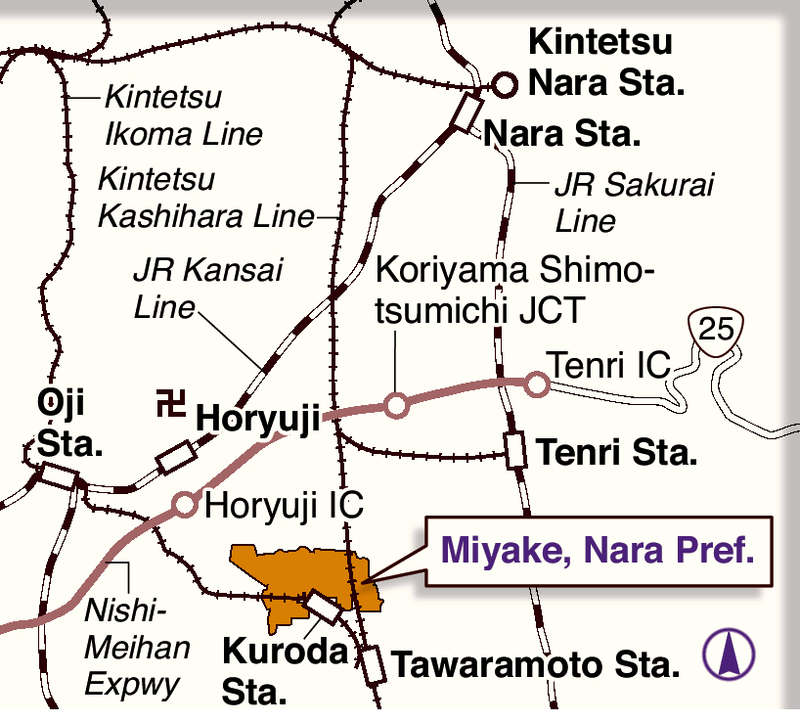
It takes about 1-1/2 hours to get to Miyake from Osaka by train. From JR Osaka Station, get off at Tsuruhashi Station to change to the Kintetsu Railway. Get off at Iwami Station on the Kashihara Line via Yamato-Yagi Station.
Alternatively, get off at Tawaramoto Station on the Kashihara Line and walk a few minutes to reach to nearby Nishitawaramoto Station on the Tawaramoto Line. Kuroda Station is the next stop and Tajima Station is two stops away. The nation's early models of baseball gloves made during the Taisho era (1912-26) are on display at the town government office building, which is 15 minutes walk from Kuroda Station.
Read more from The Japan News at https://japannews.yomiuri.co.jp/