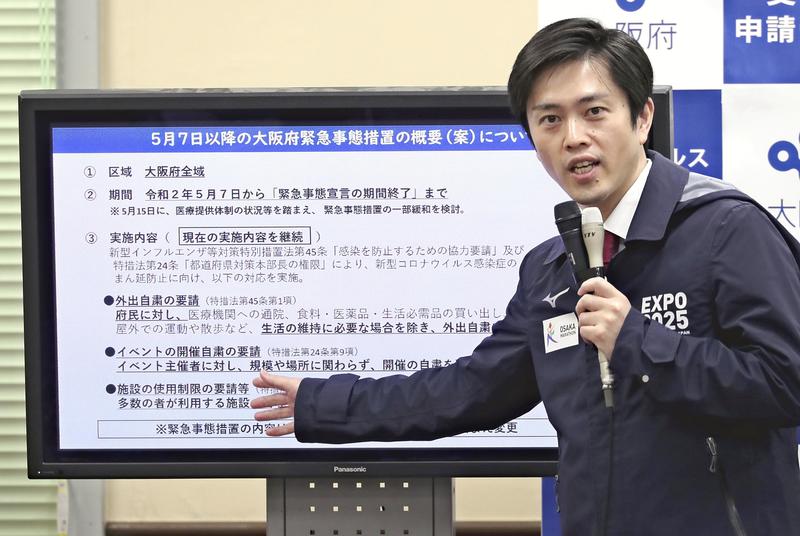
The Osaka prefectural government has decided to lift its request for the suspension of business operations in a wide range of industries on Friday midnight. The decision came after Osaka met its own lifting standards, so-called "Osaka model," on Thursday. While this applies to a number of industries, including commercial facilities, the government requested nightclubs to continue to remain closed. The government also asked the public to refrain from going out and holding events.
"We want to create a society that coexists with the new coronavirus while maintaining economic activities. We need to remain on alert," Osaka Gov. Hirofumi Yoshimura said at a meeting at the prefectural government office.
The request will be lifted at movie theaters, department stores and universities. Internet cafes, pachinko parlors and other amusement facilities will be subject to cancellation only if they have a floor space of 1,000 square meters or less.
As a condition for resuming business, the prefectural government will require to follow the manual set by the prefecture, including the use of the Osaka coronavirus tracking system, which asks customers to register their email addresses in case an infected person is confirmed.
Nightclubs and live music venues will be asked to remain closed due to the outbreak of infection that has occurred nationwide. Operating hours at restaurants will be extended from 8 p.m. to 10 p.m. and liquor will be served until 9 p.m. instead of 7 p.m.
The government also said that it would lift the request to refrain from holding events with a small number of people if Osaka deviated from the designation of "special alert" prefectures and that it would lift the request for business closing entirely when a state of emergency was lifted.
On April 14, the prefectural government made a request for the suspension of business operations under the revised law concerning special measures against new strains of influenza. On May 5, the government announced the Osaka model, which says that the prefectural government will gradually lift the suspension if three indicators, including the positive rate, meet the criteria for seven consecutive days. The government has been operating the Osaka model since May 8.
Read more from The Japan News at https://japannews.yomiuri.co.jp/