Aiming to address the growing number of children falling victim to sexual harassment and crimes, the government is planning to gradually introduce prevention programs at schools from the next academic year.
An elementary school and a junior high school in Osaka are providing original sex education programs that teach the importance of life and the body. The schools deal with age-appropriate topics, such as "private zones" where children should not allow others to touch them and abusive relationships between unmarried couples. This progressive approach to fostering life skills in children is attracting attention from other schools.
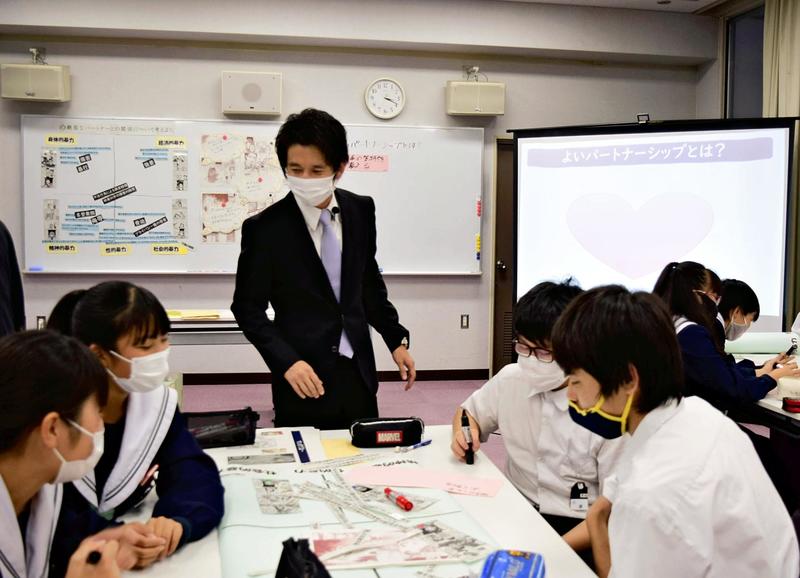
In early October, Kenichiro Nishimura, 35, told second-year students at Tajima Junior High School in Osaka, "We're going to learn about romantic relationships today."
The topic was abusive relationships. After showing a scene from a romantic drama, Nishimura asked the 23 students, "What was cool about the main character?" One of the students answered, "He was very sadistic," and others burst into laughter.
Next, the students identified behaviors considered to be abusive, such as demanding an immediate reply to messages from free chat app. The students all looked serious by the time Nishimura said to them, "Controlling someone or treating them like your property isn't love, is it?"
The class is part of the sex and life education program that began six years ago at Ikuno Minami Elementary School in Osaka. At the time, there was a high incidence of violent behavior and sexual problems. In response, 39-year-old teacher Taeko Ono and others created an original program for each grade, in order to cultivate knowledge of how to take care of one's own body and be considerate of others.
The program was also fully introduced this year at Tajima Junior High School, where students go after graduating from the elementary school.
First-graders learn about their "private zone," which they should not show other people or allow others to touch. Teachers use an illustration of a boy and a girl in swimsuits, indicating that the body parts covered by them are a private zone. Children are also encouraged to talk to an adult they can trust if they experience something they do not like.
In contrast, fifth-graders learn about the dangers of social media and the nature of relationships with a boyfriend or girlfriend.
"Talking and thinking about sexuality and romantic love helps students acquire an attitude and a sense of values that respects both themselves and others," said Ono.
As this kind of program is rare in Japan, it has attracted a number of inquiries from educators and others.
--Japan lags behind
Japan is considered to be hesitant about teaching sex education compared to other countries. The United Nations Educational, Scientific and Cultural Organization's (UNESCO) guide to sex education lists sexual intercourse and contraceptive measures as subjects of learning for 9-12 year olds.
Students in Europe and the United States learn about various things, including these topics, in sex education classes. The Japanese education ministry's curriculum guidelines for elementary school mention learning about body changes during puberty, but leave the content of instruction up to each school.
Meanwhile, the prevalence of the internet and social media has increased exposure to sexual information at a young age, as well as the risk of falling victim to sexual crimes.
Junior high school students and younger children accounted for about 20% of the victims of forced sex and assault cases recognized in 2019, according to the National Police Agency.
More than 2,000 people under the age of 18 became victims or were involved in crimes through social media, the NPA added.
--Government takes action
To address the current situation, the government is set to introduce "life safety education" at educational facilities, including elementary and junior high schools, from the next academic year. Under the current curriculum guidelines, schools will give lessons to prevent students from becoming perpetrators or victims of sexual violence.
A panel of experts is planning to compile educational materials and instructional guidelines by the end of this fiscal year. In the course of these efforts, the panel will draw on the sex education programs in the schools in Ikuno Ward, Osaka.
A Cabinet Office official in charge said, "There are still very few practical examples of teachers teaching in-depth about sex, so we're paying attention [to the efforts at schools in the ward.]"
"In reality, sex education has been undertaken with ingenuity by teachers who are passionate, and Japan lags behind other countries in this area," said Haruo Asai, a professor emeritus who specializes in child welfare at Rikkyo University. "The government will finally take a step forward. I hope this will lead all of society to think about the importance of giving children correct knowledge and attitudes about sexuality."
Read more from The Japan News at https://japannews.yomiuri.co.jp/