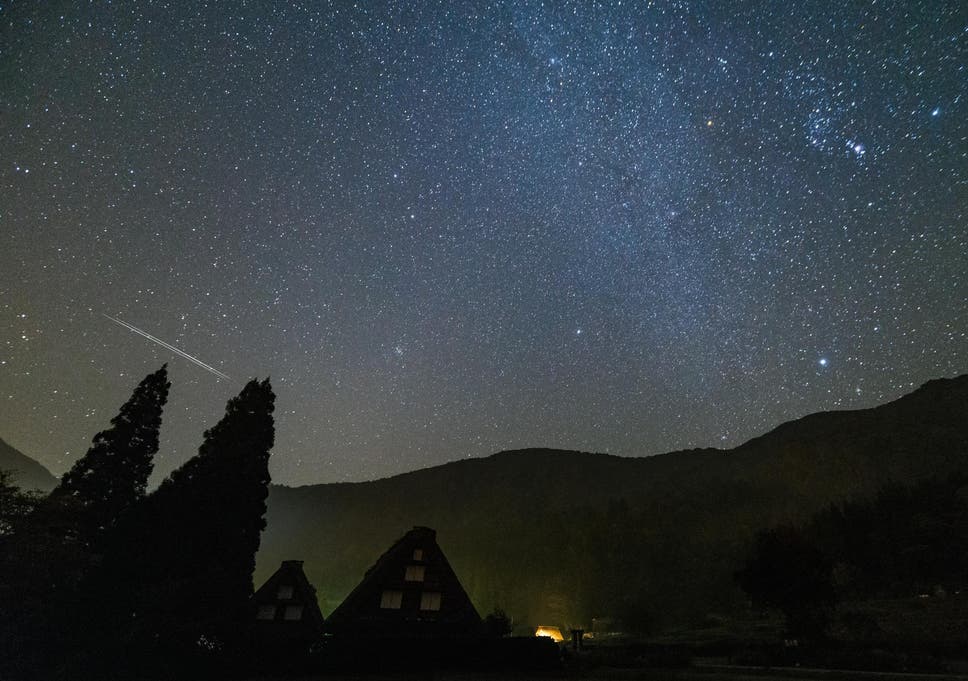
The night sky will be lit up by spectacular celestial fireworks as Earth passes through an area of space “littered” with the debris of Halley’s Comet.
The Orionid meteor shower is active throughout October and will peak at around 11.30pm on Monday, producing 20 or so meteors every hour.
The phenomenon will be visible to the naked eye for most people across the UK, weather forecasters have predicted.
The display is caused by meteoroids colliding with Earth’s atmosphere at 148,000mph and burning up in streaks of light that are visible across the night sky.
There will be a ridge of high pressure across the UK on Monday evening, producing dry weather and clear skies for most, according to the Met Office.
While some in the far northwest and far southeast of the country may have some clouds to contend with, most will get a good view.
The phenomenon gets its name from the Orion constellation, one of the brightest groups of stars in the sky. And it will be most eye-catching in that part of the firmament.
Anna Ross, an astronomer at the Royal Observatory Greenwich, said: “Meteors will be visible all over the sky but they will appear to originate from close to the star Betelgeuse in the constellation of Orion, which will be in the east of the sky during that peak time.”
“As both the Earth and Halley’s comet have elliptical orbits around the Sun, these two intersect twice per year,” she said. “This causes not only the Orionids, but also the Eta Aquarids meteor shower in May.”
The Orionids will be visible in both northern and southern hemispheres until 7 November.
Astronomers recommend heading somewhere with relatively little light pollution so that the night sky is more visible.
Ms Ross said: “For the best chances to spot the Orionids, find a dark area of clear sky and allow around 20 minutes to let your eyes adapt to the dark. It may also be advisable to lie down as you will be looking up for a long time.”
Additional reporting by Press Association