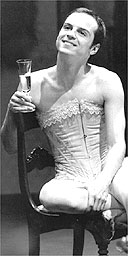
Wedekind's Lulu has a sex change in Peter Gill's new all-male play, Original Sin. Instead of a femme fatale at large in the human zoo, Gill gives us an 18-year-old boy, Angel, on the prowl in 1890s London. The result, which sticks close to Wedekind's original, is sombrely impressive even if the gender switch raises a number of awkward questions.
Lulu is essentially a blank cheque ardently filled in by her numerous lovers; or, as Leo Treitler puts it, the male protagonists invest her with the "unrestrained sexuality" that they themselves are denied by social constraints. But, although Gill's hero is variously known as Boy, Beauty and Angel, he seems less a Lulu-like creature of infinite colours than a calculating Victorian version of Orton's Mr Sloane. One also misses Wedekind's key irony by which, in a rampantly hetero world, the lesbian Countess Geschwitz offers the one example of unconditional love: Gill's equivalent, Lord Henry Wantage, simply emerges as a gentle masochist in a gay world.
What Gill provides, in place of Wedekind's polyphony, is a claustrophobic image of a Victorian sub-world. As Angel passes through the various hands of a physician, painter, newspaper proprietor and playwright, one is reminded of Oscar Wilde with all the women left out, specifically of The Picture of Dorian Gray, since a portrait of Angel haunts every scene even when its subject is ravaged by cholera. One also finds echoes of Proust in a Parisian salon populated by berouged figures who look like endless variations on the Baron de Charlus.
In the context of Sheffield's Gill festival, one is still left asking what the writer's purpose is in transposing Wedekind's play. On the one hand he implies, in an echo of Caryl Churchill's Cloud Nine, that penetrative Victorian male sex was a metaphor for colonisation. But the most haunting line in the final Whitechapel scene is: "Why are men so terrible to men?" Gill's play suddenly becomes the product of his puritan aesthetic, which views promiscuous sex with dark foreboding and which implicitly longs for permanence.
Gill's play misses some of the surrealist fun of Wedekind's original, but it is hauntingly powerful and beautifully directed by the author himself. The sense of Victorian nightmare is reinforced by Alison Chitty's crepuscular designs; and there are excellent performances from Andrew Scott as the polymorphous Angel - who at one point wishes he were a woman so he might "be inside myself" - as well as John Normington as his itinerant father-figure, Michael Byrne as the possessive newspaper owner and Barry Howard as everything from a camp dresser to a deaf client of the prostituted Angel. It may not be Gill's most original play but it is his most unrelievedly tragic.
· Until June 22. Box office: 0114-249 6000.