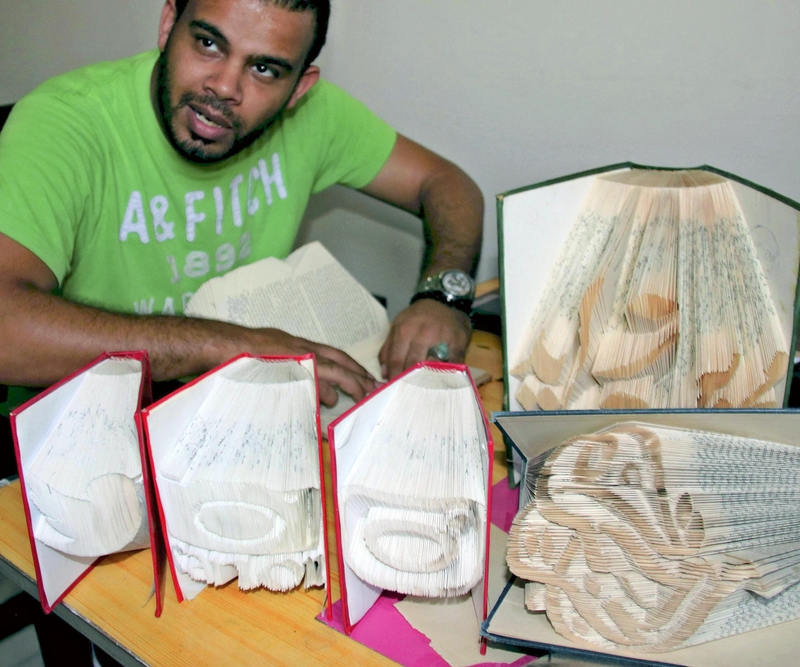
GAZA STRIP -- A man living in the Gaza Strip has escaped poverty by making "book art" using origami techniques.
Ahmed Humaid, 29, began creating book art after coming across such works made by a Japanese person on the internet. "Origami changed my desperate life," he said with a smile.
Ahmed lives in the central part of the Gaza Strip, an autonomous Palestinian territory in conflict with Israel. In his room in an apartment building partially destroyed by air strikes by Israeli forces, he has book art works featuring the name of the Muslim Prophet Muhammad, birds and other animals.
Ahmed had worked in road construction as a daily laborer after graduating from university, but he lost his job four years ago because the construction company went bankrupt due to the conflict with Israel. As a result of the economic blockade by Israel, more than half of about 2 million residents in the Gaza Strip receive food assistance from the United Nations, while the unemployment rate among young people has reached about 70 percent, the highest rate in the world.
"We had no hopes or dreams," Ahmed said.
About two years ago, he happened to see examples online of book art, which is made by folding book pages at different angles to make letters or animals emerge when the book is partially opened. It was introduced as Japanese origami.
"I was attracted by the process of paper being made into a three-dimensional work," Ahmed recalled.
According to the Nippon Origami Association and others, book art uses origami techniques and is increasingly popular online and around Japan.
Ahmed attempted his own book art by watching others, then posted his works to Instagram in October 2018. Subsequently, he received an order from a woman operating a general store in the Gaza Strip who wanted to buy his work. Asked to make an artwork featuring the Arabic word "hayaa," Ahmed spent 15 hours making it and earned 100 shekels (about 3,000 yen).
He has continued to receive requests for his work and now earns about 600 shekels (about 20,000 yen) per month.
At present, orders for his work come in not only from the Gaza Strip but also from more than 10 countries including Muslim states and European countries. He is confident that his works can attract attention, saying, "I want to hold my own exhibition in Japan someday."
Read more from The Japan News at https://japannews.yomiuri.co.jp/