LOS ANGELES _ The Orange County grand jury said Tuesday that it had found "no definitive evidence" of a wide-ranging informant program in the county's jails, completing a months-long review sparked by conversations between a confessed mass shooter and a prolific jailhouse snitch.
In a 28-page report, the grand jury said critics and media outlets had blown the scandal out of proportion after it became central to the case of Scott Dekraai, who has admitted he walked into a Seal Beach hair salon in 2011 and fatally shot eight people.
"Although the use of in-custody informants does occur, it is generally organic in nature, case specific and does not represent a conspiracy between the Orange County Sheriff's Department and Orange County district attorney's office," the report read.
The matter is still the subject of an investigation by the U.S. Department of Justice and the California attorney general's office.
According to the report, the grand jury found no evidence that the district attorney's office or Sheriff's Department had used "mercenary informants" _ snitches who are provided with favors or valuables to solicit information from a specific inmate _ in order to crack cases.
The question of whether the Sheriff's Department and prosecutors had colluded to place high-profile defendants, like Dekraai, in cells near known informants has been a source of widespread controversy for both law enforcement agencies for years.
The Sheriff's Department use of informants is normally limited to gathering intelligence that would preserve the security of the jails, rather than investigating crimes, the report said.
The scandal exploded in 2015, when a judge removed the district attorney's office from Dekraai's case after his lawyer argued that authorities intentionally placed him in a cell near a well-known informant. The case, which is now being prosecuted by the state attorney general's office, has languished in the penalty phase for years.
Dekraai, a former tugboat captain, has pleaded guilty to murdering his ex-wife and seven others at a Seal Beach salon in 2011. But the informant scandal has delayed proceedings to determine whether he will face the death penalty.
Dekraai's attorney, Orange County Assistant Public Defender Scott Sanders, has argued that the death penalty should be tossed out because authorities cannot be trusted to turn over relevant evidence. Sanders contends that jailhouse informants and their handlers have violated the rights of inmates for years by coaxing information from defendants who are represented by lawyers.
Defense attorneys in other cases have since argued that prosecutors failed to disclose information about the use of informants during discovery, which would violate their clients' rights.
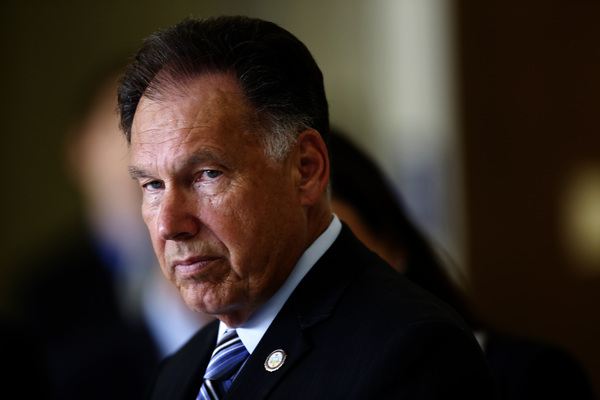
Last year, a panel of legal experts established by Orange County District Attorney Tony Rackauckas found that a "failure of leadership" among prosecutors led to problems with the handling of informants that had eroded public trust in Orange County law enforcement. In that report, the legal experts said prosecutors and deputies lacked training about the proper way to handle informants. The report also said many prosecutors had adopted a "win at all costs" mentality and feared bringing troubling information about informants to Rackauckas.
Rackauckas has scoffed at allegations that his office was engaged in any misconduct, and has pointed to the rarity in which informants' testimony is used at trial. In 2015, the district attorney's office filed 8,600 felony cases but jailhouse informants were used in only three cases, he said last year.
The Sheriff's Department said it felt vindicated by the grand jury's findings.
"One of the most important points highlighted by the grand jury is that continued investigation into this issue is best handled by the California attorney general and U.S. Department of Justice, not the trial court," the statement read. "It's important for the Dekraai case to move toward a conclusion, allowing justice to be rendered."
The grand jury's conclusions contrast with allegations made by Dekraai's attorney.
In court papers filed in March, Sanders said that county authorities operated a decades-old snitch network that might involve as many as 1,000 informants. The Sheriff's Department recently released 5,653 pages of records to Dekraai's defense team, including memos showing that high-level department officials knew about the program, according to Sanders.
On Tuesday, Sanders dismissed the grand jury report as a failure to understand the scale of the problem within the Orange County justice system regarding the use of informants.
"We don't think this is particular good work by the grand jury here," he said. "They are taking on the judge, the court of appeals, who've all decided this is systemic issue. It is kind of an embarrassing effort."
Sanders said he will be releasing a detailed analysis of the grand jury findings shortcomings later Tuesday.
"There are so many different things in this report that are so troubling," said Sanders.