A policy agreement among four opposition parties has come under criticism -- not only from members of the ruling Liberal Democratic Party but also from some in the opposition itself.
The agreement, in preparation for the upcoming House of Representatives election, calls for the partial abolition of security-related laws, the expansion of social security measures and the reduction of the consumption tax rate.
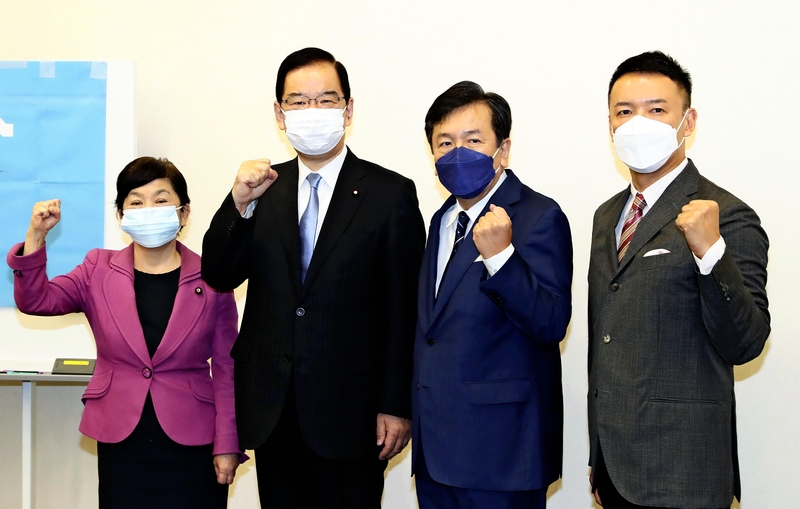
It was signed on Wednesday at the Diet Building by Yukio Edano, leader of the Constitutional Democratic Party of Japan; Kazuo Shii, chair of the Japanese Communist Party; Mizuho Fukushima, leader of the Social Democratic Party; and Taro Yamamoto, leader of Reiwa Shinsengumi. The opposition parties will reflect the agreement in their election pledges.
As many of the listed policy measures appear infeasible, questions have been raised even by some members of the main opposition CDPJ.
In security, the agreement states that the parties will call for the abolition of "unconstitutional parts" of the security-related laws as well as the cancellation of the relocation of the U.S. military's Futenma Air Station from Ginowan, Okinawa Prefecture, to the Henoko district in Nago in the prefecture.
The parties also agreed to make more efforts to redistribute income by cutting the consumption tax rate and increasing the burden on the wealthy, while expanding and improving public support in areas such as health and nursing care and education. In the area of energy, the parties agreed to pursue a "decarbonized society without nuclear power" by boosting renewable energy.
However, as the security-related laws have been the foundation of trust in the Japan-U.S. alliance, a review of the laws could shake the alliance. The past government led by the Democratic Party of Japan, which is the main predecessor of the CDPJ, had called for relocating the Futenma base to "at least outside of the prefecture," but ended up seeking the Henoko relocation plan after falling into disarray, undermining its trust with both the United States and Okinawa Prefecture.
The policy agreement sparked criticism among LDP members, with one saying, "If the relocation to Henoko is canceled without an alternative plan, the Futenma relocation will be delayed further."
In addition, the agreement did not specify how to secure financial resources for expanding social security measures or how to obtain energy sources alternative to nuclear power. Even some CDPJ lawmakers voiced doubts about the agreement, making such comments as, "It was full of unrealistic policies and would have a negative impact on the election," and "It seems to simply repeat what the JCP has called for."
-- DPFP calls pact 'unrealistic'
The Democratic Party for the People confirmed at its general meeting of lawmakers of both Diet chambers on Wednesday that it would not participate in the policy agreement signed by the four other opposition parties. The DPFP distanced itself from the four parties, calling the content of the accord "unrealistic."
"We did not participate in the policy agreement and will not sign it at a later date," DPFP Secretary General Kazuya Shimba said at a press conference on the same day.
Regarding the party's plans for the lower house election, he said, "We want to change politics with realistic measures, not with unrealistic and uniform appeals by the opposition."
Read more from The Japan News at https://japannews.yomiuri.co.jp/